Species · Fishes
Rio Grande Chub Gila pandora
The scientific name of the Rio Grande Chub is Gila pandora. It is a species of fish in the family Cyprinidae (carps), order Cypriniformes. The name dates from 1872.
- Scientific name
- Gila pandora (Cope, 1872)
- Common name
- Rio Grande Chub
- Genus
- Gila
- Family
- Cyprinidae (Carps)
- Order
- Cypriniformes
- Class
- Teleostei
- Red List category
- LC Least Concern
- Environment
- freshwater
- Recorded in
- 2 countries
- Name status
- accepted in the Catalogue of Life

Overview
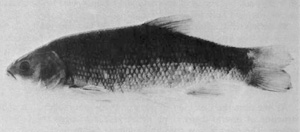
The native range includes the upper Rio Grande and Pecos River systems in Colorado, New Mexico, and Texas. The Rio Grande Chub has large eyes, an elongated head, a forked tail, and two faint black longitudinal lines.
Written 27 November 2026 from the sources listed below. Each statement was checked against the passage it cites; statements that could not be supported were removed.
Appearance
The Rio Grande Chub has large eyes, an elongated head, and a forked tail. Its dorsal surface is dark, while its underside is light, with coloration gradually becoming lighter toward the ventral side.[1][2]
The species has two faint black longitudinal lines, one above and one below its lateral line. The lateral line contains between 51 and 67 scales, and both the dorsal and anal fins have eight rays.[3][4][5]
Adults can reach 30 cm in length, although they are typically smaller. Rio Grande chubs in Colorado are usually approximately 13 cm long.[6][7]
Habitat
The Rio Grande Chub inhabits small streams, rivers, headwaters, and flowing pools. It has also been recorded in small lakes and ponds and occasionally inhabits irrigation ditches, canals, and stock ponds.[8][9][10]
The species prefers cool, flowing water. Suitable habitat includes cover provided by undercut banks, overhanging vegetation, woody material, and aquatic vegetation.[11][12]
The species shows a preference for habitats with sand, gravel, cobble, or combinations of these substrate types. It occurs at elevations between 7,580 and 8,400 feet and occupies depths between 12 and 69 inches in the water column.[13][14][15]
Diet
The Rio Grande Chub feeds on zooplankton, insects, crustaceans, and juvenile fish. It also consumes limited amounts of vegetation and detritus.[16][17]
The species has greater predation success against larvae with smaller cases.[18]
Behaviour
The Rio Grande Chub has both carnivorous and omnivorous feeding characteristics.[19]
Reproduction and life cycle
Gravel and cobble substrates are required by the Rio Grande Chub for spawning.[20]
Conservation
The Rio Grande Chub is listed as sensitive by the US Forest Service and the Bureau of Land Management. It is designated a Colorado species of concern and a tier 1 species of greatest conservation need.[21][22][23]
The species has experienced an estimated 75 percent decline in overall population numbers. Introduced brook trout and brown trout compete with the Rio Grande Chub and prey upon it.[24][25]
Effective breeder numbers ranged from 6.1 in Upper Rio Bonito to 109.7 in Rio Peñasco. Genetic diversity conservation planning should consider which populations are selected for translocation.[26][27]
Genetic diversity research examined 15 populations across the Rio Grande, Pecos, and Canadian drainage basins in New Mexico. The Rio Ojo Caliente population had the highest recorded allelic richness, at 15.09, while the Upper Rio Bonito population had the lowest recorded allelic richness, at 6.75.[28][29][30]
Genetic differentiation was detected among all populations examined. Seven genetic clusters were identified among the studied populations.[31][32]
Similar species
The Rio Grande Chub can naturally hybridize with the longnose dace (Rhinichthys cataractae).[33]
Classification of the Rio Grande Chub
| Kingdom | Animalia |
|---|---|
| Phylum | Chordata |
| Subphylum | Vertebrata |
| Infraphylum | Gnathostomata |
| Parvphylum | Osteichthyes |
| Gigaclass | Actinopterygii |
| Superclass | Actinopteri |
| Class | Teleostei (Teleost) |
| Order | Cypriniformes |
| Family | Cyprinidae (Carps) |
| Subfamily | Leuciscinae |
| Genus | Gila (Western Chubs) |
| Species | Gila pandora (Cope, 1872) |
Where the Rio Grande Chub is found
Checklists and occurrence records place Gila pandora in 2 countries. GBIF holds 1,715 georeferenced records of it.
Countries
Regions and cities with the most records
- New Mexico, United States 1,364
- Colorado, United States 110
- Albuquerque, United States 83
- Rio Rancho, United States 81
- Enchanted Hills, United States 78
- South Valley, United States 64
- Texas, United States 28
- Los Lunas, United States 20
A number beside a place is its count of GBIF occurrence records. A place without a number comes from a checklist alone. Records show where a species has been observed or collected, which can include escapes and vagrants.
Common names
English
- Rio Grande Chub
Names in 2 other languages
- Czech
- gila riograndská
- Russian
- Риограндская гила
Synonyms
3 other scientific names have been used for this species and are now treated as synonyms of Gila pandora.
- Clinostomus pandora Cope, 1872
- Gila gula Cope, 1875
- Tigoma gracilis Girard, 1856
Related species
-
 Humpback ChubGila cypha
-
 Bonytail ChubGila elegans
-
 Thicktail ChubGila crassicauda
-
 Utah ChubGila atraria
-
 Roundtail ChubGila robusta
-
 Arroyo ChubGila orcuttii
- Virgin ChubGila seminuda
-
 Gila ChubGila intermedia
Compare
Questions and answers
What is the scientific name of the Rio Grande Chub?
The scientific name of the Rio Grande Chub is Gila pandora. Written with its author, the full name is Gila pandora (Cope, 1872).
Which family does the Rio Grande Chub belong to?
Gila pandora belongs to the family Cyprinidae, in the order Cypriniformes and the class Teleostei.
Where is the Rio Grande Chub found?
Checklists and occurrence records place Gila pandora in 2 countries: United States and Mexico.
What is the conservation status of the Rio Grande Chub?
The IUCN Red List category recorded for Gila pandora is Least Concern (LC).
Sources
Passages the profile rests on
- The Rio Grande chub has large eyes, an elongated head, and a forked tail. Source passage: “The Rio Grande chub has large eyes and an elongated head. They also have a forked tail.” — English Wikipedia
- Its dorsal surface is dark, while its underside is light, with coloration gradually becoming lighter toward the ventral side. Source passage: “They typically have a dark dorsal side, or back. They have a light underside. The colors gradually get lighter as you move to the ventral side.” — English Wikipedia
- The species has two faint black longitudinal lines, one above and one below its lateral line. Source passage: “They have two faint black lines along the sides of their body. One these lines is above the fish's lateral line and the other is below.” — English Wikipedia
- The lateral line contains between 51 and 67 scales. Source passage: “The Rio Grade chub will have between 51 and 67 scales that create the lateral line.” — English Wikipedia
- Both the dorsal and anal fins have eight rays. Source passage: “There are also 8 rays in both the dorsal and anal fin.” — English Wikipedia
- Adults can reach 30 cm in length, although they are typically smaller. Source passage: “Adults of this species can grow as large as 30 centimeters however they are typically much smaller.” — English Wikipedia
- Rio Grande chubs in Colorado are usually approximately 13 cm long. Source passage: “In Colorado, they are usually about 13 cm long.” — English Wikipedia
- The species inhabits small streams, rivers, headwaters, and flowing pools. Source passage: “Small streams and rivers, headwaters, and flowing pools are this fish's preferred habitat.” — English Wikipedia
- The species has also been recorded in small lakes and ponds. Source passage: “They have also been found in small lakes and ponds.” — English Wikipedia
- The Rio Grande chub occasionally inhabits irrigation ditches, canals, and stock ponds. Source passage: “Examples of this include irrigation ditches, canals, and stock ponds.” — English Wikipedia
- The species prefers cool, flowing water. Source passage: “The Rio Grande chub prefers cool, flowing water.” — English Wikipedia
- Suitable habitat includes cover provided by undercut banks, overhanging vegetation, woody material, and aquatic vegetation. Source passage: “Undercut banks, overhanging vegetation, in-stream woody material, and in-stream vegetation all provide this fish enough cover for suitable habitat.” — English Wikipedia
- The species shows a preference for habitats with sand, gravel, cobble, or combinations of these substrate types. Source passage: “There is also some evidence that they like areas with a bottom consisting of sand, gravel, cobble, or a combination of the three.” — English Wikipedia
- Rio Grande chubs occur at elevations between 7,580 and 8,400 feet. Source passage: “They can be found between 7580 and 8400 feet in elevation” — English Wikipedia
- The species occupies depths between 12 and 69 inches in the water column. Source passage: “between 12 and 69 inches in the water column.” — English Wikipedia
- The Rio Grande chub feeds on zooplankton, insects, crustaceans, and juvenile fish. Source passage: “This fish preys on zooplankton, insects, crustaceans, and juvenile fish.” — English Wikipedia
- The species also consumes limited amounts of vegetation and detritus. Source passage: “They will eat limited vegetation and some amount of detritus.” — English Wikipedia
- Rio Grande chubs have greater predation success against larvae with smaller cases. Source passage: “One study did show that Rio Grande chub have a higher success rate when they prey on larvae with smaller cases.” — English Wikipedia
- The species has both carnivorous and omnivorous feeding characteristics. Source passage: “The Rio Grande chub is characterized by some as a mid-water carnivore. This fish preys on zooplankton, insects, crustaceans, and juvenile fish. The Rio Grande chub also exhibits some omnivore behavior.” — English Wikipedia
- Gravel and cobble substrates are required by the species for spawning. Source passage: “This fish needs gravel and cobble areas to spawn.” — English Wikipedia
- The species is listed as sensitive by the US Forest Service. Source passage: “However, the US Forest Service lists this fish as a sensitive species.” — English Wikipedia
- The Bureau of Land Management also lists the Rio Grande chub as a sensitive species. Source passage: “It is also listed as a sensitive species with the Bureau of Land Management.” — English Wikipedia
- The species is designated a Colorado species of concern and a tier 1 species of greatest conservation need. Source passage: “In Colorado, the Rio Grande chub is listed as a species of concern. It is designated a tier 1 species of greatest conservation needed.” — English Wikipedia
- The Rio Grande chub has experienced an estimated 75 percent decline in overall population numbers. Source passage: “It is estimated that overall numbers have declined by 75 percent.” — English Wikipedia
- Introduced brook trout and brown trout compete with the Rio Grande chub and prey upon it. Source passage: “Both of these species compete with the Rio Grande chub for resources. They also prey upon the chub.” — English Wikipedia
- Effective breeder numbers ranged from 6.1 in Upper Rio Bonito to 109.7 in Rio Peñasco. Source passage: “Estimates of effective number of breeders (N b ) varied from 6.1 (Pecos: Upper Rio Bonito) to 109.7 (Rio Grande: Rio Peñasco)” — usgs.gov
- Genetic diversity conservation planning should consider which populations are selected for translocation. Source passage: “consideration must be given as to which populations are selected for translocation.” — usgs.gov
- Genetic diversity research examined 15 populations across the Rio Grande, Pecos, and Canadian drainage basins in New Mexico. Source passage: “among 15 populations in three drainage basins (Rio Grande, Pecos, Canadian).” — usgs.gov
- The Rio Ojo Caliente population had the highest recorded allelic richness, at 15.09. Source passage: “Rio Ojo Caliente (Rio Grande) had the highest allelic richness (AR = 15.09)” — usgs.gov
- The Upper Rio Bonito population had the lowest recorded allelic richness, at 6.75. Source passage: “Upper Rio Bonito (Pecos) had the lowest allelic richness (AR = 6.75).” — usgs.gov
- Genetic differentiation was detected among all populations examined. Source passage: “Genetic differentiation existed among all populations” — usgs.gov
- Seven genetic clusters were identified among the studied populations. Source passage: “STRUCTURE analysis revealed seven genetic clusters.” — usgs.gov
- The Rio Grande chub can naturally hybridize with the longnose dace (Rhinichthys cataractae). Source passage: “Natural hybridization can occur between the Rio Grande chub and the longnose dace (Rhinichthys cataractae).” — English Wikipedia
Data
- Catalogue of Life, 2026-10-16 XR cc by
- Global Biodiversity Information Facility CC BY 4.0
- Wikidata CC0
- GeoNames CC BY 4.0
- Wikimedia Commons per image; credit shown with each image
- Within the Catalogue of Life, this name comes from World Register of Marine Species cc by
This species in other databases
- Catalogue of Life 3G2GV
- Wikidata Q6398177
- iNaturalist 101443
- WoRMS urn:lsid:marinespecies.org:taxname:1026422
- ITIS 163556
Page built on 28 November 2026. See how the catalog is made and all sources and licences.
Cite this page
ScientificNames.org. (2026). Gila pandora (Rio Grande Chub). Retrieved November 28, 2026, from https://scientificnames.org/species/gila-pandora
“Gila pandora (Rio Grande Chub).” ScientificNames.org, 2026, scientificnames.org/species/gila-pandora. Accessed 28 Nov. 2026.
ScientificNames.org. “Gila pandora (Rio Grande Chub).” Accessed November 28, 2026. https://scientificnames.org/species/gila-pandora.
@misc{scientificnames_gila_pandora_rio_grande_chub,
  author = {{ScientificNames.org}},
  title = {Gila pandora (Rio Grande Chub)},
  year = {2026},
  url = {https://scientificnames.org/species/gila-pandora},
  note = {Accessed 2026-11-28}
}