Comparison

Glass Shrimp vs Common Prawn

Glass Shrimp (Palaemon affinis) and Common Prawn (Palaemon serratus) both belong to the genus Palaemon (glass shrimps) and part ways below it.

Glass Shrimp

Glass Shrimp

Palaemon affinis

Tony Wills (iNaturalist username: tony_wills), CC BY-SA 4.0, via Wikimedia Commons
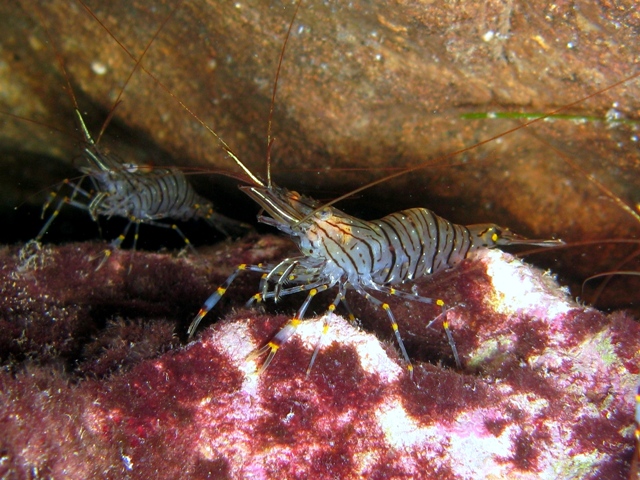
Common Prawn

Common Prawn

Palaemon serratus

Etrusko25, Public domain, via Wikimedia Commons

Side by side

Glass ShrimpCommon Prawn
Scientific namePalaemon affinis H. Milne-Edwards, 1837Palaemon serratus (Pennant, 1777)
English nameGlass ShrimpCommon Prawn
GroupCrustaceansCrustaceans
ClassMalacostracaMalacostraca
OrderDecapodaDecapoda
FamilyPalaemonidae PalaemonidsPalaemonidae Palaemonids
GenusPalaemon Glass ShrimpsPalaemon Glass Shrimps
Named in18371777
Environmentmarinemarine
Countries on record2 countries18 countries
GBIF occurrence records997 records13,112 records

Rows where the two agree are shown in grey.

Where each is found

Only Glass Shrimp (2)

Only Common Prawn (18)

From Catalogue of Life checklists and GBIF occurrence records. A country missing from a list means no record is held, which is not proof of absence.

Checked facts

Glass ShrimpCommon Prawn
Appearance
  • Palaemon affinis has a transparent, prawn-like body. English Wikipedia
  • Its body is often striped in red and green, with orange-black dots along the tail and legs. English Wikipedia
  • Its rostrum has a sharp, saw-like shape and is usually longer than its carapace. English Wikipedia
  • The rostrum curves upwards and has a bifurcated tip. English Wikipedia
  • The species has pinkish-brown coloration with reddish patterns. English Wikipedia
  • The species is a large, round-bodied prawn that can reach 11 centimetres in length. marlin.ac.uk
  • Its body is translucent and has variable markings, generally consisting of red or brown horizontal or oblique lines on the carapace and vertical lines on the abdomen. marlin.ac.uk
  • The first two pairs of walking legs have pincers and yellow-and-brown banding. marlin.ac.uk
  • The head region is covered by a carapace bearing a well-developed, distinctly upward-curving rostrum. marlin.ac.uk
  • The rostrum has 6–7 dorsal teeth, including two behind the eye socket, and 4–5 ventral teeth. marlin.ac.uk
  • The mandible has a three-segmented palp. marlin.ac.uk
Size
  • Male carapace length averages approximately 6.1 mm, while total body length ranges from 15 to 36 mm. English Wikipedia
  • Female carapace length averages approximately 13.3 mm, while total body length ranges from 5 to 57.2 mm. English Wikipedia
No checked fact yet
Habitat
  • The species inhabits rocky intertidal shorelines and estuaries. English Wikipedia
  • The species has been recorded at depths reaching 300 m. English Wikipedia
  • The species tolerates salinity levels ranging from 5% to 43%. English Wikipedia
  • At McCormacks Bay in Canterbury, the species is most abundant during high tide, at night, and in summer. English Wikipedia
Diet
  • The species is predominantly carnivorous. English Wikipedia
  • Amphipods are its primary recorded food based on stomach-content examinations. English Wikipedia
  • Its diet can also include polychaetes, gastropods, and bivalves. English Wikipedia
  • The species may consume plant material when food availability influences its feeding choices. English Wikipedia
  • Smaller males consume less food than larger females. English Wikipedia
  • Individuals prefer feeding at night and maintain stomach fullness at approximately 50% during daytime. English Wikipedia
No checked fact yet
Behaviour
  • Individuals are generally solitary or occur in loose aggregations. English Wikipedia
  • The species exhibits relatively low aggression and uses pushing or claw flicking as defensive responses. English Wikipedia
  • Individuals use chemical cues to communicate the presence of predators and other dangers. English Wikipedia
  • Individuals hide beneath rocks after moulting to reduce their vulnerability to predators. English Wikipedia
  • The species uses fucoid seaweed to evade predation. English Wikipedia
  • Under high predation risk, individuals move towards areas with substantial algal cover. English Wikipedia
  • The species can distinguish chemical cues from members of its own species and other species. English Wikipedia
  • Individuals respond evasively to chemical signals originating directly or indirectly from predators. English Wikipedia
Reproduction
  • Females begin reaching reproductive maturity at total body lengths of approximately 33–41 mm during late spring to early summer. English Wikipedia
  • Females produce approximately 110–690 eggs per breeding cycle. English Wikipedia
  • Females carry eggs on pleopods beneath the abdomen until hatching. English Wikipedia
  • Eggs are continuously fanned and cleaned during incubation to prevent fungal growth. English Wikipedia
  • Newly hatched larvae are planktonic and undergo several moulting stages. English Wikipedia
  • Juveniles begin settling on rocky beds after their limbs have developed. English Wikipedia
  • The species exhibits sequential hermaphroditism, with individuals capable of switching between female and male forms. English Wikipedia
  • Females can change into males at carapace lengths of approximately 12–13 mm. English Wikipedia
  • Individuals can change back into females at a carapace length of approximately 16 mm. English Wikipedia
No checked fact yet
LifespanNo checked fact yet
Distribution
  • The species is endemic to New Zealand waters. English Wikipedia
  • The species occurs in the intertidal zones of both New Zealand's North and South Islands. English Wikipedia
  • Palaemon serratus occurs in the Atlantic Ocean between Denmark and Mauritania, as well as in the Mediterranean Sea and Black Sea. English Wikipedia
Conservation
  • The species is currently considered restricted to New Zealand, although possible occurrences in subantarctic islands and Australia have been suggested. English Wikipedia
  • The species is subject to concern that current fishing exploitation levels may constitute overfishing. English Wikipedia
  • A minimum landing size is among the measures being considered to limit fishing catches. English Wikipedia
Uses
  • The species is sometimes kept as an aquarium pet, particularly in Australia. English Wikipedia
  • The species can be bred in aquaria. English Wikipedia
  • Aquarium housing for the species typically requires a tank with a volume of approximately 50 litres. English Wikipedia
  • A small commercial fishery for this species operates along the west coast of Great Britain, particularly in West Wales. English Wikipedia
  • Commercial fishing for this species in Ireland began at Baltimore, County Cork, during the 1970s. English Wikipedia
  • Irish landings of this species reached a recorded peak of 548 tonnes in 1999. English Wikipedia
  • Galway, Kerry, Cork and Waterford together account for more than 90% of the Irish catch. English Wikipedia
OtherNo checked fact yet

In brief

Glass Shrimp

Glass Shrimp has a transparent, prawn-like body. The species inhabits rocky intertidal shorelines and estuaries in New Zealand waters. It exhibits sequential hermaphroditism, with individuals capable of switching between female and male forms. Full profile

Common Prawn

Palaemon serratus occurs in the Atlantic Ocean between Denmark and Mauritania, as well as in the Mediterranean Sea and Black Sea. It has an upward-curving rostrum with a bifurcated tip and pinkish-brown coloration with reddish patterns. Full profile

Compare something else

Page built on 27 November 2026 from the data on the two species pages, where every source is listed.

Cite this page

ScientificNames.org. (2026). Glass Shrimp vs Common Prawn. Retrieved November 27, 2026, from https://scientificnames.org/compare/glass-shrimp-vs-common-prawn