Comparison

African Barred Owlet vs Northern Pygmy Owl

African Barred Owlet (Glaucidium capense) and Northern Pygmy Owl (Glaucidium californicum) both belong to the genus Glaucidium (pygmy owl) and part ways below it.

African Barred Owlet

African Barred Owlet

Glaucidium capense

lin padgham, CC BY 2.0, via Wikimedia Commons

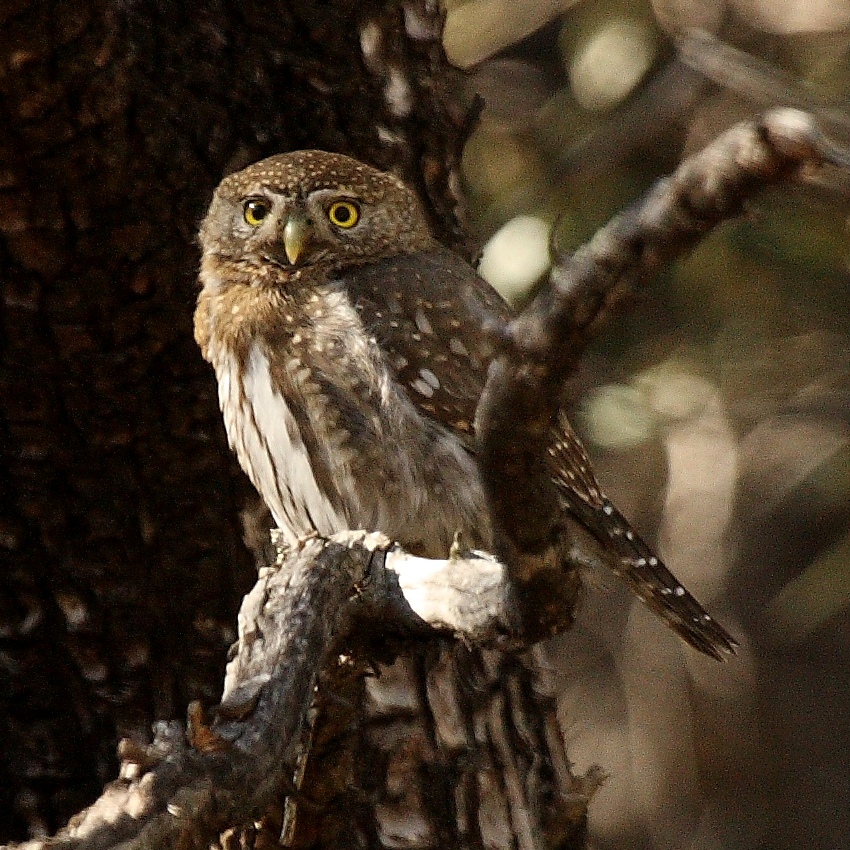
Northern Pygmy Owl

Northern Pygmy Owl

Glaucidium californicum

dominic sherony, CC BY-SA 2.0, via Wikimedia Commons

Side by side

African Barred OwletNorthern Pygmy Owl
Scientific nameGlaucidium capense (A. Smith, 1834)Glaucidium californicum P. L. Sclater, 1857
English nameAfrican Barred OwletNorthern Pygmy Owl
GroupBirdsBirds
ClassAves BirdAves Bird
OrderStrigiformes OwlStrigiformes Owl
FamilyStrigidae OwlsStrigidae Owls
GenusGlaucidium Pygmy OwlGlaucidium Pygmy Owl
Named in18341857
Red List categoryLeast ConcernLeast Concern
Countries on record16 countries3 countries
GBIF occurrence records10,712 records1,321 records

Rows where the two agree are shown in grey.

Where each is found

Only African Barred Owlet (16)

Only Northern Pygmy Owl (3)

From Catalogue of Life checklists and GBIF occurrence records. A country missing from a list means no record is held, which is not proof of absence.

Checked facts

African Barred OwletNorthern Pygmy Owl
Appearance
  • The nominate subspecies has greyish-brown upperparts with fine buff bars and a narrow white eyebrow. English Wikipedia
  • Its scapulars and greater wing coverts have white outer webs and dark brown tips, forming a white stripe across the shoulder and folded wing. English Wikipedia
  • Its brown chest is finely barred with buff, while its white breast and flanks have brown spots. English Wikipedia
  • Its underwing coverts, legs and vent are white. English Wikipedia
  • Its flight feathers and tail are brown with rufous bars. English Wikipedia
  • Its bill and cere are dull greenish yellow, while its eyes, legs and feet are yellow. English Wikipedia
  • The species has bars on its breast and spots on its belly. ebird.org
Size
Habitat
  • The species occupies open habitats containing trees, including gallery forests, woodlands, forest edges and secondary growth. English Wikipedia
  • The species inhabits temperate, subtropical, and tropical moist forests, savannas, and wetlands. English Wikipedia
  • In Oregon and Washington, the species nests and forages in dense, continuous forests near streams. English Wikipedia
  • Its breeding habitat includes open to semi-open woodlands in foothills and mountains of western North America. English Wikipedia
  • The species occupies both pure coniferous forests and mixed coniferous-deciduous forests. English Wikipedia
Diet
  • Its diet includes small mammals, birds, reptiles, frogs, insects, scorpions and caterpillars. English Wikipedia
  • It normally catches prey after making a short flight from a perch. English Wikipedia
Behaviour
  • The species is partly active during daylight hours. English Wikipedia
  • It calls mainly at dawn and dusk, although it also calls throughout calm and clear nights. English Wikipedia
  • It frequently uses exposed perches to scan for prey, including during daylight. English Wikipedia
  • It roosts under cover, often inside natural cavities in trees. English Wikipedia
  • Individuals detected by other birds during daylight are often subjected to mobbing. English Wikipedia
  • Both sexes call to establish their territories, most frequently before breeding. English Wikipedia
  • Its vocalizations consist of a series of single-pitched purring notes. English Wikipedia
  • Its vocalizations include a yelping series of hoots. ebird.org
  • Males regularly perch at the tops of the tallest available conifers to make territorial calls. English Wikipedia
  • The species produces a buzzing or whirring sound with its wings during flight. English Wikipedia
  • The species is active during daylight, dawn, and dusk. English Wikipedia
  • The species hunts by swooping down on prey and may catch insects while flying. English Wikipedia
  • The species may cache surplus food for later consumption. English Wikipedia
  • Small songbirds including chickadees and nuthatches sometimes mob the species through rapid flight, loud vocalizations, and physical attacks. English Wikipedia
Reproduction
  • The species usually nests in tree cavities and frequently uses old woodpecker holes. English Wikipedia
  • Females lay between two and seven eggs, typically four to six. English Wikipedia
  • Potential nest trees include Douglas-fir, western redcedar, western hemlock, and red alder. English Wikipedia
  • Males establish and defend territories of approximately 250 hectares early in the breeding cycle. English Wikipedia
  • Females incubate eggs, brood the young, and guard the nest. English Wikipedia
  • Males provide food to their mates and offspring at approximately two-hour intervals. English Wikipedia
  • Fledging is synchronous, with all nestlings leaving the nest within a short period. English Wikipedia
Distribution
  • The species is endemic to southern and eastern Africa, with its recorded range extending from Kenya to the Eastern Cape and westward to Angola. English Wikipedia
  • The northern pygmy owl is native to Canada, the United States, and Mexico. English Wikipedia
Conservation
  • The species may be negatively affected by modern forestry because it depends on mature forests for hunting and cavities for nesting, roosting, and winter food storage. English Wikipedia
  • Loss of mature forests and woodlands through severe wildfires is identified as a major population threat. English Wikipedia
  • Logging and forest management that remove large trees and snags threaten the species' nesting cavities. English Wikipedia
  • In Oregon, the species was classified as a species of concern from 1997 through 2008 before being removed from that classification. English Wikipedia
  • The species is classified as S3 in Idaho and S4 in Montana. English Wikipedia
Other
  • The species exhibits geographic variation in appearance. English Wikipedia
  • The taxonomic complex may represent four species rather than one. English Wikipedia
  • Three subspecies are currently recognized, although many authorities treat each as a separate species. English Wikipedia
  • The taxonomic status of G. capense etchecopari is uncertain. English Wikipedia
No checked fact yet

In brief

African Barred Owlet

Glaucidium capense is endemic to southern and eastern Africa, with its recorded range extending from Kenya to the Eastern Cape and westward to Angola. It has bars on its breast, spots on its belly and brown flight feathers and tail with rufous bars. Full profile

Northern Pygmy Owl

The species is native to Canada, the United States, and Mexico, and inhabits temperate, subtropical, and tropical moist forests, savannas, and wetlands. It has a round, white-spotted head, yellow eyes, and two black, white-outlined spots on the back of its head that resemble eyes. Full profile

Compare something else

Page built on 27 November 2026 from the data on the two species pages, where every source is listed.

Cite this page

ScientificNames.org. (2026). African Barred Owlet vs Northern Pygmy Owl. Retrieved November 27, 2026, from https://scientificnames.org/compare/african-barred-owlet-vs-glaucidium-californicum