Species · Birds
Northern Pygmy Owl Glaucidium californicum
The scientific name of the Northern Pygmy Owl is Glaucidium californicum. It is a species of bird in the family Strigidae (owls), order Strigiformes. The name dates from 1857.
- Scientific name
- Glaucidium californicum P. L. Sclater, 1857
- Common name
- Northern Pygmy Owl
- Genus
- Glaucidium
- Family
- Strigidae (Owls)
- Order
- Strigiformes
- Class
- Aves
- Red List category
- LC Least Concern
- Recorded in
- 3 countries
- Name status
- accepted in the Catalogue of Life
Overview
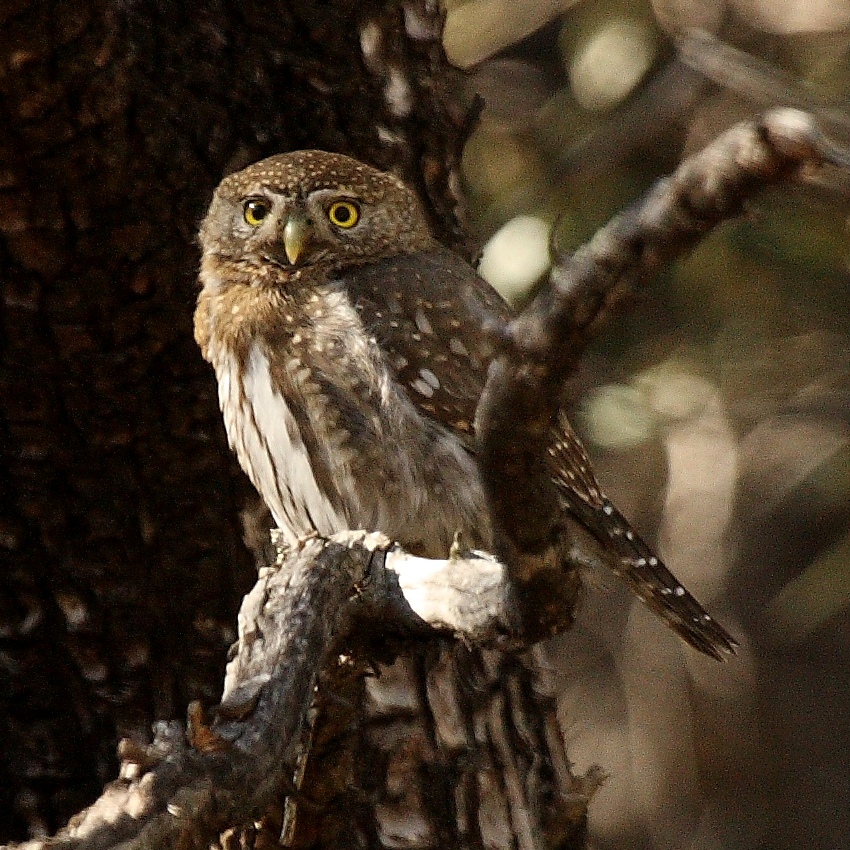
The species is native to Canada, the United States, and Mexico, and inhabits temperate, subtropical, and tropical moist forests, savannas, and wetlands. It has a round, white-spotted head, yellow eyes, and two black, white-outlined spots on the back of its head that resemble eyes.
Written 26 November 2026 from the sources listed below. Each statement was checked against the passage it cites; statements that could not be supported were removed.
Appearance
Adults have gray, brownish-gray, or rufous plumage. The head is round and white-spotted, with a weakly defined facial disc, yellow eyes, and a yellowish-green bill.[1][2][3]
Two black spots outlined in white occur on the back of the head and resemble eyes. The mid to lower breast is white with darker vertical streaks.[4][5]
The legs are feathered down to four well-armed toes on each foot. Adults measure 15–17 cm in overall length.[6][7]
Habitat
The species inhabits temperate, subtropical, and tropical moist forests, savannas, and wetlands. Its breeding habitat includes open to semi-open woodlands in foothills and mountains of western North America.[8][9]
The species occupies both pure coniferous forests and mixed coniferous-deciduous forests. In Oregon and Washington, it nests and forages in dense, continuous forests near streams.[10][11]
Diet
The northern pygmy owl eats small mammals, birds, and large insects. Recorded prey includes voles, warblers, chickadees, and finches, and the species has been observed eating Wilson's warblers.[12][13][14]
The proportion of birds in its diet increases in early summer compared with spring, when mammals predominate. The species may store surplus food on thorns.[15][16]
Behaviour
The species is active during daylight, dawn, and dusk. It hunts by swooping down on prey and may catch insects while flying.[17][18]
Males regularly perch at the tops of the tallest available conifers to make territorial calls. The species produces a buzzing or whirring sound with its wings during flight.[19][20]
The species may cache surplus food for later consumption. Small songbirds, including chickadees and nuthatches, sometimes mob it through rapid flight, loud vocalizations, and physical attacks.[21][22]
Reproduction and life cycle
The species usually nests in tree cavities and frequently uses old woodpecker holes. Potential nest trees include Douglas-fir, western redcedar, western hemlock, and red alder.[23][24]
Females lay between two and seven eggs, typically four to six. Males establish and defend territories of approximately 250 hectares early in the breeding cycle.[25][26]
Females incubate eggs, brood the young, and guard the nest. Males provide food to their mates and offspring at approximately two-hour intervals.[27][28]
Fledging is synchronous, with all nestlings leaving the nest within a short period.[29]
Conservation
Modern forestry may negatively affect the species because it depends on mature forests for hunting and cavities for nesting, roosting, and winter food storage. Logging and forest management that remove large trees and snags threaten its nesting cavities.[30][31]
Loss of mature forests and woodlands through severe wildfires is identified as a major population threat.[32]
In Oregon, the species was classified as a species of concern from 1997 through 2008 before being removed from that classification. It is classified as S3 in Idaho and S4 in Montana.[33][34]
Classification of the Northern Pygmy Owl
| Kingdom | Animalia |
|---|---|
| Phylum | Chordata |
| Subphylum | Vertebrata |
| Infraphylum | Gnathostomata |
| Parvphylum | Osteichthyes |
| Megaclass | Tetrapoda |
| Class | Aves (Bird) |
| Order | Strigiformes (Owl) |
| Family | Strigidae (Owls) |
| Subfamily | Surniinae |
| Genus | Glaucidium (Pygmy Owl) |
| Species | Glaucidium californicum P. L. Sclater, 1857 |
Where the Northern Pygmy Owl is found
Checklists and occurrence records place Glaucidium californicum in 3 countries across North America. GBIF holds 1,321 georeferenced records of it.
Countries
Regions and cities with the most records
- California, United States 312
- British Columbia, Canada 266
- Oregon, United States 108
- Washington, United States 95
- Idaho, United States 81
- Arcadia, United States 53
- Duarte, United States 53
- Monrovia, United States 53
- Altadena, United States 50
- Temple City, United States 49
- La Cañada Flintridge, United States 48
- San Gabriel, United States 45
- Alhambra, United States 44
- Pasadena, United States 44
- Rosemead, United States 44
- South Pasadena, United States 44
- Arizona, United States 42
- Vernon, Canada 41
- La Crescenta-Montrose, United States 38
- Glendale, United States 36
- Colwood, Canada 29
- Langford, Canada 29
- Esquimalt, Canada 27
- Glendora, United States 27
- Victoria, Canada 27
- El Monte, United States 26
- New Mexico, United States 26
- Monterey Park, United States 25
- Central Saanich, Canada 24
- Courtenay, Canada 23
- Saanich, Canada 23
- Mission, Canada 22
- Abbotsford, Canada 21
- Baldwin Park, United States 21
- South El Monte, United States 21
- Vincent, United States 21
Range as the checklists state it
Middle America
North America
A number beside a place is its count of GBIF occurrence records. A place without a number comes from a checklist alone. Records show where a species has been observed or collected, which can include escapes and vagrants.
Common names
English
- Northern Pygmy Owl
- Northern Pygmy-Owl
Names in 23 other languages
- Catalan
- mussolet de Califòrnia
- Chinese
- 北美鸺鹠, 北鵂鶹
- Croatian
- kalifornijski ćuk
- Czech
- kulíšek západní
- Danish
- Troldspurveugle
- Dutch
- Noordelijke Dwerguil
- Esperanto
- nordkalifornia strigeto
- Estonian
- lääne-värbkakk
- Finnish
- kalifornianvarpuspöllö
- French
- Chevêchette des Rocheuses
- German
- Kalifornienzwergkauz
- Italian
- Civettina del Nordamerica
- Japanese
- カリフォルニアスズメフクロウ, ロッキースズメフクロウ
- Lithuanian
- šiaurinė žvirblinė pelėda
- Norwegian
- tusseugle
- Polish
- sóweczka kalifornijska
- Portuguese
- mochinho-das-rochosas, mocho-pigmeu-americano, mocho-pigmeu-do-norte
- Russian
- Западный сычик, Калифорнийский воробьиный сыч
- Slovak
- kuvičok hôrny
- Spanish
- Mochuelo californiano
- Swedish
- trollsparvuggla
- Ukrainian
- сичик-горобець каліфорнійський
- Welsh
- cordylluan Califfornia
Subspecies and varieties
- Glaucidium californicum californicum subspecies
- Glaucidium californicum grinnelli subspecies
- Glaucidium californicum pinicola subspecies
- Glaucidium californicum swarthi subspecies
Related species
-
 Eurasian Pygmy OwlGlaucidium passerinum
-
 Northern Pygmy OwlGlaucidium gnoma
-
 Ferruginous Pygmy OwlGlaucidium brasilianum
-
 Pearl-spotted OwletGlaucidium perlatum
-
 Asian Barred OwletGlaucidium cuculoides
-
 Jungle OwletGlaucidium radiatum
- Pernambuco Pygmy OwlGlaucidium mooreorum
-
 African Barred OwletGlaucidium capense
Compare
Questions and answers
What is the scientific name of the Northern Pygmy Owl?
The scientific name of the Northern Pygmy Owl is Glaucidium californicum. Written with its author, the full name is Glaucidium californicum P. L. Sclater, 1857.
Which family does the Northern Pygmy Owl belong to?
Glaucidium californicum belongs to the family Strigidae, in the order Strigiformes and the class Aves.
Where is the Northern Pygmy Owl found?
Checklists and occurrence records place Glaucidium californicum in 3 countries: United States, Canada and Mexico.
What is the conservation status of the Northern Pygmy Owl?
The IUCN Red List category recorded for Glaucidium californicum is Least Concern (LC).
What other names does the Northern Pygmy Owl have?
Glaucidium californicum is also known in English as Northern Pygmy-Owl.
Sources
Passages the profile rests on
- Adults have gray, brownish-gray, or rufous plumage. Source passage: “Adults are 15–17 cm (5.9–6.7 in) in overall length and are gray, brownish-gray or rufous in color.” — English Wikipedia
- The head is round and white-spotted, with a weakly defined facial disc. Source passage: “This owl has a round white-spotted head, weakly defined facial disc” — English Wikipedia
- The eyes are yellow and the bill is yellowish-green. Source passage: “The eyes are yellow and the bill is yellowish-green.” — English Wikipedia
- Two black spots outlined in white occur on the back of the head and resemble eyes. Source passage: “The bird has two black nape spots outlined in white on the back of its head, which look like eyes.” — English Wikipedia
- The mid to lower breast is white with darker vertical streaks. Source passage: “The mid to lower breast is white with darker vertical streaking.” — English Wikipedia
- The legs are feathered down to four well-armed toes on each foot. Source passage: “The legs are feathered down to the four well-armed toes on each foot.” — English Wikipedia
- Adults measure 15–17 cm in overall length. Source passage: “Adults are 15–17 cm (5.9–6.7 in) in overall length” — English Wikipedia
- The species inhabits temperate, subtropical, and tropical moist forests, savannas, and wetlands. Source passage: “Their habitat includes temperate, subtropical and tropical moist forest, savanna, and wetlands.” — English Wikipedia
- Its breeding habitat includes open to semi-open woodlands in foothills and mountains of western North America. Source passage: “Their breeding habitat includes open to semi-open woodlands of foothills and mountains in western North America.” — English Wikipedia
- In Oregon and Washington, the species nests and forages in dense, continuous forests near streams. Source passage: “In Oregon and Washington they are known to nest and forage in the center of dense, continuous forests, near streams.” — English Wikipedia
- The species occupies both pure coniferous forests and mixed coniferous-deciduous forests. Source passage: “As the northern pygmy owl inhabits both pure coniferous forests and forests with a mixture of conifers and deciduous trees” — English Wikipedia
- The species eats small mammals, birds, and large insects. Source passage: “They eat small mammals, birds and large insects” — English Wikipedia
- Recorded prey includes voles, warblers, chickadees, and finches. Source passage: “These can include voles, warblers, chickadees, and finches.” — English Wikipedia
- The species has been observed eating Wilson's warblers. Source passage: “They've been observed eating Wilson's warblers.” — English Wikipedia
- The proportion of birds in its diet increases in early summer compared with spring, when mammals predominate. Source passage: “Pygmy owls are known to shift their diet to include a higher proportion of birds in early summer compared to the spring (mostly mammals).” — English Wikipedia
- The species may store surplus food on thorns. Source passage: “they have even been observed storing prey items on thorns.” — English Wikipedia
- The species is active during daylight, dawn, and dusk. Source passage: “These owls are diurnal, and also active at dawn and dusk.” — English Wikipedia
- The species hunts by swooping down on prey and may catch insects while flying. Source passage: “They swoop down on prey; they may also catch insects in flight.” — English Wikipedia
- Males regularly perch at the tops of the tallest available conifers to make territorial calls. Source passage: “Males will regularly perch at the top of the tallest available conifer trees to issue their territorial call” — English Wikipedia
- The species produces a buzzing or whirring sound with its wings during flight. Source passage: “When they fly, their wings make a buzzing or whirring sound.” — English Wikipedia
- The species may cache surplus food for later consumption. Source passage: “Northern pygmy owls may cache excess food for later” — English Wikipedia
- Small songbirds including chickadees and nuthatches sometimes mob the species through rapid flight, loud vocalizations, and physical attacks. Source passage: “Small songbirds (ex: chickadees and nuthatches) gather to direct mobbing at Northern Pygmy-owls by flying quickly, making loud vocalizations, and sometimes even attacking to protect themselves.” — English Wikipedia
- The species usually nests in tree cavities and frequently uses old woodpecker holes. Source passage: “They usually nest in a tree cavity and will often use old woodpecker holes.” — English Wikipedia
- Potential nest trees include Douglas-fir, western redcedar, western hemlock, and red alder. Source passage: “Nest tree species may include Douglas-fir, western redcedar, western hemlock and red alder.” — English Wikipedia
- Females lay between two and seven eggs, typically four to six. Source passage: “The female lays 2–7 eggs, typically 4–6.” — English Wikipedia
- Males establish and defend territories of approximately 250 hectares early in the breeding cycle. Source passage: “Early in the breeding cycle males establish and defend a territory of perhaps 250 hectares (about 1 sq. mi.).” — English Wikipedia
- Females incubate eggs, brood the young, and guard the nest. Source passage: “During the breeding cycle the female incubates the eggs, broods the young and guards the nest.” — English Wikipedia
- Males provide food to their mates and offspring at approximately two-hour intervals. Source passage: “The male hunts, making food deliveries approximately every 2 hours.” — English Wikipedia
- Fledging is synchronous, with all nestlings leaving the nest within a short period. Source passage: “Fledging is synchronous, meaning that all nestlings leave the nest within a short period of time.” — English Wikipedia
- The species may be negatively affected by modern forestry because it depends on mature forests for hunting and cavities for nesting, roosting, and winter food storage. Source passage: “they may be negatively affected by modern forestry. This is predicted due to their dependence on mature forest for hunting, and dependence on cavities for nesting, roosting, and caching prey in the winter.” — English Wikipedia
- Logging and forest management that remove large trees and snags threaten the species' nesting cavities. Source passage: “due to forest management practices and logging that removes large trees and snags, their nesting cavities are also at risk.” — English Wikipedia
- Loss of mature forests and woodlands through severe wildfires is identified as a major population threat. Source passage: “One of the biggest threats to their population is the loss of mature forests and woodlands to high-frequency, high severity wildfires” — English Wikipedia
- In Oregon, the species was classified as a species of concern from 1997 through 2008 before being removed from that classification. Source passage: “In Oregon, it was listed as a species of concern from 1997 to 2008, but was removed due to their relative abundance in the mature, montane forests in the state.” — English Wikipedia
- The species is classified as S3 in Idaho and S4 in Montana. Source passage: “In Idaho it is ranked as S3, and in Montana it is ranked as S4.” — English Wikipedia
- The northern pygmy owl is native to Canada, the United States, and Mexico. Source passage: “The northern pygmy owl is native to Canada, the United States, and Mexico.” — English Wikipedia
Data
- Catalogue of Life, 2026-10-16 XR cc by
- Global Biodiversity Information Facility CC BY 4.0
- Wikidata CC0
- GeoNames CC BY 4.0
- Wikimedia Commons per image; credit shown with each image
- Within the Catalogue of Life, this name comes from The Integrated Taxonomic Information System cc0
References
- Peters, & James Lee. (1940). Check-List of Birds of the World, Vol. 4.
This species in other databases
Page built on 28 November 2026. See how the catalog is made and all sources and licences.
Cite this page
ScientificNames.org. (2026). Glaucidium californicum (Northern Pygmy Owl). Retrieved November 28, 2026, from https://scientificnames.org/species/glaucidium-californicum
“Glaucidium californicum (Northern Pygmy Owl).” ScientificNames.org, 2026, scientificnames.org/species/glaucidium-californicum. Accessed 28 Nov. 2026.
ScientificNames.org. “Glaucidium californicum (Northern Pygmy Owl).” Accessed November 28, 2026. https://scientificnames.org/species/glaucidium-californicum.
@misc{scientificnames_glaucidium_californicum_northern_pygmy_owl,
  author = {{ScientificNames.org}},
  title = {Glaucidium californicum (Northern Pygmy Owl)},
  year = {2026},
  url = {https://scientificnames.org/species/glaucidium-californicum},
  note = {Accessed 2026-11-28}
}