Comparison

Subtropical Pygmy Owl vs Northern Pygmy Owl

Subtropical Pygmy Owl (Glaucidium parkeri) and Northern Pygmy Owl (Glaucidium californicum) both belong to the genus Glaucidium (pygmy owl) and part ways below it.

Subtropical Pygmy Owl

Glaucidium parkeri
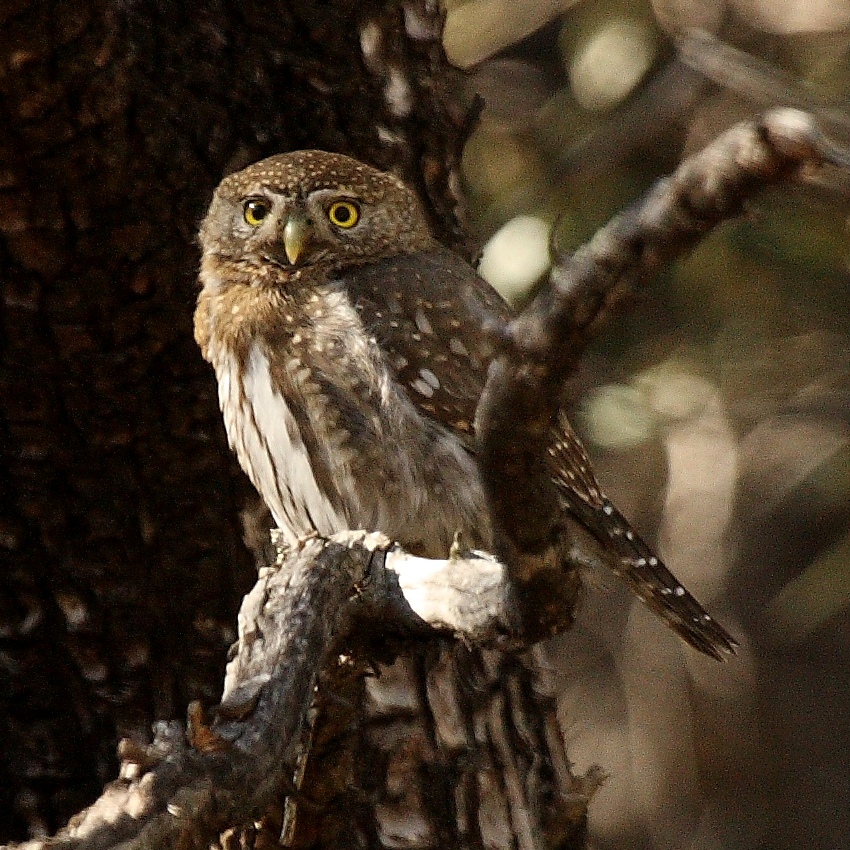
Northern Pygmy Owl

Northern Pygmy Owl

Glaucidium californicum

dominic sherony, CC BY-SA 2.0, via Wikimedia Commons

Side by side

Subtropical Pygmy OwlNorthern Pygmy Owl
Scientific nameGlaucidium parkeri Robbins & S. N. G. Howell, 1995Glaucidium californicum P. L. Sclater, 1857
English nameSubtropical Pygmy OwlNorthern Pygmy Owl
GroupBirdsBirds
ClassAves BirdAves Bird
OrderStrigiformes OwlStrigiformes Owl
FamilyStrigidae OwlsStrigidae Owls
GenusGlaucidium Pygmy OwlGlaucidium Pygmy Owl
Named in19951857
Red List categoryLeast ConcernLeast Concern
Countries on record4 countries3 countries
GBIF occurrence records425 records1,321 records

Rows where the two agree are shown in grey.

Where each is found

Only Subtropical Pygmy Owl (4)

Only Northern Pygmy Owl (3)

From Catalogue of Life checklists and GBIF occurrence records. A country missing from a list means no record is held, which is not proof of absence.

Checked facts

Subtropical Pygmy OwlNorthern Pygmy Owl
Appearance
  • The species occurs in a widespread brown morph and a rare rufous morph. English Wikipedia
  • Adults of the brown morph have a grayish-brown crown. English Wikipedia
  • Adults of the brown morph have prominent white spots on the crown and sides of the face. English Wikipedia
  • The species has black false-eye markings on its nape. English Wikipedia
  • The species has a dark brown back and rump. English Wikipedia
  • The species has a blackish tail with spotted white bands. English Wikipedia
  • The underparts are white with broad, dull reddish-olive-brown streaks. English Wikipedia
  • The species has yellow eyes. ebird.org
  • The species has white bands on its wings and tail. ebird.org
  • The species' overall plumage coloration ranges from brown to bright cinnamon. ebird.org
  • The species has a round head. ebird.org
Size
Habitat
  • The species inhabits temperate, subtropical, and tropical moist forests, savannas, and wetlands. English Wikipedia
  • In Oregon and Washington, the species nests and forages in dense, continuous forests near streams. English Wikipedia
  • Its breeding habitat includes open to semi-open woodlands in foothills and mountains of western North America. English Wikipedia
  • The species occupies both pure coniferous forests and mixed coniferous-deciduous forests. English Wikipedia
Diet
  • The species' diet is presumed to include large arthropods and small vertebrates, although published dietary information is unavailable. English Wikipedia
Behaviour
  • The species is active during both daytime and nighttime. English Wikipedia
  • The species' song consists of three or four short phrases, generally containing two to four or six notes separated by intervals of several seconds. English Wikipedia
  • Males regularly perch at the tops of the tallest available conifers to make territorial calls. English Wikipedia
  • The species produces a buzzing or whirring sound with its wings during flight. English Wikipedia
  • The species is active during daylight, dawn, and dusk. English Wikipedia
  • The species hunts by swooping down on prey and may catch insects while flying. English Wikipedia
  • The species may cache surplus food for later consumption. English Wikipedia
  • Small songbirds including chickadees and nuthatches sometimes mob the species through rapid flight, loud vocalizations, and physical attacks. English Wikipedia
Reproduction
  • The species is presumed to nest in tree cavities, including old woodpecker holes. English Wikipedia
  • The species usually nests in tree cavities and frequently uses old woodpecker holes. English Wikipedia
  • Females lay between two and seven eggs, typically four to six. English Wikipedia
  • Potential nest trees include Douglas-fir, western redcedar, western hemlock, and red alder. English Wikipedia
  • Males establish and defend territories of approximately 250 hectares early in the breeding cycle. English Wikipedia
  • Females incubate eggs, brood the young, and guard the nest. English Wikipedia
  • Males provide food to their mates and offspring at approximately two-hour intervals. English Wikipedia
  • Fledging is synchronous, with all nestlings leaving the nest within a short period. English Wikipedia
Distribution
  • The Subtropical Pygmy Owl occurs in Bolivia, Colombia, Ecuador, and Peru. English Wikipedia
  • The species occurs along the eastern slope of the Andes, from far southwestern Colombia through Ecuador and Peru to central Bolivia. English Wikipedia
  • The northern pygmy owl is native to Canada, the United States, and Mexico. English Wikipedia
Conservation
  • The species may be negatively affected by modern forestry because it depends on mature forests for hunting and cavities for nesting, roosting, and winter food storage. English Wikipedia
  • Loss of mature forests and woodlands through severe wildfires is identified as a major population threat. English Wikipedia
  • Logging and forest management that remove large trees and snags threaten the species' nesting cavities. English Wikipedia
  • In Oregon, the species was classified as a species of concern from 1997 through 2008 before being removed from that classification. English Wikipedia
  • The species is classified as S3 in Idaho and S4 in Montana. English Wikipedia

In brief

Subtropical Pygmy Owl

Glaucidium parkeri occurs along the eastern slope of the Andes, from far southwestern Colombia through Ecuador and Peru to central Bolivia. It occurs in a widespread brown morph and a rare rufous morph. Full profile

Northern Pygmy Owl

The species is native to Canada, the United States, and Mexico, and inhabits temperate, subtropical, and tropical moist forests, savannas, and wetlands. It has a round, white-spotted head, yellow eyes, and two black, white-outlined spots on the back of its head that resemble eyes. Full profile

Compare something else

Page built on 29 November 2026 from the data on the two species pages, where every source is listed.

Cite this page

ScientificNames.org. (2026). Subtropical Pygmy Owl vs Northern Pygmy Owl. Retrieved November 29, 2026, from https://scientificnames.org/compare/subtropical-pygmy-owl-vs-glaucidium-californicum