| Appearance | - The plant has alternate, pinnately compound leaves borne on thin, stiff stems. English Wikipedia
- Its flowers are small, white or cream-colored, and have five petals. English Wikipedia
- The flowers grow in showy panicles. English Wikipedia
- The plant produces plumes of feathery white or cream flowers during summer. English Wikipedia
- Its compound leaves consist of three or five leaflets. English Wikipedia
- Male-flowered plants produce more showy blooms than female-flowered plants. English Wikipedia
- Its leaves are twice- or thrice-pinnately compound and can exceed one foot in length. uaex.uada.edu
- Its leaflets measure approximately two to three inches long. uaex.uada.edu
- The plant develops yellow foliage in autumn. uaex.uada.edu
- Its white flowers grow in finger-like trusses arranged in terminal clusters that can exceed one foot in length. uaex.uada.edu
- The plant forms large, bushy clumps and can reach six feet in height. fs.usda.gov
- Its tiny cream-colored flowers form feathery clusters on long, branched spikes above the leaves. fs.usda.gov
- Its leaves are bipinnately compound and toothed, with lower leaves generally larger than upper leaves. fs.usda.gov
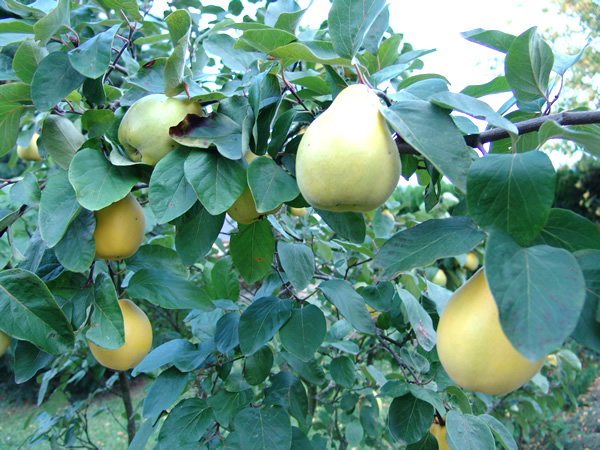
| - The quince is a deciduous shrub or small tree with crowded branches. rhs.org.uk
- Its leaves are broadly oval, mid-green, and have grey, downy undersides. rhs.org.uk
- Its solitary flowers are pale pink to white and appear in late spring. rhs.org.uk
- Its aromatic fruits are golden-yellow and pear-shaped. rhs.org.uk
- The fruit is a pome with an appearance resembling a pear or golden apple. extension.psu.edu
- The fruit remains tough and hard even when fully ripe. extension.psu.edu
- Ripening fruit changes from green through pale green to golden in late fall. extension.psu.edu
- The fruit flesh contains dispersed gritty stone cells. English Wikipedia
|
|---|
| Size | - The species typically reaches a height of 1.2 to 1.8 metres. English Wikipedia
- The plant can reach five to six feet in height and a similar spread under favorable growing conditions. uaex.uada.edu
| |
|---|
| Habitat | - The species grows in moist woodland, frequently at higher elevations. English Wikipedia
- The species favors humus-rich soil and shaded or partially shaded sites. English Wikipedia
- The species can grow in full sun when moisture is consistently available. English Wikipedia
- The species grows best in USDA hardiness zones 4 through 7. uaex.uada.edu
- The species grows well in humus-rich, well-drained soil kept moist during summer. uaex.uada.edu
- The species is particularly effective when planted beside woodland streams and water features. uaex.uada.edu
- Plants grown in dry shade tolerate the conditions but tend to remain smaller. uaex.uada.edu
- The species is native to northern temperate regions of North America, Europe, and Asia. fs.usda.gov
- The species occurs in moist woods, meadows, and along streams. fs.usda.gov
- The species also grows in moist to wet ravines, on rocky ledges, and in avalanche chutes. fs.usda.gov
| - The species grows in warm-temperate and temperate climates. English Wikipedia
- The species can grow in most soil types. extension.psu.edu
- The species tolerates both shaded and sunny growing conditions. English Wikipedia
- The species can grow in deep, fertile, moist but well-drained soil in a warm, sheltered, sunny location. rhs.org.uk
- The species requires a cool period with temperatures below 7 °C to flower properly. English Wikipedia
|
|---|
| Diet | No checked fact yet | - The fruit is used as food in cooked preparations including jams, jellies, marmalade, and cakes. pmc.ncbi.nlm.nih.gov
- The fruit can be eaten raw after sufficient ripening in warmer climates. pmc.ncbi.nlm.nih.gov
- The fruit can be incorporated into applesauce and apple pie. extension.psu.edu
|
|---|
| Behaviour | - The species serves as a host plant for the dusky azure butterfly. English Wikipedia
- In woodland habitats, individuals generally grow at irregular intervals rather than forming large colonies. uaex.uada.edu
| No checked fact yet |
|---|
| Reproduction | - Male and female flowers occur on separate plants. English Wikipedia
- The species flowers from late spring to early summer. English Wikipedia
- Male flowers generally remain attractive in the garden for approximately four weeks. uaex.uada.edu
- Young plants can be propagated by division or seed. uaex.uada.edu
- The species produces either entirely female or entirely male flowers on each individual plant. fs.usda.gov
- The species can be propagated from seed, although establishment takes a long time. fs.usda.gov
| - The species produces flowers with five petals, five styles, and at least 20 stamens. pmc.ncbi.nlm.nih.gov
- The species has flowers with a lower ovary containing numerous ovules. pmc.ncbi.nlm.nih.gov
- The species can be propagated using cuttings or layering. English Wikipedia
- The species can also be propagated by seed sown in autumn. rhs.org.uk
|
|---|
| Distribution | - The species occurs in temperate regions of Europe, Asia, and eastern and western North America. English Wikipedia
- In western North America, the species grows from northern California to Alaska. uaex.uada.edu
- In south-central and southeastern Alaska, the species grows abundantly along forest edges, roads, and railroad embankments. fs.usda.gov
| - The species is native to the northern forests of Asia Minor and the Caucasus Mountains between Persia and Turkmenistan. pmc.ncbi.nlm.nih.gov
- Wild populations are reported in Dagestan, Azerbaijan, Turkmenia, and Iran. pmc.ncbi.nlm.nih.gov
|
|---|
| Uses | - In Italy, the young shoots are eaten after brief boiling in herb-infused water and subsequent cooking with eggs and cheese. English Wikipedia
- The species is an ingredient in Friuli's homemade wild-greens soup called pistic. English Wikipedia
- Native Americans in the Northwest used the plant medicinally as a diuretic and poultice and to treat blood diseases, smallpox, and sore throats. English Wikipedia
- In perennial borders, the species can be used as a background plant. uaex.uada.edu
- The roots have been used to make poultices for treating sores. fs.usda.gov
- Root infusions have traditionally been used to treat rheumatism, sore throats, fevers, and blood diseases. fs.usda.gov
| - The species is grown as an ornamental plant for its attractive pink blossoms. extension.psu.edu
- The species is used as a rootstock for certain pear cultivars. English Wikipedia
- The fruit is used to produce alcoholic beverages. English Wikipedia
- The fruit is used in the Balkans to produce quince eau-de-vie known as rakija. English Wikipedia
- The fruit is traditionally added to chicken or kibbeh in Levantine cooking. English Wikipedia
- The leaves have been investigated for their potential use in therapeutic supplements. pmc.ncbi.nlm.nih.gov
- The leaves contain calcium, magnesium, and iron as their most abundant minerals. pmc.ncbi.nlm.nih.gov
|
|---|
| Similar species | - The dwarf cultivar Aruncus dioicus 'Kneiffii' has finely divided leaves and is somewhat smaller than the species. uaex.uada.edu
| |
|---|
| Name origin | No checked fact yet | - The English name quince originated in the fourteenth century from the plural form of the Middle English word quoyn. English Wikipedia
- The name ultimately derives from the Greek expression kydonion mēlon, meaning Kydonian apple. English Wikipedia
|
|---|
| Other | No checked fact yet | |
|---|