Comparison
Golden Poison Frog vs Strawberry Poison Dart Frog
Golden Poison Frog (Phyllobates terribilis) and Strawberry Poison Dart Frog (Oophaga pumilio) both belong to the subfamily Dendrobatinae and part ways below it.
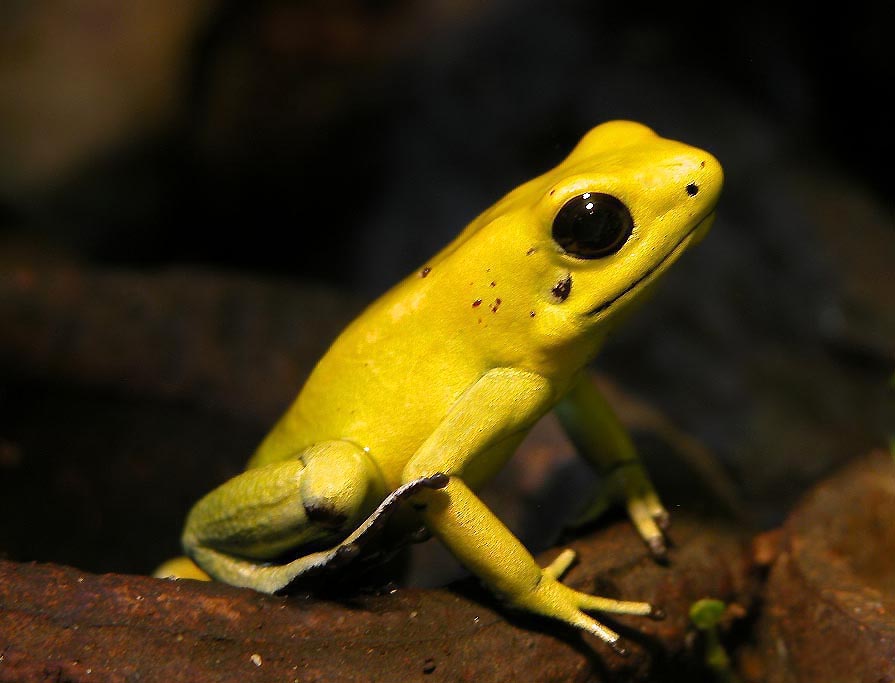


How they differ
Golden poison frog (Phyllobates terribilis) is endemic to the Pacific coastal rainforests of Colombia, whereas Strawberry poison dart frog (Oophaga pumilio) occurs from eastern central Nicaragua through Costa Rica to northwestern Panama. Golden poison frog (Phyllobates terribilis) produces batrachotoxins in its skin glands, whereas Strawberry poison dart frog (Oophaga pumilio) sequesters the specialized toxin pumiliotoxin 251D. Golden poison frog (Phyllobates terribilis) has adults that can reach approximately 6 cm in body length and nearly 30 g in weight, whereas Strawberry poison dart frog (Oophaga pumilio) exhibits approximately 15–30 color morphs. Golden poison frog (Phyllobates terribilis) receives no further parental care after adults transfer offspring to water, whereas Strawberry poison dart frog (Oophaga pumilio) has females that revisit tadpoles every few days to provide unfertilized eggs.
| Golden Poison Frog | Strawberry Poison Dart Frog | |
|---|---|---|
| Activity | Golden poison frog (Phyllobates terribilis) is diurnal. | Strawberry poison dart frog (Oophaga pumilio) is active during the day. |
| Habitat | Golden poison frog (Phyllobates terribilis) is terrestrial and inhabits the forest floor. | Strawberry poison dart frog (Oophaga pumilio) is frequently found among leaf litter in forested and disturbed habitats. |
| Conservation | Golden poison frog (Phyllobates terribilis) has become endangered partly because of habitat destruction. | Strawberry poison dart frog (Oophaga pumilio) is described as common throughout its geographic range. |
| Mating | Golden poison frog (Phyllobates terribilis) males attract females through high-pitched vocalizations. | Strawberry poison dart frog (Oophaga pumilio) females select the nearest calling male rather than the male of highest quality as a mating partner. |
Written from the checked facts listed further down. Statements that the sources did not support were removed.
Side by side
| Golden Poison Frog | Strawberry Poison Dart Frog | |
|---|---|---|
| Scientific name | Phyllobates terribilis Myers, Daly & Malkin, 1978 | Oophaga pumilio (Schmidt, 1857) |
| English name | Golden Poison Frog | Strawberry Poison Dart Frog |
| Group | Amphibians | Amphibians |
| Class | Amphibia Amphibians | Amphibia Amphibians |
| Order | Anura Frogs | Anura Frogs |
| Family | Dendrobatidae Poison Dart Frog | Dendrobatidae Poison Dart Frog |
| Genus | Phyllobates Golden Poison Frogs | Oophaga Poison Frogs |
| Named in | 1978 | 1857 |
| Red List category | Endangered | Least Concern |
| Countries on record | 2 countries | 3 countries |
| GBIF occurrence records | 814 records | 13,889 records |
Rows where the two agree are shown in grey.
Where each is found
Only Golden Poison Frog (2)
Only Strawberry Poison Dart Frog (3)
From Catalogue of Life checklists and GBIF occurrence records. A country missing from a list means no record is held, which is not proof of absence.
Checked facts
| Golden Poison Frog | Strawberry Poison Dart Frog | |
|---|---|---|
| Appearance |
|
|
| Size |
| No checked fact yet |
| Habitat |
|
|
| Diet |
|
|
| Behaviour |
|
|
| Reproduction |
|
|
| Distribution |
|
|
| Conservation |
|
|
| Uses | No checked fact yet |
|
| Similar species | No checked fact yet |
|
| Name origin |
| No checked fact yet |
| Other |
|
|
In brief
Golden Poison Frog
Phyllobates terribilis is endemic to the Pacific coastal rainforests of Colombia. It produces batrachotoxins in its skin glands as a chemical defense. Full profile
Strawberry Poison Dart Frog
Oophaga pumilio occurs from eastern central Nicaragua through Costa Rica to northwestern Panama and inhabits humid lowlands and premontane forests. The species exhibits approximately 15–30 color morphs and is the most toxic member of its genus. Full profile
Compare something else
Page built on 24 November 2026 from the data on the two species pages, where every source is listed.
Cite this page
ScientificNames.org. (2026). Golden Poison Frog vs Strawberry Poison Dart Frog. Retrieved November 24, 2026, from https://scientificnames.org/compare/golden-poison-frog-vs-strawberry-poison-dart-frog
“Golden Poison Frog vs Strawberry Poison Dart Frog.” ScientificNames.org, 2026, scientificnames.org/compare/golden-poison-frog-vs-strawberry-poison-dart-frog. Accessed 24 Nov. 2026.
ScientificNames.org. “Golden Poison Frog vs Strawberry Poison Dart Frog.” Accessed November 24, 2026. https://scientificnames.org/compare/golden-poison-frog-vs-strawberry-poison-dart-frog.
@misc{scientificnames_golden_poison_frog_vs_strawberry_poison_dart_frog,
  author = {{ScientificNames.org}},
  title = {Golden Poison Frog vs Strawberry Poison Dart Frog},
  year = {2026},
  url = {https://scientificnames.org/compare/golden-poison-frog-vs-strawberry-poison-dart-frog},
  note = {Accessed 2026-11-24}
}