Species · Amphibians
Golden Poison Frog Phyllobates terribilis
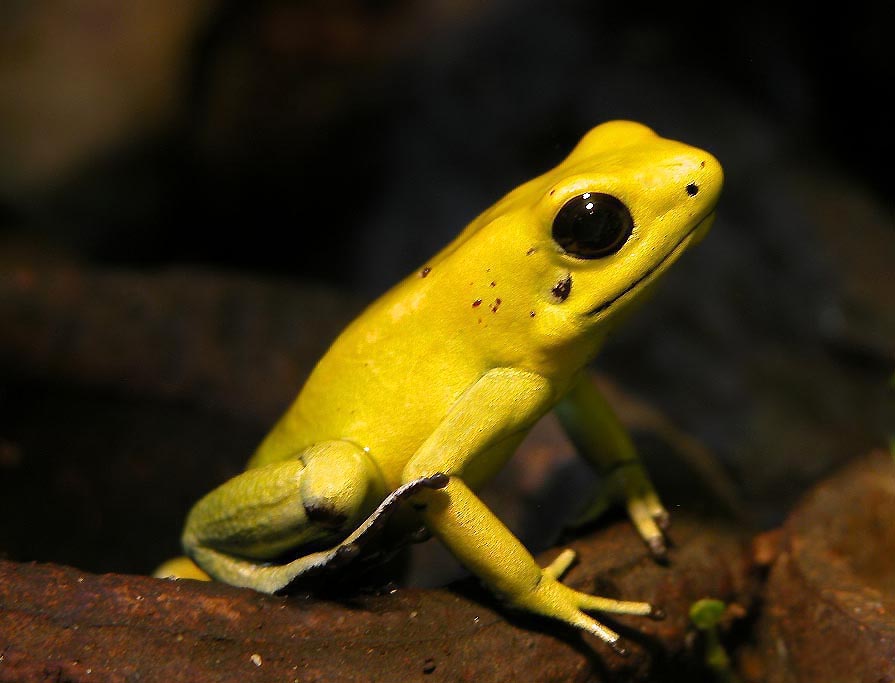
The scientific name of the Golden Poison Frog is Phyllobates terribilis. It is a species of amphibian in the family Dendrobatidae (poison dart frog), order Anura. The name dates from 1978.
- Scientific name
- Phyllobates terribilis Myers, Daly & Malkin, 1978
- Common name
- Golden Poison Frog
- Genus
- Phyllobates
- Family
- Dendrobatidae (Poison Dart Frog)
- Order
- Anura
- Class
- Amphibia
- Red List category
- EN Endangered
- Recorded in
- 2 countries
- Name status
- accepted in the Catalogue of Life
Overview
Phyllobates terribilis is endemic to the Pacific coastal rainforests of Colombia. It produces batrachotoxins in its skin glands as a chemical defense.
Written 24 November 2026 from the sources listed below. Each statement was checked against the passage it cites; statements that could not be supported were removed.
Appearance
Young frogs have dark bodies with dorsolateral stripes that disappear as they mature. The species has an outward-projecting jaw bone plate that creates the appearance of teeth.[1][2]
Adults can reach approximately 6 cm in body length and nearly 30 g in weight. Females typically measure 47 mm on average and can reach 50–55 mm in length, and are generally larger than males.[3][4][5]
Habitat
The species occupies hilly terrain at elevations of approximately 100–200 m. It is terrestrial and inhabits the forest floor.[6][7]
Freshwater habitats are important for the development of its young.[8]
Diet
Adults primarily consume ants belonging to the genera Brachymyrmex and Paratrechina. They also eat various insects and small invertebrates.[9][10]
Tadpoles consume algae and mosquito larvae. The species hunts by ambushing prey rather than specializing in a particular food source.[11][12]
Behaviour
Golden Poison Dart Frogs are diurnal. Individuals generally remain separated rather than forming large groups.[13][14]
Individuals have been observed sitting on the ground or slightly above it on roots and vegetation. The species uses body push-ups as a dominance gesture.[15][16]
Males communicate with females using long, melodious trilling calls. The courtship trill lasts approximately 6–7 seconds and is followed by a shorter 2–3 second version.[17][18]
Reproduction and life cycle
Males and females have multiple mating partners. Males attract females through high-pitched vocalizations.[19][20]
Egg clutches generally contain fewer than 20 eggs. Males carry fertilized eggs on their backs to small pools of water.[21][22]
Captive eggs hatch approximately 11–12 days after fertilization. The species is believed to reproduce throughout the year.[23][24]
After transferring their offspring to water for development, adults provide no further parental care.[25]
Conservation
The species has a geographically limited range but can be abundant within its occupied area. Habitat destruction has contributed to its becoming endangered.[26][27]
Captive frogs raised on commercially available feeder insects eventually lose their toxicity.[28]
Uses
The species produces batrachotoxins in its skin glands as a chemical defense. Its epithet terribilis refers to the deadly toxins present in its skin secretions.[29][30]
Classification of the Golden Poison Frog
| Kingdom | Animalia |
|---|---|
| Phylum | Chordata |
| Subphylum | Vertebrata |
| Infraphylum | Gnathostomata |
| Parvphylum | Osteichthyes |
| Megaclass | Tetrapoda |
| Class | Amphibia (Amphibians) |
| Order | Anura (Frogs) |
| Superfamily | Dendrobatoidea |
| Family | Dendrobatidae (Poison Dart Frog) |
| Subfamily | Dendrobatinae |
| Genus | Phyllobates (Golden Poison Frogs) |
| Species | Phyllobates terribilis Myers, Daly & Malkin, 1978 |
Where the Golden Poison Frog is found
Checklists and occurrence records place Phyllobates terribilis in 2 countries. GBIF holds 814 georeferenced records of it.
Countries
Regions and cities with the most records
A number beside a place is its count of GBIF occurrence records. A place without a number comes from a checklist alone. Records show where a species has been observed or collected, which can include escapes and vagrants.
Common names
English
- Golden Poison Frog
- Golden Poison Dart Frog
Names in 13 other languages
- Chinese
- 金色箭毒蛙
- Czech
- pralesnička strašná
- French
- Kokoï de Colombie, Phyllobate terrible
- Galician
- Ra dourada
- German
- Gelber Blattsteiger, Goldener Blattsteiger, Goldener Giftfrosch, Schrecklicher Blattsteiger, Schrecklicher Giftfrosch, Schrecklicher Pfeilgiftfrosch, Zitronengelber Blattsteiger
- Hungarian
- rettenetes nyílméregbéka
- Italian
- Dendrobate dorato
- Japanese
- モウドクフキヤガエル
- Norwegian Bokmål
- Gullgiftfrosk
- Portuguese
- Rã-dourada-venenosa
- Russian
- Ужасный листолаз
- Slovenian
- zlata grozna listovka
- Spanish
- Rana dorada venenosa
Related species
-
 Two-toned Poison FrogPhyllobates bicolor
-
 Golfodulcean Poison FrogPhyllobates vittatus
-
 Kokoe Poison FrogPhyllobates aurotaenia
-
 Lovely Poison FrogPhyllobates lugubris
- Phyllobates samperi
- Phyllobates bezosi
-
 Strawberry Poison Dart FrogOophaga pumilio
-
 Yellow-banded Poison Dart FrogDendrobates leucomelas
Compare
Questions and answers
What is the scientific name of the Golden Poison Frog?
The scientific name of the Golden Poison Frog is Phyllobates terribilis. Written with its author, the full name is Phyllobates terribilis Myers, Daly & Malkin, 1978.
Which family does the Golden Poison Frog belong to?
Phyllobates terribilis belongs to the family Dendrobatidae, in the order Anura and the class Amphibia.
Where is the Golden Poison Frog found?
Checklists and occurrence records place Phyllobates terribilis in 2 countries: Colombia and Brazil.
What is the conservation status of the Golden Poison Frog?
The IUCN Red List category recorded for Phyllobates terribilis is Endangered (EN).
What other names does the Golden Poison Frog have?
Phyllobates terribilis is also known in English as Golden Poison Dart Frog.
How poisonous is the golden poison frog?
The Golden Poison Dart Frog produces batrachotoxins in its skin glands as a chemical defense. Its skin secretions contain deadly toxins.[29][30]
How many golden poison frogs are left in the world?
The species has a geographically limited range but can be abundant within its occupied area.[26]
Sources
Passages the profile rests on
- Young frogs have dark bodies with dorsolateral stripes that disappear as they mature. Source passage: “They have dorsolateral stripes on dark bodies until they mature.” — animaldiversity.org
- The species has an outward-projecting jaw bone plate that creates the appearance of teeth. Source passage: “Instead, they have an extra bone plate in their jaw that projects outwards and gives the appearance of teeth.” — animaldiversity.org
- Adult frogs can reach approximately 6 cm in body length and nearly 30 g in weight. Source passage: “can reach a weight of nearly 30 grams with a length of 6 cm as adults.” — English Wikipedia
- Adult females typically measure 47 mm on average and can reach 50–55 mm in length. Source passage: “The average body length reaches 47 mm but females can reach 50 to 55 mm.” — animaldiversity.org
- Females are generally larger than males. Source passage: “Females are typically larger than males.” — English Wikipedia
- The species occupies hilly terrain at elevations of approximately 100–200 m. Source passage: “The region they inhabit is characterized by a hilly landscape, elevations varying from 100 to 200 m” — animaldiversity.org
- Golden poison frogs are terrestrial and inhabit the forest floor. Source passage: “They are terrestrial animals that live on the forest floor” — animaldiversity.org
- Freshwater habitats are important for the development of their young. Source passage: “but they rely on freshwater to support their young.” — animaldiversity.org
- Adults primarily consume ants belonging to the genera Brachymyrmex and Paratrechina. Source passage: “The main natural sources of food of P. terribilis are the ants in the genera Brachymyrmex and Paratrechina” — English Wikipedia
- Adults also consume various insects and small invertebrates. Source passage: “but many kinds of insects and other small invertebrates are eaten.” — English Wikipedia
- Tadpoles consume algae and mosquito larvae. Source passage: “The tadpoles feed on algae and mosquito larvae in their nursery.” — English Wikipedia
- The species hunts by ambushing prey rather than specializing in a particular food source. Source passage: “This species is an unspecialized ambush hunter” — English Wikipedia
- Golden poison frogs are diurnal. Source passage: “Golden poison frogs are diurnal and strictly terrestrial.” — animaldiversity.org
- Individuals generally remain separated rather than forming large groups. Source passage: “golden poison frogs live evenly spaced without forming larger congregations.” — English Wikipedia
- The species has been observed sitting on the ground or slightly above it on roots and vegetation. Source passage: “They have only been observed sitting on the ground or sitting a few centimeters above the ground on a tree root or pieces of vegetation.” — animaldiversity.org
- The species uses body push-ups as a dominance gesture. Source passage: “A push up movement of the body represents dominance” — animaldiversity.org
- Males communicate with females using long, melodious trilling calls. Source passage: “Golden poison frog males engage females in courtship by singing a long, melodious trill.” — animaldiversity.org
- The courtship trill lasts approximately 6–7 seconds and is followed by a shorter 2–3 second version. Source passage: “This trill lasts 6 to 7 seconds followed by a 2 to 3 second version.” — animaldiversity.org
- Males and females have multiple mating partners. Source passage: “Phyllobates terribilis is polygynandrous; both males and females have multiple mates.” — animaldiversity.org
- Males attract females through high-pitched vocalizations. Source passage: “Males attract females by using a variety of high pitched calls.” — animaldiversity.org
- Egg clutches generally contain fewer than 20 eggs. Source passage: “In captivity, clutches of eggs usually do not exceed 20.” — animaldiversity.org
- Males carry fertilized eggs on their backs to small pools of water. Source passage: “In the wild, once the female lays the eggs, the male fertilizes them and attaches them to its back.” — animaldiversity.org
- Captive eggs hatch approximately 11–12 days after fertilization. Source passage: “they hatch 11 to 12 days later” — animaldiversity.org
- The species is believed to reproduce throughout the year. Source passage: “Golden poison frogs are thought to mate year round.” — animaldiversity.org
- After transferring their offspring to water for development, adults provide no further parental care. Source passage: “After fertilization and transfer to a small area of water for development, there is no further parental care.” — animaldiversity.org
- The species has a geographically limited range but can be abundant within its occupied area. Source passage: “Overall P. terribilis has a limited range, but is abundant within that area.” — animaldiversity.org
- Habitat destruction has contributed to the species becoming endangered. Source passage: “destruction of this habitat has contributed to P. terribilis becoming an endangered species.” — English Wikipedia
- Captive frogs raised on commercially available feeder insects eventually lose their toxicity. Source passage: “frogs kept in captivity fed on commercially available feeder insects will eventually lose their toxicity” — English Wikipedia
- The species epithet terribilis refers to the deadly toxins present in the frog's skin secretions. Source passage: “the species name terribilis is a reference to the deadly toxins present in the skin secretions of this species.” — English Wikipedia
- The species produces batrachotoxins in its skin glands as a chemical defense. Source passage: “these frogs produce deadly alkaloid batrachotoxins in their skin glands as a defense against predators.” — English Wikipedia
Data
- Catalogue of Life, 2026-10-16 XR cc by
- Global Biodiversity Information Facility CC BY 4.0
- Wikidata CC0
- GeoNames CC BY 4.0
- Wikimedia Commons per image; credit shown with each image
- Within the Catalogue of Life, this name comes from The Integrated Taxonomic Information System cc0
References
- A dangerously toxic new frog (Phyllobates) used by Embera indians of western Colombia with discussion of blowgun fabrication and dart poisoning. (1978). Bulletin of the American Museum of Natural History, 161(2), 309–365. https://bionames.org/references/7b723331116fb1beabcab7d70524ddb1 Link where the name was published
This species in other databases
Page built on 24 November 2026. See how the catalog is made and all sources and licences.
Cite this page
ScientificNames.org. (2026). Phyllobates terribilis (Golden Poison Frog). Retrieved November 24, 2026, from https://scientificnames.org/species/phyllobates-terribilis
“Phyllobates terribilis (Golden Poison Frog).” ScientificNames.org, 2026, scientificnames.org/species/phyllobates-terribilis. Accessed 24 Nov. 2026.
ScientificNames.org. “Phyllobates terribilis (Golden Poison Frog).” Accessed November 24, 2026. https://scientificnames.org/species/phyllobates-terribilis.
@misc{scientificnames_phyllobates_terribilis_golden_poison_frog,
  author = {{ScientificNames.org}},
  title = {Phyllobates terribilis (Golden Poison Frog)},
  year = {2026},
  url = {https://scientificnames.org/species/phyllobates-terribilis},
  note = {Accessed 2026-11-24}
}