Comparison

Eastern Goliath Beetle vs Cockchafer

Eastern Goliath Beetle (Goliathus orientalis) and Cockchafer (Melolontha melolontha) both belong to the family Scarabaeidae (dung beetles) and part ways below it.

Eastern Goliath Beetle

Eastern Goliath Beetle

Goliathus orientalis

Hectonichus, CC BY-SA 3.0, via Wikimedia Commons

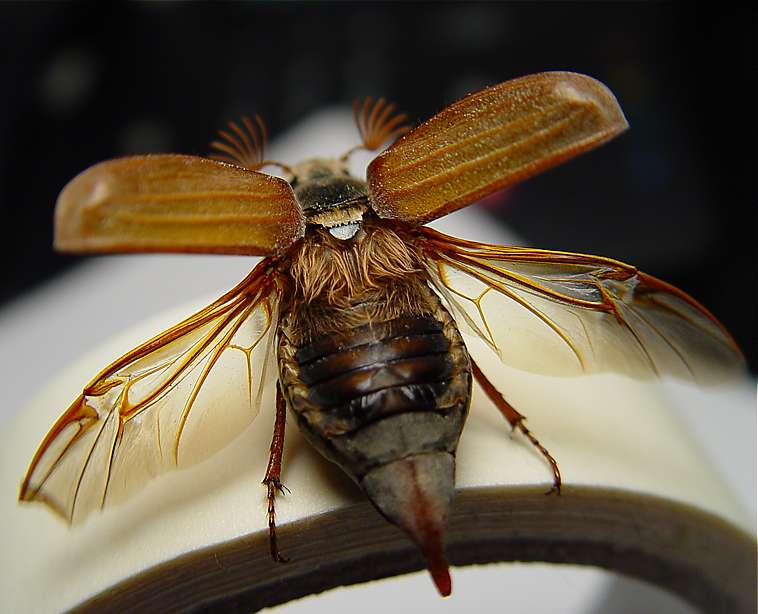
Cockchafer

Cockchafer

Melolontha melolontha

Unknown author, CC BY-SA 3.0, via Wikimedia Commons

Side by side

Eastern Goliath BeetleCockchafer
Scientific nameGoliathus orientalis Moser, 1909Melolontha melolontha (Linnaeus, 1758)
English nameEastern Goliath BeetleCockchafer
GroupInsectsInsects
ClassInsecta InsectInsecta Insect
OrderColeoptera BeetleColeoptera Beetle
FamilyScarabaeidae Dung BeetlesScarabaeidae Dung Beetles
GenusGoliathus Goliath BeetlesMelolontha May Bugs
Named in19091758
Countries on record3 countries41 countries
GBIF occurrence records118 records51,302 records

Rows where the two agree are shown in grey.

Where each is found

Only Eastern Goliath Beetle (3)

Only Cockchafer (41)

From Catalogue of Life checklists and GBIF occurrence records. A country missing from a list means no record is held, which is not proof of absence.

Checked facts

Eastern Goliath BeetleCockchafer
Appearance
  • The beetle has a broad, flat body with whitish elytra bearing a complex pattern of black markings, usually arranged as rings. English Wikipedia
  • The pronotum usually displays large black longitudinal stripes or a large black area. English Wikipedia
  • Male beetles have a black, Y-shaped horn on their heads. English Wikipedia
  • The beetle has long, powerful, black legs. English Wikipedia
  • Male adults have seven flattened, leaf-shaped antenna extensions, whereas females have six. English Wikipedia
  • The male has larger, fan-shaped antennae than the female. English Wikipedia
  • The larva has a white body, a black abdominal extremity, and a curved C-shaped posture. English Wikipedia
  • The larva has a large brown head, strong mandibles, and well-developed hairy legs. English Wikipedia
Size
  • Adult cockchafers measure between 25 and 30 mm in length. English Wikipedia
  • First-stage larvae measure 10–20 mm, second-stage larvae 30–35 mm, and final-stage larvae 40–46 mm. English Wikipedia
Habitat
  • The species occurs particularly in temperate European regions with soil conditions suitable for larval development. English Wikipedia
Diet
  • Adult cockchafers feed on leaves of oak, sycamore, maple, hornbeam, beech, and plum trees. English Wikipedia
  • Adults also feed on chestnut leaves occasionally. English Wikipedia
  • Adult cockchafers consume leaves from deciduous trees and shrubs, including hazelnut. English Wikipedia
  • Larvae feed on plant roots, including potato roots. English Wikipedia
  • Larvae particularly consume roots of grasses, cereals, and other crops. English Wikipedia
  • Cockchafer larvae feed on strawberry roots and can damage strawberry crops. English Wikipedia
Behaviour
  • Male beetles use their Y-shaped horns when fighting other males. English Wikipedia
  • Despite their large bodies, these beetles are capable of flying well. English Wikipedia
  • The beetles keep their membranous secondary wings folded beneath the elytra when not flying. English Wikipedia
  • Individuals may gather in groups of three or more while feeding on tree sap. English Wikipedia
  • Male cockchafers generally swarm during mating season, while females remain stationary and feed on leaves. English Wikipedia
  • Male cockchafers use plant-released green leaf volatiles to locate females feeding on leaves. English Wikipedia
  • Larvae use plant volatiles and carbon dioxide to locate plant roots. English Wikipedia
  • Male cockchafers emerge from the soil when temperatures become favourable in April or May. English Wikipedia
  • Adult cockchafers typically disperse no more than 2–3 km from their emergence location. English Wikipedia
  • Cockchafer larvae can move horizontally through soil by as much as 30 cm per day. English Wikipedia
  • Cockchafer larvae undergo winter hibernation by burrowing deep into the soil. English Wikipedia
Reproduction
  • Larvae take approximately four months to reach full maturity under optimum conditions. English Wikipedia
  • Fully grown larvae construct pupal chambers in which they undergo metamorphosis into adults. English Wikipedia
  • Larvae spend most of the dry season in their pupal chambers. English Wikipedia
  • Adults emerge after the rainy season begins. English Wikipedia
  • Females begin laying eggs approximately two to three weeks after adult emergence. English Wikipedia
  • Females deposit their eggs in fields approximately 15–25 cm below the soil surface. English Wikipedia
  • Each female can lay between 60 and 80 eggs. English Wikipedia
  • Mating between cockchafers lasts several hours. English Wikipedia
  • Female cockchafers lay eggs in batches containing 10–38 eggs. English Wikipedia
  • Egg maturation takes approximately 5–8 days at 27 °C and 23–32 days at 15 °C. English Wikipedia
  • Cockchafers develop through egg, larval, pupal, and adult stages. English Wikipedia
  • Eggs hatch approximately four to six weeks after being laid. English Wikipedia
  • The larva pupates underground during summer and develops into an adult over approximately six weeks. English Wikipedia
Distribution
ConservationNo checked fact yet
  • Cockchafer populations in Europe declined between the 1940s and 1970s following the use of toxic pesticides and expansion of agricultural land. English Wikipedia
  • Cockchafer populations began recovering in some European areas after highly toxic pesticides were banned. English Wikipedia
Uses
  • Cockchafers were consumed in parts of Europe during the nineteenth century, including raw, sugared, candied, and in soup. English Wikipedia
Similar speciesNo checked fact yet
  • Melolontha hippocastani is a closely related and morphologically similar species that shares physical and behavioural characteristics with M. melolontha. English Wikipedia
  • Melolontha hippocastani has a brown pronotum, whereas M. melolontha has a black pronotum. English Wikipedia
Name originNo checked fact yet
  • The name cockchafer combines the word cock, referring to size or vigour, with chafer, referring to an insect of this type. English Wikipedia
  • The scientific name Melolontha derives from the Ancient Greek word mēlolónthē, meaning cockchafer. English Wikipedia
Other
  • The secondary wings are large and membranous. English Wikipedia
  • Adults are generally collected from the wild rather than bred in captivity. English Wikipedia
  • Larvae are generally reared on dog, fish, or ferret food in captivity. English Wikipedia
  • The larvae do not consume dead leaf matter. English Wikipedia
  • The species may exhibit cannibalism toward beetles belonging to its own or other species in captivity. English Wikipedia
No checked fact yet

In brief

Eastern Goliath Beetle

The species is recorded from the Democratic Republic of the Congo, Tanzania, Angola, and Zambia. It has whitish elytra with complex black markings, and males have a black, Y-shaped horn on their heads. Full profile

Cockchafer

The species is native to Europe and has also been reported in Turkey and the Caucasus region. Adult males have seven flattened, leaf-shaped antenna extensions, while females have six. Full profile

Compare something else

Page built on 28 November 2026 from the data on the two species pages, where every source is listed.

Cite this page

ScientificNames.org. (2026). Eastern Goliath Beetle vs Cockchafer. Retrieved November 28, 2026, from https://scientificnames.org/compare/eastern-goliath-beetle-vs-cockchafer