Species · Insects
Cockchafer Melolontha melolontha
The scientific name of the Cockchafer is Melolontha melolontha. It is a species of insect in the family Scarabaeidae (dung beetles), order Coleoptera. The name dates from 1758.
- Scientific name
- Melolontha melolontha (Linnaeus, 1758)
- Common name
- Cockchafer
- Genus
- Melolontha
- Family
- Scarabaeidae (Dung Beetles)
- Order
- Coleoptera
- Class
- Insecta
- Recorded in
- 41 countries
- Name status
- accepted in the Catalogue of Life
Overview
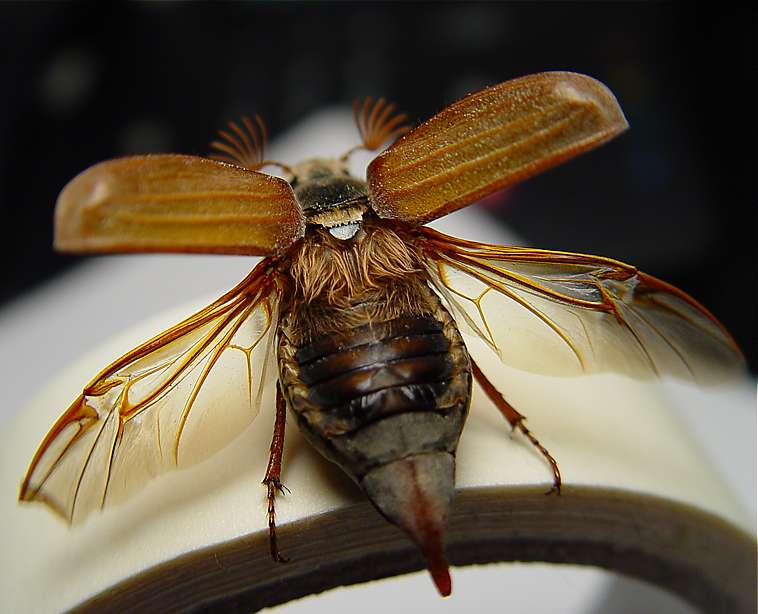
The species is native to Europe and has also been reported in Turkey and the Caucasus region. Adult males have seven flattened, leaf-shaped antenna extensions, while females have six.
Written 24 November 2026 from the sources listed below. Each statement was checked against the passage it cites; statements that could not be supported were removed.
Appearance
Adult cockchafers measure between 25 and 30 mm in length. Males have larger, fan-shaped antennae than females, with seven flattened, leaf-shaped extensions compared with six in females.[1][2][3]
The larva has a white body, a black abdominal extremity, and a curved C-shaped posture. It has a large brown head, strong mandibles, and well-developed hairy legs.[4][5]
First-stage larvae measure 10–20 mm, second-stage larvae 30–35 mm, and final-stage larvae 40–46 mm.[6]
Habitat
The species occurs particularly in temperate European regions with soil conditions suitable for larval development.[7]
Diet
Adult cockchafers feed on leaves of oak, sycamore, maple, hornbeam, beech, and plum trees. They also consume chestnut leaves occasionally and feed on deciduous trees and shrubs, including hazelnut.[8][9][10]
Larvae feed on plant roots, particularly those of grasses, cereals, and other crops. Their diet also includes potato and strawberry roots, and feeding on strawberry roots can damage strawberry crops.[11][12][13]
Behaviour
Male cockchafers generally swarm during the mating season, while females remain stationary and feed on leaves. Males use green leaf volatiles released by plants to locate females feeding on leaves.[14][15]
Male cockchafers emerge from the soil when temperatures become favourable in April or May. Adults typically disperse no more than 2–3 km from their emergence location.[16][17]
Larvae use plant volatiles and carbon dioxide to locate plant roots. They can move horizontally through soil by as much as 30 cm per day and undergo winter hibernation by burrowing deep into the soil.[18][19][20]
Reproduction and life cycle
Cockchafers develop through egg, larval, pupal, and adult stages. Mating lasts several hours.[21][22]
Females begin laying eggs approximately two to three weeks after adult emergence. They deposit eggs in fields approximately 15–25 cm below the soil surface, laying between 60 and 80 eggs per female in batches containing 10–38 eggs.[23][24][25][26]
Egg maturation takes approximately 5–8 days at 27 °C and 23–32 days at 15 °C. Eggs hatch approximately four to six weeks after being laid.[27][28]
The larva pupates underground during summer and develops into an adult over approximately six weeks.[29]
Conservation
Cockchafer populations in Europe declined between the 1940s and 1970s following the use of toxic pesticides and expansion of agricultural land. Populations began recovering in some European areas after highly toxic pesticides were banned.[30][31]
Uses
Cockchafers were consumed in parts of Europe during the nineteenth century. They were eaten raw, sugared, candied, and in soup.[32]
Similar species
Melolontha hippocastani is a closely related and morphologically similar species that shares physical and behavioural characteristics with the Common Cockchafer. Melolontha hippocastani has a brown pronotum, whereas the Common Cockchafer has a black pronotum.[33][34]
Classification of the Cockchafer
| Kingdom | Animalia |
|---|---|
| Phylum | Arthropoda |
| Subphylum | Hexapoda |
| Class | Insecta (Insect) |
| Order | Coleoptera (Beetle) |
| Suborder | Polyphaga |
| Series | Staphyliniformia |
| Superfamily | Scarabaeoidea |
| Family | Scarabaeidae (Dung Beetles) |
| Subfamily | Melolonthinae |
| Tribe | Melolonthini |
| Subtribe | Melolonthina |
| Genus | Melolontha (May Bugs) |
| Species | Melolontha melolontha (Linnaeus, 1758) |
Where the Cockchafer is found
Checklists and occurrence records place Melolontha melolontha in 41 countries across Asia and Europe. GBIF holds 51,302 georeferenced records of it.
Countries
- Albania 1
- Austria 2,365
- Belarus 95
- Belgium 789
- Bosnia and Herzegovina 9
- Bulgaria 8
- Croatia 87
- Czechia 96
- Denmark 853
- Estonia 117
- Finland 9
- France 3,674
- Germany 8,416
- Greece 9
- Guernsey 90
- Hungary 481
- Ireland 833
- Isle of Man 99
- Italy 488
- Jersey 28
- Latvia 96
- Liechtenstein 33
- Lithuania 322
- Luxembourg 454
- Moldova 3
- Montenegro 10
- North Macedonia 1
- Poland 532
- Portugal 3
- Romania 99
- Russia 753
- Serbia 191
- Slovakia 59
- Slovenia 65
- Spain 340
- Sweden 3,025
- Switzerland 5,627
- The Netherlands 3,741
- Turkey 5
- Ukraine 1,130
- United Kingdom 16,266
Regions and cities with the most records
- England, United Kingdom 12,499
- Wales, United Kingdom 3,003
- North Rhine-Westphalia, Germany 2,355
- Lower Saxony, Germany 1,213
- Gelderland, The Netherlands 1,101
- Salzburg, Austria 1,063
- Skåne, Sweden 1,037
- Ticino, Switzerland 1,027
- Lugano, Switzerland 1,008
- Baden-Wurttemberg, Germany 956
- Tonypandy, United Kingdom 823
- Salzburg, Austria 819
- Cardiff, United Kingdom 757
- Hesse, Germany 749
- Kalmar, Sweden 742
- Barry, United Kingdom 703
- Bern, Switzerland 692
- Rhondda, United Kingdom 690
- Valais, Switzerland 635
- Bavaria, Germany 625
- Farnborough, United Kingdom 622
- Bridgend, United Kingdom 556
- Woking, United Kingdom 555
- Occitanie, France 520
- Hamburg, Germany 516
- Île-de-France, France 512
- Esher, United Kingdom 497
- Norderstedt, Germany 495
- Rheinland-Pfalz, Germany 492
- Hamburg, Germany 482
- Bracknell, United Kingdom 479
- Staines, United Kingdom 478
- Ede, The Netherlands 470
- Bristol, United Kingdom 466
- Swansea, United Kingdom 462
- Overijssel, The Netherlands 458
Range as the checklists state it
Palaearctic(Albania, Austria, Belarus, Belgium, Bosnia Herzegovina, Bulgaria, Croatia, Czech Republic, Denmark, Estonia, France, Germany, Great Britain, Greece, Hungary, Ireland, Italy, Latvia, Lichtenstein, Lithuania, Luxembourg, Macedonia, Moldova, Montenegro, Netherlands, Poland, Romania, Russia, Slovakia, Slovenia, Spain, Sweden, Switzerland, Turkey, Ukraine)
A number beside a place is its count of GBIF occurrence records. A place without a number comes from a checklist alone. Records show where a species has been observed or collected, which can include escapes and vagrants.
Common names
English
- Cockchafer
- Common Cockchafer
- European Cockchafer
- Cockchafer Maybeetle
Names in 41 other languages
- Asturian
- abetarru
- Basque
- Kotxorro
- Belarusian
- Майскія жукі
- Breton
- C'hwil-derv
- Bulgarian
- Майски бръмбар, Обикновен майски бръмбар
- Croatian
- Obični hrušt
- Czech
- chroust obecný
- Danish
- Almindelig oldenborre, Oldenborre
- Dutch
- Gewone meikever, Meikever, Mulder
- Estonian
- Lõuna-maipõrnikas
- Finnish
- saksanturilas
- French
- Hanneton, Hanneton commun
- German
- Feldmaikäfer, Feldmaikäfers, Maykäfer
- Greek
- Μηλολόνθη η Μηλολόνθη
- Hungarian
- Májusi cserebogár
- Icelandic
- Aldinbori
- Italian
- Maggiolino, Maggiolino comune
- Latvian
- Lauka maijvabole
- Lithuanian
- Paprastasis grambuolys
- Macedonian
- мајски бумбар
- Norwegian Bokmål
- Vanlig oldenborre
- Persian
- سوسک طلایی
- Polish
- Chrabąszcz majowy
- Romanian
- Cărăbuș
- Russian
- Майские жуки, Хрущ майский западный
- Serbian
- Kокица, Гундељ
- Slovak
- chrúst obyčajný
- Slovenian
- majski hrošč
- Spanish
- Escarabajo Sanjuanero
- Swedish
- Ollonborre
- Thai
- แมงอีนูน
- Turkish
- Mayıs böceği
- Ukrainian
- Хрущ, Хрущ травневий західний
- arg
- Escarabacho de femera
- frr
- Driikraab
- fry
- Maaituorre
- hsb
- Mejski bruk
- ido
- Melolonto
- vep
- Böbörii
- wln
- Baloujhe
- zea
- Schallebieter
Synonyms
29 other scientific names have been used for this species and are now treated as synonyms of Melolontha melolontha.
- Melolontha melolontha amblypyga Lomnicky, 1923
- Melolontha melolontha colpopyga Petz, 1905
- Melolontha nigritarsis Pfanneberg, 1905
- Melolontha redtenbacheri Dalla Torre, 1912
- Melolontha vulgaris bioculatus Papp, 1943
- Melolontha vulgaris bipunctatus Papp, 1943
- Melolontha vulgaris discicollis Mulsant, 1842
- Melolontha vulgaris femoralis Kraatz, 1885
- Melolontha vulgaris funesta Westhoff, 1884
- Melolontha vulgaris humeralis Westhoff, 1884
- Melolontha vulgaris luctuosa Westhoff, 1884
- Melolontha vulgaris lugubris Mulsant, 1842
- Melolontha vulgaris marginata Kraatz, 1888
- Melolontha vulgaris melanopus Westhoff, 1884
- Melolontha vulgaris nigra Kellner, 1876
- Melolontha vulgaris nigroapicalis Papp, 1943
- Melolontha vulgaris nigromarginalis Papp, 1943
- Melolontha vulgaris nigropygidialis Papp, 1943
- Melolontha vulgaris obscuripes Westhoff, 1884
- Melolontha vulgaris pulcherrima Dalla Torre, 1879
- Melolontha vulgaris ruficeps Kraatz, 1885
- Melolontha vulgaris ruficollis Mulsant, 1842
- Melolontha vulgaris scapularis Westhoff, 1884
- Melolontha vulgaris unicolor Papp, 1943
- Melolontha vulgaris unipunctatus Papp, 1943
- Scarabaeus melolontha Linnaeus, 1758
- Melolontha albida Mulsant, 1842 ambiguous synonym
- Melolontha vulgaris Fabricius, 1775 ambiguous synonym
- Scarabaeus majalis Moll, 1785 ambiguous synonym
Related species
-
 Forest CockchaferMelolontha hippocastani
-
 Large CockchaferMelolontha pectoralis
- Melolontha chinensis
- Melolontha malaccensis
- Melolontha setifera
- Melolontha incana
- Japanese CockchaferMelolontha japonica
- Melolontha papposa
Compare
Questions and answers
What is the scientific name of the Cockchafer?
The scientific name of the Cockchafer is Melolontha melolontha. Written with its author, the full name is Melolontha melolontha (Linnaeus, 1758).
Which family does the Cockchafer belong to?
Melolontha melolontha belongs to the family Scarabaeidae, in the order Coleoptera and the class Insecta.
Where is the Cockchafer found?
Checklists and occurrence records place Melolontha melolontha in 41 countries, including United Kingdom, Germany, Switzerland, The Netherlands, France and Sweden.
What other names does the Cockchafer have?
Melolontha melolontha is also known in English as Common Cockchafer, European Cockchafer and Cockchafer Maybeetle.
Why are they called cockchafer?
The name cockchafer combines the word cock, referring to size or vigour, with chafer, referring to an insect of this type.[35]
What does a may beetle eat?
Adult cockchafers feed on leaves of oak, sycamore, maple, hornbeam, beech, and plum trees. They also consume chestnut leaves occasionally and feed on deciduous trees and shrubs, including hazelnut. Larvae feed on plant roots, particularly those of grasses, cereals, and other crops, as well as potato and strawberry roots.[8][9][10][11][12][13]
Is cockchafer extinct?
Cockchafer populations in Europe declined between the 1940s and 1970s following the use of toxic pesticides and expansion of agricultural land. Populations began recovering in some European areas after highly toxic pesticides were banned.[30][31]
Sources
Passages the profile rests on
- Male adults have seven flattened, leaf-shaped antenna extensions, whereas females have six. Source passage: “Male cockchafers have seven flattened leaflike extensions on their antennae, whereas females have only six.” — English Wikipedia
- The male has larger, fan-shaped antennae than the female. Source passage: “The insect's antennae are large and fan-like with the male's larger than those of the female's.” — English Wikipedia
- Adult cockchafers measure between 25 and 30 mm in length. Source passage: “The adult cockchafer reaches 25 to 30 mm (1.0 to 1.2 in) in length.” — English Wikipedia
- The larva has a white body, a black abdominal extremity, and a curved C-shaped posture. Source passage: “It has a white body, black at the abdominal extremity, which curves into a C-shaped arc” — English Wikipedia
- The larva has a large brown head, strong mandibles, and well-developed hairy legs. Source passage: “long, hairy, well-developed legs. The larva also has a large brown head with strong, grabbing mandibles” — English Wikipedia
- First-stage larvae measure 10–20 mm, second-stage larvae 30–35 mm, and final-stage larvae 40–46 mm. Source passage: “In the first stage (L1), the larva is 10–20 mm (0.4–0.8 in) long, growing to 30–35 mm (1.2–1.4 in) in the second year of development (L2), and reaching 40–46 mm (1.6–1.8 in) in its final year of development (L3)” — English Wikipedia
- The species occurs particularly in temperate European regions with soil conditions suitable for larval development. Source passage: “The cockchafer is widespread across Europe, particularly in temperate regions with suitable soil conditions for larval development.” — English Wikipedia
- Adult cockchafers feed on leaves of oak, sycamore, maple, hornbeam, beech, and plum trees. Source passage: “Adults feed primarily on the leaves of oak, sycamore, maple, hornbeam, beech and plum trees” — English Wikipedia
- Adults also feed on chestnut leaves occasionally. Source passage: “and occasionally on other trees, including the chestnut.” — English Wikipedia
- Adult cockchafers consume leaves from deciduous trees and shrubs, including hazelnut. Source passage: “Adult cockchafers feed on a variety of deciduous trees and shrubs, including oak, maple, beech and hazelnut.” — English Wikipedia
- Larvae feed on plant roots, including potato roots. Source passage: “The larva, known as a "chafer grub" or "white grub", hatches four to six weeks after the egg is laid, and feeds on the roots of plants, including the potato.” — English Wikipedia
- Larvae particularly consume roots of grasses, cereals, and other crops. Source passage: “Over three larval stages, the larva feeds on roots, particularly grasses, cereals, and other crops” — English Wikipedia
- Cockchafer larvae feed on strawberry roots and can damage strawberry crops. Source passage: “Strawberry crops are particularly susceptible to damage from cockchafer larvae, which feed on their roots.” — English Wikipedia
- Male cockchafers generally swarm during mating season, while females remain stationary and feed on leaves. Source passage: “The males usually swarm during the mating season while the females stay put and feed on leaves.” — English Wikipedia
- Male cockchafers use plant-released green leaf volatiles to locate females feeding on leaves. Source passage: “When cockchafers feed, they cause leaves to release green leaf volatiles, which the males can detect and thus locate females for mating.” — English Wikipedia
- Male cockchafers emerge from the soil when temperatures become favourable in April or May. Source passage: “The male cockchafer leaves the soil when the temperature becomes favourable, in April or May.” — English Wikipedia
- Adult cockchafers typically disperse no more than 2–3 km from their emergence location. Source passage: “It typically disperses no more than 2 to 3 km (1.2 to 1.9 mi) from where it emerges” — English Wikipedia
- Larvae use plant volatiles and carbon dioxide to locate plant roots. Source passage: “The larvae use both the plant volatiles and CO2 to locate the plant root for food.” — English Wikipedia
- Cockchafer larvae can move horizontally through soil by as much as 30 cm per day. Source passage: “The larva can move horizontally through the soil by up to 30 cm (12 in) per day.” — English Wikipedia
- Cockchafer larvae undergo winter hibernation by burrowing deep into the soil. Source passage: “only pausing to burrow deep into the soil for winter hibernation.” — English Wikipedia
- Mating between cockchafers lasts several hours. Source passage: “Mating lasts for several hours.” — English Wikipedia
- Cockchafers develop through egg, larval, pupal, and adult stages. Source passage: “the beetle undergoes stages of eggs, larvae, pupae and adults” — English Wikipedia
- Females begin laying eggs approximately two to three weeks after adult emergence. Source passage: “After two to three weeks, the female begins laying eggs” — English Wikipedia
- Females deposit their eggs in fields approximately 15–25 cm below the soil surface. Source passage: “typically depositing them in fields at a depth of around 15–25 cm (6–10 in).” — English Wikipedia
- Each female can lay between 60 and 80 eggs. Source passage: “Each female may repeat this process until it has laid between 60 and 80 eggs.” — English Wikipedia
- Female cockchafers lay eggs in batches containing 10–38 eggs. Source passage: “to lay its eggs 15 to 25 cm (6 to 10 in) in the soil in a batch of 10 to 38 eggs” — English Wikipedia
- Egg maturation takes approximately 5–8 days at 27 °C and 23–32 days at 15 °C. Source passage: “5 to 8 days at 27 °C (81 °F) and 23 to 32 days at 15 °C (59 °F).” — English Wikipedia
- Eggs hatch approximately four to six weeks after being laid. Source passage: “The larva, known as a "chafer grub" or "white grub", hatches four to six weeks after the egg is laid” — English Wikipedia
- The larva pupates underground during summer and develops into an adult over approximately six weeks. Source passage: “It then pupates in the summer, developing into an adult cockchafer over the following six weeks.” — English Wikipedia
- Cockchafer populations in Europe declined between the 1940s and 1970s following the use of toxic pesticides and expansion of agricultural land. Source passage: “These, together with an increase of farming land, led to a decrease in cockchafer populations, especially in Europe, from the 1940s to the 1970s.” — English Wikipedia
- Cockchafer populations began recovering in some European areas after highly toxic pesticides were banned. Source passage: “Numbers began to recover in some areas of Europe after the ban of these highly toxic pesticides.” — English Wikipedia
- Cockchafers were consumed in parts of Europe during the nineteenth century, including raw, sugared, candied, and in soup. Source passage: “In the 19th century, cockchafers were reportedly consumed in different parts of Europe. They were consumed raw, sugared, candied, or in soup” — English Wikipedia
- Melolontha hippocastani is a closely related and morphologically similar species that shares physical and behavioural characteristics with M. melolontha. Source passage: “alongside Melolontha hippocastani (the forest cockchafer), with which it shares several physical and behavioural characteristics” — English Wikipedia
- Melolontha hippocastani has a brown pronotum, whereas M. melolontha has a black pronotum. Source passage: “This black coloration distinguishes it from its close relative M. hippocastani, whose pronotum is brown.” — English Wikipedia
- The name cockchafer combines the word cock, referring to size or vigour, with chafer, referring to an insect of this type. Source passage: “The name cockchafer derives from the late-17th-century usage of cock (in the sense of expressing size or vigour) + chafer which simply means an insect of this type” — English Wikipedia
- The scientific name Melolontha derives from the Ancient Greek word mēlolónthē, meaning cockchafer. Source passage: “The term melolontha is derived from the Ancient Greek word mēlolónthē which means cockchafer.” — English Wikipedia
Data
- Catalogue of Life, 2026-10-16 XR cc by
- Global Biodiversity Information Facility CC BY 4.0
- Wikidata CC0
- GeoNames CC BY 4.0
- Wikimedia Commons per image; credit shown with each image
- Within the Catalogue of Life, this name comes from World Scarabaeidae Database cc by
References
- Linnaeus, C. (1758). Systema naturae per regna tria naturae, secundum classes, ordines, genera, species cum characteribus, differentiis, synonymis, locis. Tomus I. Editio X. Laurentii Salvi, Holmiae :1-824. https://doi.org/10.5962/bhl.title.542 Link where the name was published
This species in other databases
Page built on 24 November 2026. See how the catalog is made and all sources and licences.
Cite this page
ScientificNames.org. (2026). Melolontha melolontha (Cockchafer). Retrieved November 24, 2026, from https://scientificnames.org/species/melolontha-melolontha
“Melolontha melolontha (Cockchafer).” ScientificNames.org, 2026, scientificnames.org/species/melolontha-melolontha. Accessed 24 Nov. 2026.
ScientificNames.org. “Melolontha melolontha (Cockchafer).” Accessed November 24, 2026. https://scientificnames.org/species/melolontha-melolontha.
@misc{scientificnames_melolontha_melolontha_cockchafer,
  author = {{ScientificNames.org}},
  title = {Melolontha melolontha (Cockchafer)},
  year = {2026},
  url = {https://scientificnames.org/species/melolontha-melolontha},
  note = {Accessed 2026-11-24}
}