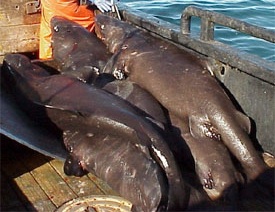
| Appearance | | - The species has a wide midsection that remains broad toward the front of its body, a narrow snout with a rounded tip, and a narrow caudal region. animaldiversity.org
- Its caudal fin is heterocercal, with a longer dorsal section than ventral section. animaldiversity.org
- Its skin is rough because of placoid scales, also called denticles, which are replaced rather than growing as the shark ages. animaldiversity.org
- Juveniles range in color from light gray to dark gray and are generally lighter than adults. animaldiversity.org
- The species has circular eyes that are frequently associated with ectoparasites. animaldiversity.org
|
|---|
| Size | - Adult Greenland sharks commonly grow to approximately 4 to 5 metres in length. English Wikipedia
- The largest confirmed Greenland shark measured 6.4 metres and weighed approximately 1,023 kilograms. English Wikipedia
- Female Greenland sharks are generally larger than males. floridamuseum.ufl.edu
| |
|---|
| Habitat | - The Greenland shark inhabits cold waters with temperatures between approximately -1.1 and 7.4 degrees Celsius. English Wikipedia
- The species commonly inhabits waters between 100 and 1,200 metres deep. English Wikipedia
- Greenland sharks mainly inhabit continental and insular shelves. animaldiversity.org
- During winter, Greenland sharks occupy intertidal regions, river mouths, and shallow bays. animaldiversity.org
- The species has been observed at depths reaching 2,200 metres. animaldiversity.org
- Greenland sharks have been recorded at 1,749 metres in the Gulf of Mexico. English Wikipedia
| - The species inhabits pelagic, benthic, and reef environments. animaldiversity.org
- Pacific sleeper sharks occupy continental shelves and slopes and adjust their depth according to oceanic temperature changes. animaldiversity.org
- At low latitudes, the species has been recorded at depths of up to 2,205 m. animaldiversity.org
- In colder, higher-latitude waters, Pacific sleeper sharks occupy littoral regions and spend more time near the surface. animaldiversity.org
|
|---|
| Diet | - Greenland sharks consume fish including herring, salmon, cod, haddock, halibut, redfish, sculpins, lumpfish, and skates. English Wikipedia
- Seals are an important food source for Greenland sharks. English Wikipedia
- Small Greenland sharks predominantly consume squid. English Wikipedia
- Greenland sharks have been found with minke whale remains in their stomachs. English Wikipedia
- Greenland sharks scavenge carrion and are attracted to the smell of rotting meat. English Wikipedia
- Greenland sharks have been found with moose, horse, and reindeer remains in their stomachs. English Wikipedia
| - The species primarily preys on teleost fishes and cephalopods. English Wikipedia
- Common prey in Northwest Pacific populations include chum salmon, walleye pollock, popeye grenadier, giant grenadier, red squid, and Kamchatka flounder. English Wikipedia
- Pacific sleeper sharks in the Gulf of Alaska have been found to consume walleye pollock, giant Pacific octopus, arrowtooth flounder, and Pacific salmon. English Wikipedia
|
|---|
| Behaviour | - Greenland sharks are slow-moving swimmers with exceptionally low swim speeds for their body size. English Wikipedia
- The species swims at an average speed of approximately 0.34 metres per second. English Wikipedia
- Greenland sharks may ambush seals while the seals are asleep. English Wikipedia
- Greenland sharks often hover near the seabed while searching for food. animaldiversity.org
- Greenland sharks are generally solitary except during mating or when congregating around carrion. animaldiversity.org
| - Pacific sleeper sharks are generally solitary outside mating interactions. animaldiversity.org
- The species performs daily vertical movements, remaining in deeper water during the day and moving closer to the surface at night. animaldiversity.org
- Pacific sleeper sharks are nocturnal opportunistic predators. animaldiversity.org
- Their reported movement speed is approximately 0.25 m/s, although they can apparently move faster when necessary. animaldiversity.org
- The species can feed collectively in queues rather than always feeding alone. pmc.ncbi.nlm.nih.gov
- Pacific sleeper sharks have been observed tearing at dead animals on the seabed while feeding. pmc.ncbi.nlm.nih.gov
|
|---|
| Reproduction | - Greenland sharks reproduce through ovoviviparity and give birth to live young. English Wikipedia
- The estimated gestation period of Greenland sharks is between 8 and 18 years. English Wikipedia
- Greenland sharks may produce up to ten pups in a litter. English Wikipedia
- Newborn Greenland shark pups are estimated to measure approximately 38 to 42 centimetres. English Wikipedia
- Female Greenland sharks have been observed with mating scars on their caudal fins. animaldiversity.org
- Fertilization in Greenland sharks occurs internally. animaldiversity.org
| - Pacific sleeper sharks are ovoviviparous, with embryos developing inside eggs that hatch within the female before live birth. animaldiversity.org
- Females typically carry approximately 300 eggs, but only around 10% develop into embryos. animaldiversity.org
- Unfertilized eggs have been reported to measure between 45 and 58 mm. animaldiversity.org
- Newborn Pacific sleeper sharks are estimated to measure 42 cm or less. animaldiversity.org
- Male Pacific sleeper sharks possess paired external reproductive organs called claspers. animaldiversity.org
- Females probably provide no parental care after giving birth. animaldiversity.org
|
|---|
| Lifespan | | No checked fact yet |
|---|
| Distribution | | - The species occurs in the Northern Pacific, including Arctic and temperate waters between 70°N and 22°N. English Wikipedia
- Its distribution includes coastal waters near the Hawaiian Islands, western North America, and northeastern Asia. animaldiversity.org
- The species has been documented in the western tropical Pacific near Palau and the Solomon Islands. English Wikipedia
|
|---|
| Conservation | - The Greenland shark is classified as Near Threatened by the World Conservation Union in document 2. floridamuseum.ufl.edu
- The estimated population doubling time of Greenland sharks exceeds 14 years. floridamuseum.ufl.edu
- The long gestation period and slow reproductive rate of Greenland sharks may limit their recovery from overfishing. English Wikipedia
| - The International Union for Conservation of Nature classifies the Pacific sleeper shark as Near Threatened. English Wikipedia
- The species is vulnerable to fishing pressure because it is frequently captured unintentionally as bycatch. English Wikipedia
- Its minimum estimated population doubling time is between 4.5 and 14 years. fishbase.se
|
|---|
| Uses | - Greenland sharks are commercially captured in Norwegian, Icelandic, and Greenland waters for their liver oil. floridamuseum.ufl.edu
- Dried Greenland shark meat is used for sled dog food and occasionally for human consumption in northern regions. floridamuseum.ufl.edu
- Inuit communities have used Greenland shark skin to make boots. floridamuseum.ufl.edu
- The lower dental bands of Greenland sharks have been used as knives for cutting hair. floridamuseum.ufl.edu
| - The liver, fins, and jaws are commercially valuable parts when Pacific sleeper sharks are deliberately targeted. English Wikipedia
|
|---|
| Similar species | - The Greenland shark is closely related to the Pacific sleeper shark and southern sleeper shark. English Wikipedia
| No checked fact yet |
|---|