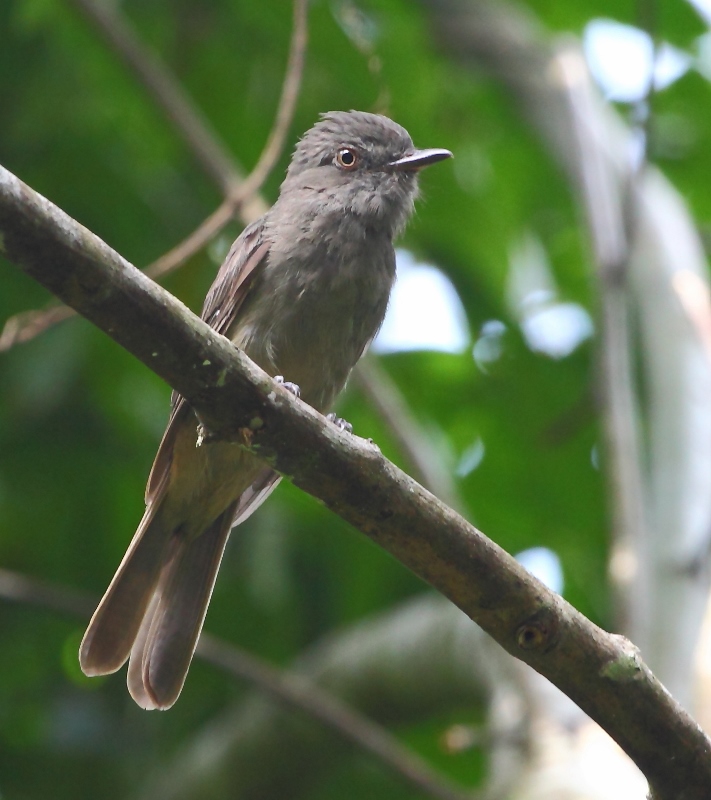
| Appearance | - Males of the nominate subspecies have a gray head with a slight crest at the rear of the crown. English Wikipedia
- The upperparts, wings, and tail are gray, with a brown tinge on the wings and tail. English Wikipedia
- The throat is light gray, while the underparts are slightly darker gray and the belly has a slight yellowish-green tinge. English Wikipedia
- Females resemble males but have fulvous edges on their wing and tail feathers. English Wikipedia
- The subspecies Rhytipterna simplex frederici is darker overall than the nominate subspecies. English Wikipedia
- Both subspecies have dark red to reddish-brown irises, slightly hooked black bills that are often pink at the base, and black legs and feet. English Wikipedia
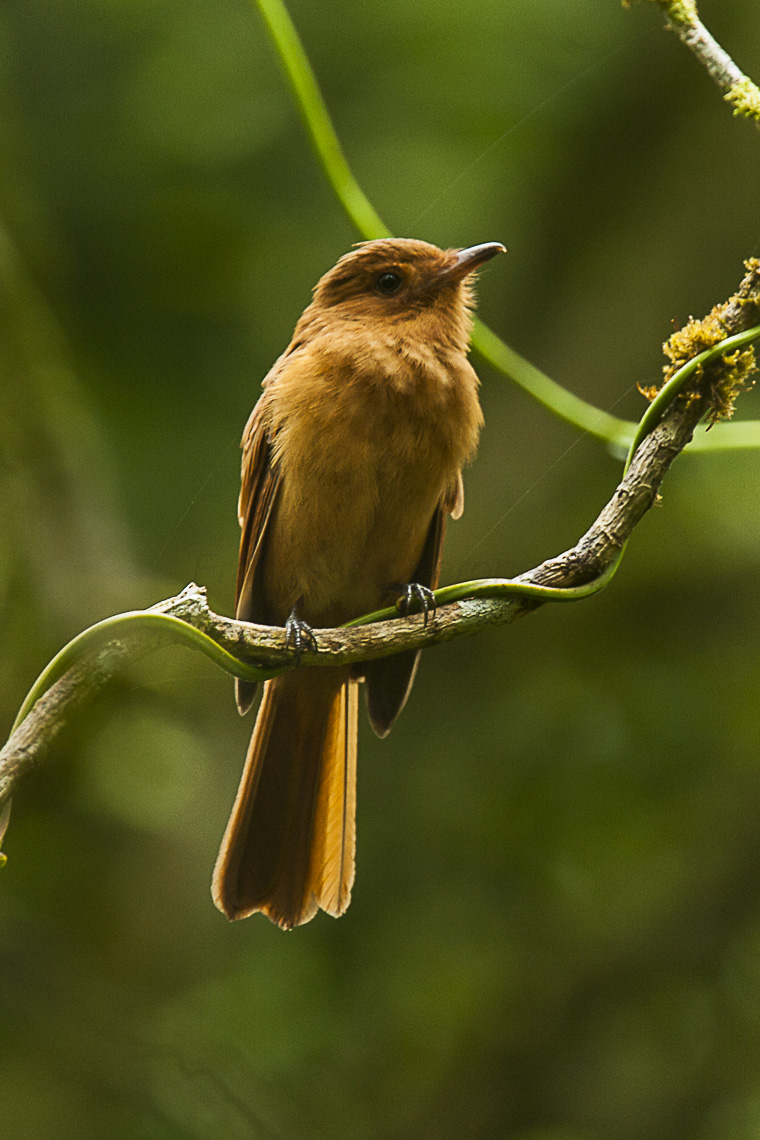
| - Male and female Rufous Mourners have the same plumage. English Wikipedia
- Adult males of the nominate subspecies have cinnamon-brown to russet heads and upperparts with darker rufous crowns. English Wikipedia
- The wings are darker brown than the back and have cinnamon-rufous edges on the flight feathers. English Wikipedia
- The tail is predominantly cinnamon-rufous with darker central feathers. English Wikipedia
- The underparts are bright cinnamon to tawny ochraceous, with lighter coloration on the throat and belly and darker coloration on the breast. English Wikipedia
- Juveniles have more intensely rufous upperparts and paler cinnamon-buff underparts than adults. English Wikipedia
- The subspecies Rhytipterna holerythra rosenbergi has more deeply colored upperparts and underparts than the nominate subspecies. English Wikipedia
- Both subspecies have light-brown to reddish-brown irises. English Wikipedia
- The species has a slightly hooked black bill with a dusky-brown base to the upper mandible and a variably pale base to the lower mandible. English Wikipedia
- The legs and feet range from gray to black. English Wikipedia
- The Rufous Mourner is described as an overall rusty-colored, medium-sized flycatcher. ebird.org
|
|---|
| Size | | |
|---|
| Habitat | - The species primarily inhabits the middle and upper forest layers of humid terra firme forest. English Wikipedia
- The species occasionally occupies transition zones between humid terra firme forest and other forest types. English Wikipedia
- In Brazil, the species is mostly found from sea level to 800 m elevation, sometimes occurring higher. English Wikipedia
- In Colombia and Ecuador, the species occurs up to 700 m elevation. English Wikipedia
- In Peru, the species occurs up to 1,400 m elevation. English Wikipedia
- In Venezuela, the species occurs up to 1,300 m elevation. English Wikipedia
- The species is also associated with subtropical or tropical moist lowland forests. inaturalist.org
| - The Rufous Mourner inhabits humid evergreen forests and mature secondary forests in tropical and lower subtropical lowlands. English Wikipedia
- The species occupies elevations from sea level to 1,200 m in northern Central America and Costa Rica. English Wikipedia
- In Colombia, the Rufous Mourner occurs at elevations up to 1,400 m. English Wikipedia
- In Ecuador, the species occurs at elevations up to 700 m. English Wikipedia
- The Rufous Mourner favors middle to upper levels within humid tropical lowland forests. ebird.org
|
|---|
| Diet | | - The species primarily consumes large insects and spiders, supplementing its diet with some fruit. English Wikipedia
- Recorded insect prey includes members of the families Tettigoniidae, Cicadidae, Membracidae, Formicidae, and Phasmatidae. English Wikipedia
- The Rufous Mourner also eats beetles and lepidopterans. English Wikipedia
- Recorded fruit foods include species from the genera Alchornea, Casearia, Bursera, Cymbopetalum, and Guarea. English Wikipedia
|
|---|
| Behaviour | - The species typically forages alone or in pairs. English Wikipedia
- The Greyish Mourner regularly joins mixed-species feeding flocks. English Wikipedia
- While foraging, the bird perches upright on exposed branches and sallies out to glean prey and fruit from vegetation, briefly hovering. English Wikipedia
- The Greyish Mourner is a year-round resident. English Wikipedia
- Its song is variable in tempo and normally consists of rising sharp notes ending in loud, explosive notes. English Wikipedia
- The species also produces slowly ascending series of clear, whistled notes. English Wikipedia
| - The Rufous Mourner is a year-round resident. English Wikipedia
- The Rufous Mourner forages alone or in pairs and frequently joins mixed-species feeding flocks. English Wikipedia
- While foraging, the species perches on branches, sometimes nearly horizontally, usually in the forest mid-story. English Wikipedia
- The Rufous Mourner captures prey by sallying from a perch to glean it from the underside of vegetation while briefly hovering. English Wikipedia
- The Rufous Mourner is not highly vocal. English Wikipedia
|
|---|
| Reproduction | | - The breeding season includes March through May in Belize. English Wikipedia
- The breeding season includes March through June in Costa Rica. English Wikipedia
- The breeding season includes February through May in Colombia. English Wikipedia
- The Rufous Mourner apparently nests mainly in tree cavities, including abandoned woodpecker holes. English Wikipedia
- Nesting in holes in earthen banks has also been proposed, although this report is disputed. English Wikipedia
|
|---|
| Distribution | - The species occurs in every mainland South American country except Argentina, Chile, Paraguay, and Uruguay. English Wikipedia
- The nominate subspecies occurs in eastern Brazil, from Alagoas south to eastern Minas Gerais and southwestern São Paulo. English Wikipedia
- The subspecies Rhytipterna simplex frederici occurs from southeastern Colombia through eastern Ecuador and eastern Peru to northwestern Bolivia. English Wikipedia
- Rhytipterna simplex frederici also occurs eastward through southern and eastern Venezuela, the Guianas, and Amazonian Brazil. English Wikipedia
| - The Rufous Mourner occurs in Mexico, every Central American country except El Salvador, Colombia, and Ecuador. English Wikipedia
|
|---|
| Conservation | - The IUCN classifies the Greyish Mourner as Least Concern. English Wikipedia
- The species has a very large geographic range. English Wikipedia
- The population size is unknown and is believed to be decreasing. English Wikipedia
- No immediate threats to the species have been identified. English Wikipedia
- The Greyish Mourner is considered common in Brazil and fairly common in Colombia, Peru, and Venezuela. English Wikipedia
- The species occurs in numerous public and private protected areas. English Wikipedia
- Much of the species' habitat in eastern Brazil has been destroyed, and the status of the nominate subspecies requires investigation. English Wikipedia
| - The IUCN has assessed the Rufous Mourner as Least Concern. English Wikipedia
- The species has an estimated population of at least 50,000 mature individuals. English Wikipedia
- The Rufous Mourner's population is believed to be decreasing. English Wikipedia
- No immediate threats to the Rufous Mourner have been identified. English Wikipedia
- The species is described as uncommon to fairly common in northern Central America. English Wikipedia
- The Rufous Mourner is described as fairly common in Costa Rica. English Wikipedia
- The species is described as uncommon and inconspicuous in Colombia. English Wikipedia
- The Rufous Mourner depends on threatened tropical lowland evergreen forest habitats. English Wikipedia
- Logging of mature forests and conversion of forest land to agriculture are identified as primary threats to the species. English Wikipedia
|
|---|
| Similar species | - The Greyish Mourner shares the genus Rhytipterna with the Pale-bellied Mourner and Rufous Mourner. English Wikipedia
- The Greyish Mourner and Rufous Mourner apparently form a superspecies. English Wikipedia
| - The Rufous Mourner shares its genus with the Pale-bellied Mourner (Rhytipterna immunda) and Grayish Mourner (Rhytipterna simplex). English Wikipedia
- The Rufous Mourner and Grayish Mourner apparently form a superspecies. English Wikipedia
|
|---|
| Other | No checked fact yet | - The IUCN Red List assessment for the Rufous Mourner was dated 18 August 2022. iucnredlist.org
|
|---|