| Appearance | - Adult butterflies have golden-brown bodies and a short tail. English Wikipedia
- The caterpillars have blue-green bodies and silver hairs. English Wikipedia
- The pupae are bluish-green with brown dots. English Wikipedia
- The larvae have a slug-like appearance and are highly camouflaged in their host plants. wdfw.wa.gov
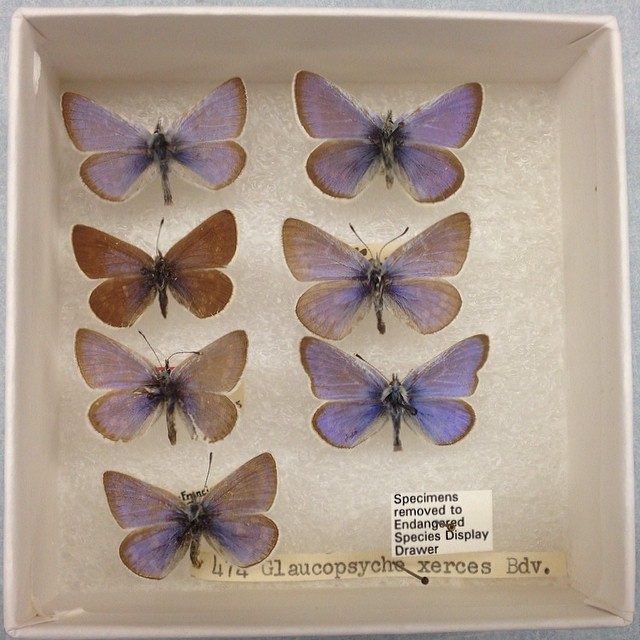
| - Males have iridescent blue coloration on the upper surfaces of their wings and pale spots on the undersides. floridamuseum.ufl.edu
- The species exhibited extensive variation in wing patterns, with several named forms. floridamuseum.ufl.edu
- The species was characterized by blue wings with white spots. English Wikipedia
|
|---|
| Size | | |
|---|
| Habitat | - The species inhabits oak woodlands, canyons, and mountain ridges. English Wikipedia
- In Washington, the species occupies small patches of golden chinquapin in low- to middle-elevation areas of southern Skamania County. wdfw.wa.gov
- The species spends its adult, egg, larval, and pupal stages in the open forest canopy of golden chinquapins. wdfw.wa.gov
- Small forest openings adjacent to chinquapin habitat provide additional nectar sources and puddling sites. wdfw.wa.gov
| - The species inhabited coastal sand dunes on the San Francisco Peninsula in California. English Wikipedia
- The species preferred stabilized sandy sites where its low-growing larval host plant grew. floridamuseum.ufl.edu
- The species occupied coastal sand dunes in the upper San Francisco Peninsula, including areas now within the Golden Gate National Recreation Area. floridamuseum.ufl.edu
|
|---|
| Diet | - The larvae feed on young leaves of Chrysolepis chrysophylla, Quercus chrysolepis, Quercus vaccinifolia, and Lithocarpus densiflorus. English Wikipedia
- Adults obtain moisture from various sources and may also consume aphid honeydew or other exudates. English Wikipedia
- Adults descend from the trees to feed on nectar. English Wikipedia
- Adult butterflies primarily obtain nectar from late-summer flowers in tree canopies and along herbaceous forest edges. wdfw.wa.gov
- Both male and female adults use their long proboscises to consume floral nectar. wdfw.wa.gov
- Males obtain salts from evaporated puddles, moist soil, and animal urine and feces. wdfw.wa.gov
| - The caterpillars used Lotus scoparius (Deerweed) as their preferred larval host plant. pmc.ncbi.nlm.nih.gov
- The butterflies fed on plants belonging to the genera Lotus and Lupinus. English Wikipedia
- Lupinus was another recorded vegetative food source, but it was unsuitable for the larval stages. English Wikipedia
|
|---|
| Behaviour | - Adults are primarily active during the early morning and evening and rest in shaded areas during the rest of the day. English Wikipedia
- The species spends most of its adult time in trees. English Wikipedia
- The species is sedentary and generally moves only a few hundred yards from its natal location. wdfw.wa.gov
- Male butterflies emerge before females, and late-season individuals are primarily or exclusively female. wdfw.wa.gov
- Males seek mates by patrolling in patterned flight or perching on vegetation and inspecting passing butterflies. wdfw.wa.gov
- Females search for egg-laying sites by hovering over host plants, landing, and inspecting vegetation before laying eggs. wdfw.wa.gov
- Ant interactions have been observed with golden hairstreak larvae, although their ecological significance remains insufficiently studied. wdfw.wa.gov
| - The species had a major flight period documented in historical biological studies. pmc.ncbi.nlm.nih.gov
|
|---|
| Reproduction | | |
|---|
| Distribution | - The species occurs in southern Arizona, Oregon, California, Washington, Idaho, and Mexico. English Wikipedia
- The species has a disjunct range encompassing the northern Oregon Cascades, a small area of the Oregon Coast Range, and the southern Washington Cascades. wdfw.wa.gov
- Documented occurrences in Washington are in Skamania County. wdfw.wa.gov
- The subspecies Habrodais grunus grunus occurs in the Sierra Nevada and Southern California. English Wikipedia
- The subspecies Habrodais grunus herri occurs in Central California, Oregon, and Idaho. English Wikipedia
- The subspecies Habrodais grunus lorquini occurs in Northern California. English Wikipedia
| - The species was endemic to the coastal sand dunes of the upper San Francisco Peninsula in California. floridamuseum.ufl.edu
|
|---|
| Conservation | - The Washington population is considered critical and has a declining population trend. wdfw.wa.gov
- The species is recognized as a Washington State Species of Greatest Conservation Need. wdfw.wa.gov
- The species is vulnerable to local extirpation if fires during June–September destroy host trees or substantially reduce available forage. wdfw.wa.gov
- Potential climate-related sensitivities include increasing temperatures, declining moisture, and fire. wdfw.wa.gov
- Agricultural and aquacultural side effects and active logging practices threaten the species' habitat and host plants. wdfw.wa.gov
| - The Xerces blue is extinct, with its extinction associated with habitat loss caused by urban development. English Wikipedia
- The last known living individuals were observed in the early 1940s. pmc.ncbi.nlm.nih.gov
- Urban development and disturbance of sandy soils caused the local loss of important host plants, contributing to the species' extinction. pmc.ncbi.nlm.nih.gov
- The loss of Lotus plants used by the larvae is considered a contributing factor in the species' extinction. English Wikipedia
- The introduction of the Argentine ant coincided with the species' decline and has been proposed as a possible contributing factor. pmc.ncbi.nlm.nih.gov
- The invasive Argentine ant was proposed as a possible threat because it may have outcompeted native ants that tend and protect the caterpillars. pmc.ncbi.nlm.nih.gov
- The species' extinction inspired the establishment of the Xerces Society for Invertebrate Conservation in 1971. floridamuseum.ufl.edu
- The species is recognized as an important symbol of insect conservation in North America. pmc.ncbi.nlm.nih.gov
|
|---|
| Similar species | No checked fact yet | - The closest relatives of the Xerces blue are Glaucopsyche australis and Glaucopsyche pseudoxerces. English Wikipedia
- The Xerces blue's closest relative group is most closely related to Glaucopsyche lygdamus, commonly called the silvery blue. English Wikipedia
- Historical researchers considered the Xerces blue and Glaucopsyche lygdamus closely related but separate species. pmc.ncbi.nlm.nih.gov
|
|---|
| Other | No checked fact yet | - Genetic analyses of museum specimens confirmed that the Xerces blue was a distinct species. pmc.ncbi.nlm.nih.gov
- DNA analysis was conducted using a museum specimen collected in 1928. pmc.ncbi.nlm.nih.gov
- The DNA analysis recovered 210,182,214 nucleotides from the museum specimen. pmc.ncbi.nlm.nih.gov
- Preserved specimens of the species are held by the California Academy of Sciences, Bohart Museum, and Harvard Museum of Natural History. English Wikipedia
- The Florida Museum of Natural History's McGuire Center holds specimens of the species. floridamuseum.ufl.edu
|
|---|