Species · Insects
Golden Hairstreak Habrodais grunus
The scientific name of the Golden Hairstreak is Habrodais grunus. It is a species of insect in the family Lycaenidae (blues), order Lepidoptera. The name dates from 1852.
- Scientific name
- Habrodais grunus (Boisduval, 1852)
- Common name
- Golden Hairstreak
- Genus
- Habrodais
- Family
- Lycaenidae (Blues)
- Order
- Lepidoptera
- Class
- Insecta
- Recorded in
- 2 countries
- Name status
- accepted in the Catalogue of Life

Overview
The species occurs in southern Arizona, Oregon, California, Washington, Idaho, and Mexico. Adult butterflies have golden-brown bodies, a short tail, and a wingspan of 25–32 mm.
Written 27 November 2026 from the sources listed below. Each statement was checked against the passage it cites; statements that could not be supported were removed.
Appearance
Adult butterflies have golden-brown bodies and a short tail. Their wingspan measures 25–32 mm.[1][2]
The caterpillars have blue-green bodies and silver hairs. The larvae have a slug-like appearance and are highly camouflaged in their host plants.[3][4]
The pupae are bluish-green with brown dots.[5]
Habitat
The species inhabits oak woodlands, canyons, and mountain ridges.[6]
In Washington, the species occupies small patches of golden chinquapin in low- to middle-elevation areas of southern Skamania County. Its adult, egg, larval, and pupal stages occur in the open forest canopy of golden chinquapins.[7][8]
Small forest openings adjacent to chinquapin habitat provide additional nectar sources and puddling sites.[9]
The species has a disjunct range encompassing the northern Oregon Cascades, a small area of the Oregon Coast Range, and the southern Washington Cascades. Documented occurrences in Washington are in Skamania County.[10][11]
The subspecies Habrodais grunus grunus occurs in the Sierra Nevada and Southern California. Habrodais grunus herri occurs in Central California, Oregon, and Idaho, while Habrodais grunus lorquini occurs in Northern California.[12][13][14]
Diet
The larvae feed on young leaves of Chrysolepis chrysophylla, Quercus chrysolepis, Quercus vaccinifolia, and Lithocarpus densiflorus.[15]
Adults descend from trees to feed on nectar. They primarily obtain nectar from late-summer flowers in tree canopies and along herbaceous forest edges.[16][17]
Both male and female adults use their long proboscises to consume floral nectar. Adults also obtain moisture from various sources and may consume aphid honeydew or other exudates.[18][19]
Males obtain salts from evaporated puddles, moist soil, and animal urine and feces.[20]
Behaviour
Adults are primarily active during the early morning and evening. They rest in shaded areas during the rest of the day and spend most of their adult time in trees.[21][22]
The species is sedentary and generally moves only a few hundred yards from its natal location.[23]
Male butterflies emerge before females. Late-season individuals are primarily or exclusively female.[24]
Males seek mates by patrolling in patterned flight or perching on vegetation and inspecting passing butterflies.[25]
Females search for egg-laying sites by hovering over host plants, landing, and inspecting vegetation before laying eggs.[26]
Ant interactions have been observed with Golden Hairstreak larvae, although their ecological significance remains insufficiently studied.[27]
Reproduction and life cycle
The species completes one generation per year and is univoltine, completing one life cycle annually.[28][29]
Females lay eggs singly on inspected host plant vegetation, depositing them on host plant twigs.[30][31]
The species overwinters in the egg stage. The caterpillars take approximately two weeks to mature into adults.[32][33]
Conservation
The Washington population is considered critical and has a declining population trend. The species is recognized as a Washington State Species of Greatest Conservation Need.[34][35]
The species is vulnerable to local extirpation if fires during June–September destroy host trees or substantially reduce available forage.[36]
Potential climate-related sensitivities include increasing temperatures, declining moisture, and fire.[37]
Agricultural and aquacultural side effects and active logging practices threaten the species' habitat and host plants.[38]
Classification of the Golden Hairstreak
| Kingdom | Animalia |
|---|---|
| Phylum | Arthropoda |
| Subphylum | Hexapoda |
| Class | Insecta (Insect) |
| Order | Lepidoptera |
| Superfamily | Papilionoidea |
| Family | Lycaenidae (Blues) |
| Subfamily | Lycaeninae |
| Genus | Habrodais |
| Species | Habrodais grunus (Boisduval, 1852) |
Where the Golden Hairstreak is found
Checklists and occurrence records place Habrodais grunus in 2 countries across North America. GBIF holds 2,128 georeferenced records of it.
Countries
Regions and cities with the most records
- California, United States 1,125
- Los Altos, United States 208
- Mountain View, United States 190
- Saratoga, United States 188
- Palo Alto, United States 177
- Menlo Park, United States 166
- Cupertino, United States 165
- Oregon, United States 162
- Sunnyvale, United States 160
- East Palo Alto, United States 134
- Campbell, United States 120
- Los Gatos, United States 120
- Santa Clara, United States 114
- Redwood City, United States 98
- Yucaipa, United States 60
- Washington, United States 58
- Redlands, United States 45
- Lafayette, United States 44
- Live Oak, United States 44
- Danville, United States 42
- Moraga, United States 42
- Walnut Creek, United States 42
- Pleasant Hill, United States 41
- San Ramon, United States 41
- Santa Cruz, United States 41
- Palm Springs, United States 39
- Highland, United States 36
- Antioch, United States 35
- Bay Point, United States 35
- Concord, United States 35
- Pittsburg, United States 35
- San Carlos, United States 34
- Belmont, United States 32
- Foster City, United States 31
- Altadena, United States 28
- San Mateo, United States 27
A number beside a place is its count of GBIF occurrence records. A place without a number comes from a checklist alone. Records show where a species has been observed or collected, which can include escapes and vagrants.
Common names
English
- Golden Hairstreak
Synonyms
One other scientific name has been used for this species and is now treated as a synonym of Habrodais grunus.
- Thecla grunus Boisduval, 1852
Subspecies and varieties
- Habrodais grunus grunus (Boisduval’s Hairstreak) subspecies
- Habrodais grunus lorquini (Lorquin’s Golden Hairstreak) subspecies
Related species
- Habrodais unicolor
-
 Common BluePolyommatus icarus
-
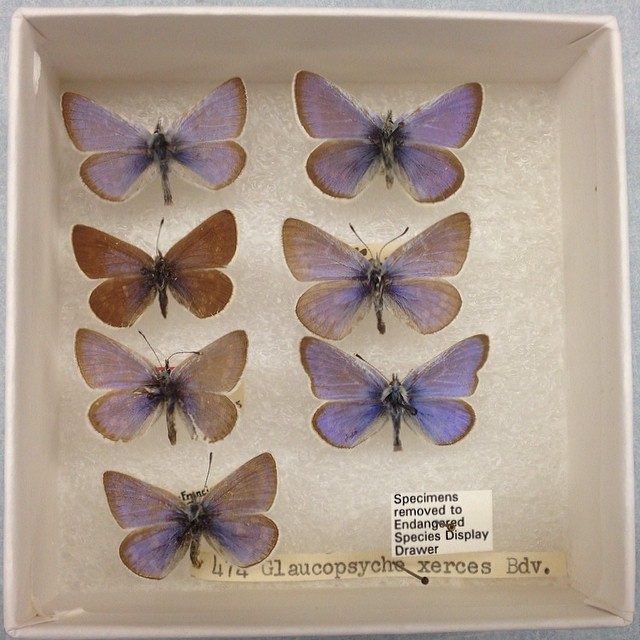 Xerces BlueGlaucopsyche xerces
-
 Adonis BlueLysandra bellargus
-
 Western Pygmy BlueBrephidium exilis
-
 AtalaEumaeus atala
-
 Holly BlueCelastrina argiolus
-
 Long-tailed BlueLampides boeticus
Compare
Questions and answers
What is the scientific name of the Golden Hairstreak?
The scientific name of the Golden Hairstreak is Habrodais grunus. Written with its author, the full name is Habrodais grunus (Boisduval, 1852).
Which family does the Golden Hairstreak belong to?
Habrodais grunus belongs to the family Lycaenidae, in the order Lepidoptera and the class Insecta.
Where is the Golden Hairstreak found?
Checklists and occurrence records place Habrodais grunus in 2 countries: United States and Mexico.
What butterfly is gold?
The Golden Hairstreak has golden-brown bodies as an adult butterfly.[1]
Sources
Passages the profile rests on
- Adult butterflies have golden-brown bodies and a short tail. Source passage: “Adults have a golden-brown coloration on their body, and have a short tail.” — English Wikipedia
- The adult butterfly has a wingspan of 25–32 mm. Source passage: “The wingspan is 25–32 mm.” — English Wikipedia
- The caterpillars have blue-green bodies and silver hairs. Source passage: “The caterpillars are blue-green in color on their body, and have silver hairs.” — English Wikipedia
- The larvae have a slug-like appearance and are highly camouflaged in their host plants. Source passage: “Larvae are slug-like in appearance and highly camouflaged in their host species.” — wdfw.wa.gov
- The pupae are bluish-green with brown dots. Source passage: “they are bluish-green with brown dots.” — English Wikipedia
- The species inhabits oak woodlands, canyons, and mountain ridges. Source passage: “The habitat consists of oak woodland, canyons and mountain ridges.” — English Wikipedia
- In Washington, the species occupies small patches of golden chinquapin in low- to middle-elevation areas of southern Skamania County. Source passage: “The golden hairstreak is confined to the few small patches of its hostplant, the golden chinquapin (Chrysolepis chrysophylla), a broadleaf evergreen tree that occurs in low to middle elevations in southern Skamania County” — wdfw.wa.gov
- The species spends its adult, egg, larval, and pupal stages in the open forest canopy of golden chinquapins. Source passage: “The golden hairstreak spends much of its adult life, and all of its egg, larval, and pupal life stages in the open forest canopy of chinquapins.” — wdfw.wa.gov
- Small forest openings adjacent to chinquapin habitat provide additional nectar sources and puddling sites. Source passage: “Small, adjacent forest openings in this landscape often provide additional floral nectar sources and puddling sites.” — wdfw.wa.gov
- The species has a disjunct range encompassing the northern Oregon Cascades, a small area of the Oregon Coast Range, and the southern Washington Cascades. Source passage: “The species' overall range is disjunct and limited by its golden chinquapin host in northern Oregon Cascades Range, a small area in the Oregon Coast Range and a small area in the southern Washington Cascades” — wdfw.wa.gov
- Documented occurrences in Washington are in Skamania County. Source passage: “occurrence in Washington has been documented in Skamania County.” — wdfw.wa.gov
- The subspecies Habrodais grunus grunus occurs in the Sierra Nevada and Southern California. Source passage: “Habrodais grunus grunus (California, specifically in Sierra Nevada and Southern California)” — English Wikipedia
- The subspecies Habrodais grunus herri occurs in Central California, Oregon, and Idaho. Source passage: “Habrodais grunus herri Field, 1938 (Central California, Oregon, Idaho)” — English Wikipedia
- The subspecies Habrodais grunus lorquini occurs in Northern California. Source passage: “Habrodais grunus lorquini Field, 1938 (Northern California)” — English Wikipedia
- The larvae feed on young leaves of Chrysolepis chrysophylla, Quercus chrysolepis, Quercus vaccinifolia, and Lithocarpus densiflorus. Source passage: “feed on the young leaves of Chrysolepis chrysophylla, Quercus chrysolepis, Quercus vaccinifolia and Lithocarpus densiflorus.” — English Wikipedia
- Adults descend from the trees to feed on nectar. Source passage: “They spend the majority of their time above in the trees, only descending for nectar.” — English Wikipedia
- Adult butterflies primarily obtain nectar from late-summer flowers in tree canopies and along herbaceous forest edges. Source passage: “The golden hairstreak’s primary nectar plants are late-summer flowers in tree canopy and herbaceous forest edge.” — wdfw.wa.gov
- Adults obtain moisture from various sources and may also consume aphid honeydew or other exudates. Source passage: “They feed on moisture from various sources and possibly also feed on aphid honeydew or other exudates.” — English Wikipedia
- Both male and female adults use their long proboscises to consume floral nectar. Source passage: “Both males and females feed by using their long proboscis to sip floral nectar.” — wdfw.wa.gov
- Males obtain salts from evaporated puddles, moist soil, and animal urine and feces. Source passage: “Males of most species require salts, which they obtain from evaporated puddles and moist soil and animal urine and feces.” — wdfw.wa.gov
- Adults are primarily active during the early morning and evening and rest in shaded areas during the rest of the day. Source passage: “Adults are primarily crepuscular, being most active in the early morning and evening, while resting in shaded areas for the remainder of the day.” — English Wikipedia
- The species spends most of its adult time in trees. Source passage: “They spend the majority of their time above in the trees” — English Wikipedia
- The species is sedentary and generally moves only a few hundred yards from its natal location. Source passage: “All lycaenids are sedentary butterflies and do not migrate; instead, the species inhabits sites year-round (as egg, larva, pupa and adult), typically moving within only a few hundred yards of their natal locations.” — wdfw.wa.gov
- Male butterflies emerge before females, and late-season individuals are primarily or exclusively female. Source passage: “Males begin emergence first, followed by females; late season individuals are primarily or solely females.” — wdfw.wa.gov
- Males seek mates by patrolling in patterned flight or perching on vegetation and inspecting passing butterflies. Source passage: “Male lycaenids seek mates using patrolling patterned flight or perching on vegetation in select spots and darting out to inspect passing butterflies.” — wdfw.wa.gov
- Females search for egg-laying sites by hovering over host plants, landing, and inspecting vegetation before laying eggs. Source passage: “Females search for egg-laying sites by slowly flying and hovering above hostplant vegetation, and then landing and crawling to inspect vegetation before depositing eggs singly.” — wdfw.wa.gov
- Ant interactions have been observed with golden hairstreak larvae, although their ecological significance remains insufficiently studied. Source passage: “Ant interactions have been observed with golden hairstreak; however, more study is needed to determine the extent of interaction and ecological significance of ant-larval relationships.” — wdfw.wa.gov
- The species completes one generation per year. Source passage: “Adults are on wing from June to September in one generation per year.” — English Wikipedia
- The species is univoltine, completing one life cycle annually. Source passage: “This lycaenid butterfly completes a single life cycle annually (univoltine).” — wdfw.wa.gov
- Females lay eggs on host plant twigs. Source passage: “The larvae, which hatch from eggs laid on host twigs” — English Wikipedia
- Females deposit eggs singly on inspected host plant vegetation. Source passage: “before depositing eggs singly.” — wdfw.wa.gov
- The species overwinters in the egg stage. Source passage: “golden hairstreak overwinter as eggs.” — wdfw.wa.gov
- The caterpillars take approximately two weeks to mature into adults. Source passage: “The caterpillars will mature to their adult stage in the span of approximately 2 weeks.” — English Wikipedia
- The Washington population is considered critical and has a declining population trend. Source passage: “The population of golden hairstreak in Washington is critical and is considered to have a declining trend.” — wdfw.wa.gov
- The species is recognized as a Washington State Species of Greatest Conservation Need. Source passage: “This lycaenid butterfly species is recognized as a state "Species of Greatest Conservation Need"” — wdfw.wa.gov
- The species is vulnerable to local extirpation if fires during June–September destroy host trees or substantially reduce available forage. Source passage: “making it vulnerable to extirpation if fire occurs in its current habitat distribution during key adult and larval periods (June-September), kills its current host trees, or significantly reduces available forage (nectar plants).” — wdfw.wa.gov
- Potential climate-related sensitivities include increasing temperatures, declining moisture, and fire. Source passage: “Climate sensitivity of this species is likely driven by temperature, moisture declines, and fire.” — wdfw.wa.gov
- Agricultural and aquacultural side effects and active logging practices threaten the species' habitat and host plants. Source passage: “Agriculture and aquaculture side effects Threat: Habitat and hostplant, a rare tree/shrub occurs in areas with active logging practices” — wdfw.wa.gov
Data
- Catalogue of Life, 2026-10-16 XR cc by
- Global Biodiversity Information Facility CC BY 4.0
- Wikidata CC0
- GeoNames CC BY 4.0
- Wikimedia Commons per image; credit shown with each image
- Within the Catalogue of Life, this name comes from Global Lepidoptera Index cc by
References
- Boisduval. (1852). Annales de la Société Entomologique de France. 10. http://www.biodiversitylibrary.org/item/34969#page/294/mode/2up Link where the name was published
This species in other databases
Page built on 27 November 2026. See how the catalog is made and all sources and licences.
Cite this page
ScientificNames.org. (2026). Habrodais grunus (Golden Hairstreak). Retrieved November 27, 2026, from https://scientificnames.org/species/habrodais-grunus
“Habrodais grunus (Golden Hairstreak).” ScientificNames.org, 2026, scientificnames.org/species/habrodais-grunus. Accessed 27 Nov. 2026.
ScientificNames.org. “Habrodais grunus (Golden Hairstreak).” Accessed November 27, 2026. https://scientificnames.org/species/habrodais-grunus.
@misc{scientificnames_habrodais_grunus_golden_hairstreak,
  author = {{ScientificNames.org}},
  title = {Habrodais grunus (Golden Hairstreak)},
  year = {2026},
  url = {https://scientificnames.org/species/habrodais-grunus},
  note = {Accessed 2026-11-27}
}