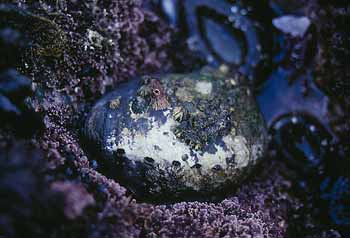
| Appearance | | - The shell is dark brown, dark green, dark blue, or nearly black, with a pearly interior displaying pink and green iridescence. English Wikipedia
- The shell is relatively smooth compared with those of most other abalone species. English Wikipedia
- The shell is oval-shaped and evenly convex, with both sides equally curved. English Wikipedia
- The shell typically has five to seven small, open respiratory pores along its left side, with rims flush with the shell surface. English Wikipedia
- The mantle, foot, and tentacles of the living animal are black. English Wikipedia
- The shell has five to nine open respiratory pores that are flush with its surface. marine.ucsc.edu
|
|---|
| Size | | - The shell can reach a maximum length of 20 cm, with typical lengths of 10–14 cm. English Wikipedia
- Shell growth averages approximately 20 mm during the first year and 10–20 mm annually over the following several years before slowing at approximately 100 mm shell length. marine.ucsc.edu
|
|---|
| Habitat | | - Individuals commonly occupy crevices, cracks, and holes during low tide. English Wikipedia
- Black abalone generally occur in areas exposed to moderate or high surf. English Wikipedia
- The species inhabits rocky substrates from the high intertidal zone to depths of 6 m and is most abundant in the mid-low intertidal zone. marine.ucsc.edu
- Black abalone commonly cluster in crevices, beneath boulders, and along surge-channel walls on exposed shores. marine.ucsc.edu
- Newly settled individuals are believed to occupy narrow crevices, boulder undersides, and spaces within mussel beds. marine.ucsc.edu
|
|---|
| Diet | - Adult red abalone feed on giant kelp, feather boa kelp, and bull kelp. English Wikipedia
- Juvenile red abalone consume coralline algae, bacteria, and diatoms. English Wikipedia
- Red abalone are herbivorous and feed primarily on sessile macroalgae, kelp, and plankton. animaldiversity.org
- Red abalone in southern parts of their range primarily consume giant kelp. animaldiversity.org
- Red abalone in northern parts of their range primarily consume bull kelp. animaldiversity.org
| - Black abalone are herbivorous and feed primarily on drift algae and kelp. English Wikipedia
- In southern California, the species feeds on giant kelp and feather boa kelp. English Wikipedia
- In central and northern California, black abalone feed on bull kelp. English Wikipedia
- Adult black abalone feed primarily on drift algae, particularly brown kelps. marine.ucsc.edu
- Juvenile black abalone likely graze on crustose coralline algae and microscopic flora, including diatom films. marine.ucsc.edu
- Black abalone capture drifting plant material beneath their anterior foot and hold it there for ingestion. pubs.usgs.gov
- Giant kelp accounted for approximately 76% of recorded instances of entrapped food items in the San Nicolas Island study. pubs.usgs.gov
- Three kelp species accounted for approximately 95% of recorded food-entrapment observations at San Nicolas Island. pubs.usgs.gov
|
|---|
| Behaviour | | - Juveniles occupy crevices to reduce their risk of predation, whereas larger adults move onto exposed rock surfaces. English Wikipedia
- Adult black abalone are generally more sedentary than juveniles. marine.ucsc.edu
|
|---|
| Reproduction | | - Black abalone reach sexual maturity at approximately three years of age. English Wikipedia
- Spawning generally occurs in spring and early summer, with an occasional second spawning period in autumn. English Wikipedia
- Successful spawning requires individuals to be grouped closely together. English Wikipedia
- Black abalone larvae remain free-swimming for approximately 5–14 days before settling on hard substrate. English Wikipedia
- Larvae generally settle near larger individuals before metamorphosing into their adult form. English Wikipedia
- Juveniles generally remain hidden in crevices until reaching approximately four inches in length. English Wikipedia
- Reproductive maturity occurs at approximately 45 mm shell length, corresponding to an age of three to seven years. marine.ucsc.edu
- Fecundity increases with adult size, with older and larger individuals producing substantially more gametes than newly mature individuals. marine.ucsc.edu
- Larval recruitment is generally localized rather than involving extensive dispersal. marine.ucsc.edu
|
|---|
| Distribution | - Red abalone occur from British Columbia, Canada, to Baja California, Mexico. English Wikipedia
| - The species occurs along the Pacific coast of North America from Mendocino County, California, to Cabo San Lucas, Baja California, Mexico. English Wikipedia
- The subspecies Haliotis cracherodii californiensis occurs around Guadalupe Island off Baja California, Mexico. English Wikipedia
- The current reported range extends from approximately Point Arena in northern California to southern Baja California. marine.ucsc.edu
- Black abalone are rare north of San Francisco and south of Punta Eugenia in Baja California. marine.ucsc.edu
|
|---|
| Conservation | - Withering syndrome has historically caused severe population declines across the native range of red abalone. English Wikipedia
- Elevated water temperatures accelerate the progression and transmission of withering syndrome. English Wikipedia
- A moratorium on red abalone fishing in California has been in effect since 2017. English Wikipedia
| - The IUCN Red List classifies black abalone as Critically Endangered. English Wikipedia
- Black abalone was listed as endangered under the United States Endangered Species Act on January 14, 2009. English Wikipedia
- The NMFS designated critical habitat for black abalone on October 27, 2011. English Wikipedia
- The black abalone fishery was closed in 1993 following substantial population declines. marine.ucsc.edu
- Population mortality following withering syndrome outbreaks exceeded 95% in affected populations. marine.ucsc.edu
- Some California Channel Island populations have shown signs of recovery. marine.ucsc.edu
- Black abalone populations have shown signs of ecological rebound along some Channel Island shorelines following management and recovery efforts. pmc.ncbi.nlm.nih.gov
- A bacteriophage has been identified that appears to reduce the lethality of the pathogen responsible for withering syndrome. marine.ucsc.edu
|
|---|
| Uses | - The Chumash and other California Indigenous peoples used red abalone shells to manufacture fishhooks, beads, ornaments, and other artifacts. English Wikipedia
- Red abalone shell is used as a source of mother-of-pearl for art and decorative objects. animaldiversity.org
| - Black abalone have been harvested as food by humans along the California coast for at least 10,000 years. English Wikipedia
- The Island Chumash used black abalone shells to manufacture fishhooks, beads, and ornaments. English Wikipedia
- Black abalone supported one of California's first commercial shellfisheries beginning in the nineteenth century. pmc.ncbi.nlm.nih.gov
- The black abalone fishery was an important human resource before its closure. marine.ucsc.edu
|
|---|
| Similar species | No checked fact yet | - Pink abalone have highly corrugated shells, usually with two to four large elevated respiratory holes. marine.ucsc.edu
- Green abalone have olive-green to reddish-brown shells with numerous broad, flat-topped ribs and five to seven small, slightly elevated circular pores. marine.ucsc.edu
|
|---|