Species · Molluscs
Black Abalone Haliotis cracherodii
The scientific name of the Black Abalone is Haliotis cracherodii. It is a species of mollusc in the family Haliotidae (abalone), order Lepetellida. The name dates from 1814.
- Scientific name
- Haliotis cracherodii Leach, 1814
- Common name
- Black Abalone
- Genus
- Haliotis
- Family
- Haliotidae (Abalone)
- Order
- Lepetellida
- Class
- Gastropoda
- Red List category
- CR Critically Endangered
- Environment
- marine
- Recorded in
- 2 countries
- Name status
- accepted in the Catalogue of Life
Overview
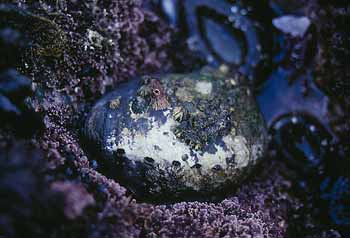
Haliotis cracherodii inhabits rocky substrates from the high intertidal zone to depths of 6 m. It has a relatively smooth, dark shell with a pearly interior displaying pink and green iridescence.
Written 26 November 2026 from the sources listed below. Each statement was checked against the passage it cites; statements that could not be supported were removed.
Appearance
The shell is dark brown, dark green, dark blue, or nearly black, with a pearly interior displaying pink and green iridescence. It is relatively smooth compared with the shells of most other abalone species.[1][2]
The shell is oval-shaped and evenly convex, with both sides equally curved. It typically has five to seven small, open respiratory pores along its left side, with rims flush with the shell surface.[3][4]
The shell has five to nine open respiratory pores that are flush with its surface. The mantle, foot, and tentacles of the living animal are black.[5][6]
The shell can reach a maximum length of 20 cm, with typical lengths of 10–14 cm.[7]
Habitat
Black abalone inhabit rocky substrates from the high intertidal zone to depths of 6 m and are most abundant in the mid-low intertidal zone. They generally occur in areas exposed to moderate or high surf.[8][9]
Individuals commonly occupy crevices, cracks, and holes during low tide. They also cluster beneath boulders and along surge-channel walls on exposed shores.[10][11]
Newly settled individuals are believed to occupy narrow crevices, boulder undersides, and spaces within mussel beds.[12]
Black abalone occur along the Pacific coast of North America from Mendocino County, California, to Cabo San Lucas, Baja California, Mexico. The current reported range extends from approximately Point Arena in northern California to southern Baja California.[13][14]
Black abalone are rare north of San Francisco and south of Punta Eugenia in Baja California. The subspecies Haliotis cracherodii californiensis occurs around Guadalupe Island off Baja California, Mexico.[15][16]
Diet
Black abalone are herbivorous and feed primarily on drift algae and kelp. Adults feed particularly on brown kelps.[17][18]
In southern California, the species feeds on giant kelp and feather boa kelp. In central and northern California, it feeds on bull kelp.[19][20]
Juveniles likely graze on crustose coralline algae and microscopic flora, including diatom films. Black abalone capture drifting plant material beneath their anterior foot and hold it there for ingestion.[21][22]
At San Nicolas Island, giant kelp accounted for approximately 76% of recorded instances of entrapped food items. Three kelp species accounted for approximately 95% of recorded food-entrapment observations.[23][24]
Behaviour
Juveniles occupy crevices to reduce their risk of predation, whereas larger adults move onto exposed rock surfaces. Adult black abalone are generally more sedentary than juveniles.[25][26]
Reproduction and life cycle
Black abalone reach sexual maturity at approximately three years of age. Reproductive maturity occurs at approximately 45 mm shell length, corresponding to an age of three to seven years.[27][28]
Spawning generally occurs in spring and early summer, with an occasional second spawning period in autumn. Successful spawning requires individuals to be grouped closely together.[29][30]
Larvae remain free-swimming for approximately 5–14 days before settling on hard substrate. They generally settle near larger individuals before metamorphosing into their adult form.[31][32]
Juveniles generally remain hidden in crevices until reaching approximately four inches in length. Larval recruitment is generally localized rather than involving extensive dispersal.[33][34]
Fecundity increases with adult size, with older and larger individuals producing substantially more gametes than newly mature individuals.[35]
Shell growth averages approximately 20 mm during the first year and 10–20 mm annually over the following several years before slowing at approximately 100 mm shell length.[36]
Conservation
The IUCN Red List classifies black abalone as Critically Endangered. It was listed as endangered under the United States Endangered Species Act on January 14, 2009.[37][38]
The NMFS designated critical habitat for black abalone on October 27, 2011. The black abalone fishery was closed in 1993 following substantial population declines.[39][40]
Population mortality following withering syndrome outbreaks exceeded 95% in affected populations.[41]
Some California Channel Island populations have shown signs of recovery. Black abalone populations have also shown signs of ecological rebound along some Channel Island shorelines following management and recovery efforts.[42][43]
A bacteriophage has been identified that appears to reduce the lethality of the pathogen responsible for withering syndrome.[44]
Uses
Black abalone have been harvested as food by humans along the California coast for at least 10,000 years. The Island Chumash used black abalone shells to manufacture fishhooks, beads, and ornaments.[45][46]
Black abalone supported one of California's first commercial shellfisheries beginning in the nineteenth century. The fishery was an important human resource before its closure.[47][48]
Similar species
Pink abalone have highly corrugated shells, usually with two to four large elevated respiratory holes. Green abalone have olive-green to reddish-brown shells with numerous broad, flat-topped ribs and five to seven small, slightly elevated circular pores.[49][50]
Classification of the Black Abalone
| Kingdom | Animalia |
|---|---|
| Phylum | Mollusca |
| Class | Gastropoda (Gastropod) |
| Subclass | Vetigastropoda |
| Order | Lepetellida |
| Superfamily | Haliotoidea |
| Family | Haliotidae (Abalone) |
| Genus | Haliotis (Abalone) |
| Species | Haliotis cracherodii Leach, 1814 |
Where the Black Abalone is found
Checklists and occurrence records place Haliotis cracherodii in 2 countries. GBIF holds 2,436 georeferenced records of it.
Countries
Regions and cities with the most records
- Pacific Grove, United States 679
- Seaside, United States 649
- Monterey, United States 647
- Marina, United States 616
- California, United States 591
- Salinas, United States 175
- Prunedale, United States 165
- Rancho Palos Verdes, United States 99
- Lomita, United States 91
- Torrance, United States 84
- Carson, United States 82
- West Carson, United States 81
- Redondo Beach, United States 78
- Long Beach, United States 76
- Hermosa Beach, United States 74
- Gardena, United States 70
- Watsonville, United States 69
- Lawndale, United States 66
- Manhattan Beach, United States 47
- Laguna Beach, United States 40
- Seal Beach, United States 39
- Baja California, Mexico 38
- San Luis Obispo, United States 38
- Hawthorne, United States 37
- Aliso Viejo, United States 36
- El Segundo, United States 36
- Laguna Niguel, United States 35
- Newport Beach, United States 35
- Compton, United States 34
- Laguna Hills, United States 34
- Laguna Woods, United States 34
- Costa Mesa, United States 33
- Irvine, United States 31
- Mission Viejo, United States 31
- Lennox, United States 28
- Lake Forest, United States 27
A number beside a place is its count of GBIF occurrence records. A place without a number comes from a checklist alone. Records show where a species has been observed or collected, which can include escapes and vagrants.
Common names
English
- Black Abalone
Names in 6 other languages
- German
- Schwarze Abalone, Schwarzes Meerohr
- Italian
- Abalone nero
- Japanese
- スルスミアワビ
- Russian
- Галиотис черный
- Slovak
- ušo čierny
- Spanish
- abulón negro
Synonyms
One other scientific name has been used for this species and is now treated as a synonym of Haliotis cracherodii.
- Haliotis cracherodii var. lusus Finlay, 1927
Subspecies and varieties
- Haliotis cracherodii californiensis subspecies
- Haliotis cracherodii cracherodii subspecies
Related species
-
 Green OrmerHaliotis tuberculata
-
 Donkey's Ear AbaloneHaliotis asinina
-
 Red AbaloneHaliotis rufescens
-
 PauaHaliotis iris
-
 PerlemoenHaliotis midae
-
 Northern AbaloneHaliotis kamtschatkana
-
 White AbaloneHaliotis sorenseni
-
 Pink AbaloneHaliotis corrugata
Compare
Questions and answers
What is the scientific name of the Black Abalone?
The scientific name of the Black Abalone is Haliotis cracherodii. Written with its author, the full name is Haliotis cracherodii Leach, 1814.
Which family does the Black Abalone belong to?
Haliotis cracherodii belongs to the family Haliotidae, in the order Lepetellida and the class Gastropoda.
Where is the Black Abalone found?
Checklists and occurrence records place Haliotis cracherodii in 2 countries: United States and Mexico.
What is the conservation status of the Black Abalone?
The IUCN Red List category recorded for Haliotis cracherodii is Critically Endangered (CR).
Are black abalone rare?
Black abalone are rare north of San Francisco and south of Punta Eugenia in Baja California. The IUCN Red List classifies the species as Critically Endangered.[16][37]
Where do black abalone live?
Black abalone occur along the Pacific coast of North America from Mendocino County, California, to Cabo San Lucas, Baja California, Mexico. They inhabit rocky substrates from the high intertidal zone to depths of 6 m and are most abundant in the mid-low intertidal zone.[9][13]
What is an abalone diet?
Black abalone are herbivorous and feed primarily on drift algae and kelp. Adults feed particularly on brown kelps, while juveniles likely graze on crustose coralline algae and microscopic flora, including diatom films.[17][18][21]
Sources
Passages the profile rests on
- The shell is dark brown, dark green, dark blue, or nearly black, with a pearly interior displaying pink and green iridescence. Source passage: “The coloration is dark brown, dark green, dark blue or almost black. The silvery interior of the shell shows a pale pinkish and greenish iridescence.” — English Wikipedia
- The shell is relatively smooth compared with those of most other abalone species. Source passage: “The exterior of the shell is smoother than most abalone” — English Wikipedia
- The shell is oval-shaped and evenly convex, with both sides equally curved. Source passage: “The shell is oval, evenly convex, the two sides equally curved.” — English Wikipedia
- The shell typically has five to seven small, open respiratory pores along its left side, with rims flush with the shell surface. Source passage: “There are usually five to seven small, open respiratory holes, or pores, along the left side of the shell and the rims of the holes are flush with the rest of the shell.” — English Wikipedia
- The mantle, foot, and tentacles of the living animal are black. Source passage: “In the living animal, the tentacles on the epipodium, the mantle, and the foot are black.” — English Wikipedia
- The shell has five to nine open respiratory pores that are flush with its surface. Source passage: “There are usually five to nine open respiratory pores sitting flush with the shell’s surface.” — marine.ucsc.edu
- The shell can reach a maximum length of 20 cm, with typical lengths of 10–14 cm. Source passage: “The black abalone's shell length can reach a maximum of 20 cm (7.9 in), being typically 10–14 cm (3.9–5.5 in) long.” — English Wikipedia
- Black abalone generally occur in areas exposed to moderate or high surf. Source passage: “They generally occur in areas of moderate to high surf.” — English Wikipedia
- The species inhabits rocky substrates from the high intertidal zone to depths of 6 m and is most abundant in the mid-low intertidal zone. Source passage: “Black abalone inhabit suitable rocky substrate from the high intertidal zone to 6 m depth but are most abundant in the mid-low intertidal.” — marine.ucsc.edu
- Individuals commonly occupy crevices, cracks, and holes during low tide. Source passage: “They can typically be found wedged into crevices, cracks, and holes during low tide.” — English Wikipedia
- Black abalone commonly cluster in crevices, beneath boulders, and along surge-channel walls on exposed shores. Source passage: “Black abalone are typically found clustered in crevices, under boulders, or on the walls of surge channels along exposed shores.” — marine.ucsc.edu
- Newly settled individuals are believed to occupy narrow crevices, boulder undersides, and spaces within mussel beds. Source passage: “they are believed to inhabit cryptic locations such as narrow crevices, undersides of boulders, and the interstices of mussel beds” — marine.ucsc.edu
- The species occurs along the Pacific coast of North America from Mendocino County, California, to Cabo San Lucas, Baja California, Mexico. Source passage: “Black abalone can be found along the Pacific coast of the United States from Mendocino County, California to Cabo San Lucas, Baja California, Mexico.” — English Wikipedia
- The current reported range extends from approximately Point Arena in northern California to southern Baja California. Source passage: “Their current range is from about Point Arena in northern California to Southern Baja California (MARINe).” — marine.ucsc.edu
- The subspecies Haliotis cracherodii californiensis occurs around Guadalupe Island off Baja California, Mexico. Source passage: “The subspecies Haliotis cracherodii californiensis is found around Guadalupe Island, off Baja California (Mexico).” — English Wikipedia
- Black abalone are rare north of San Francisco and south of Punta Eugenia in Baja California. Source passage: “Black abalone are rare north of San Francisco and south of Punta Eugenia, Baja” — marine.ucsc.edu
- Black abalone are herbivorous and feed primarily on drift algae and kelp. Source passage: “Black abalone are herbivorous gastropods, and feed mostly on drift algae and kelp.” — English Wikipedia
- Adult black abalone feed primarily on drift algae, particularly brown kelps. Source passage: “adults tend to be more sessile, feeding primarily on drift algae, especially brown kelps” — marine.ucsc.edu
- In southern California, the species feeds on giant kelp and feather boa kelp. Source passage: “In southern California habitats, black abalone are thought to feed on the giant kelp (Macrocystis pyrifera) and feather boa kelp (Egregia menziesii)” — English Wikipedia
- In central and northern California, black abalone feed on bull kelp. Source passage: “in central and northern California habitats they feed on the bull kelp (Nereocystis leutkeana).” — English Wikipedia
- Juvenile black abalone likely graze on crustose coralline algae and microscopic flora, including diatom films. Source passage: “Juveniles appear to be fairly motile, and likely graze on crustose coralline algae and micro flora, such as diatom films” — marine.ucsc.edu
- Black abalone capture drifting plant material beneath their anterior foot and hold it there for ingestion. Source passage: “Drift materials are entrapped beneath the anterior foot and held for ingestion.” — pubs.usgs.gov
- Giant kelp accounted for approximately 76% of recorded instances of entrapped food items in the San Nicolas Island study. Source passage: “Of those, giant kelp was the most frequently observed entrapped category (∼76%).” — pubs.usgs.gov
- Three kelp species accounted for approximately 95% of recorded food-entrapment observations at San Nicolas Island. Source passage: “Frequency data were dominated (∼95% of all records) by three species of kelp Macrocystis pyrifera (Linnaeus) C. Agardh; commonly known as “giant kelp”, Egregia menziesii (Turner), and Eisenia arborea Areschoug.” — pubs.usgs.gov
- Juveniles occupy crevices to reduce their risk of predation, whereas larger adults move onto exposed rock surfaces. Source passage: “Juveniles tend to reside in crevices to reduce their risk of predation, but the larger adults will move out onto rock surfaces.” — English Wikipedia
- Adult black abalone are generally more sedentary than juveniles. Source passage: “adults tend to be more sessile” — marine.ucsc.edu
- Black abalone reach sexual maturity at approximately three years of age. Source passage: “Black abalone reach sexual maturity at 3 years” — English Wikipedia
- Reproductive maturity occurs at approximately 45 mm shell length, corresponding to an age of three to seven years. Source passage: “Black abalone become reproductively mature at around 45mm (between 3-7 years old)” — marine.ucsc.edu
- Spawning generally occurs in spring and early summer, with an occasional second spawning period in autumn. Source passage: “Spawning occurs in spring and early summer; occasionally, a second spawn occurs in the fall.” — English Wikipedia
- Successful spawning requires individuals to be grouped closely together. Source passage: “successful spawning requires that individuals be grouped closely together.” — English Wikipedia
- Black abalone larvae remain free-swimming for approximately 5–14 days before settling on hard substrate. Source passage: “Larvae are free-swimming for between 5 and 14 days before they settle onto hard substrate” — English Wikipedia
- Larvae generally settle near larger individuals before metamorphosing into their adult form. Source passage: “usually near larger individuals, where they then metamorphose into their adult form” — English Wikipedia
- Juveniles generally remain hidden in crevices until reaching approximately four inches in length. Source passage: “Juveniles settle in crevices and remain hidden until they reach approximately 4 inches in length.” — English Wikipedia
- Larval recruitment is generally localized rather than involving extensive dispersal. Source passage: “recruitment is believed to be generally localized” — marine.ucsc.edu
- Fecundity increases with adult size, with older and larger individuals producing substantially more gametes than newly mature individuals. Source passage: “older, larger individuals producing significantly higher numbers of gametes than newly mature, smaller animals.” — marine.ucsc.edu
- Shell growth averages approximately 20 mm during the first year and 10–20 mm annually over the following several years before slowing at approximately 100 mm shell length. Source passage: “Growth varies with size, location, and other environmental factors, but does appear to be slow—about 20mm in the first year, and 10-20mm per year over the next several years, then slowing at sizes of approximately 100mm” — marine.ucsc.edu
- The IUCN Red List classifies black abalone as Critically Endangered. Source passage: “Black abalone are listed on the International Union for Conservation of Nature's Red List as Critically Endangered (CR A4e).” — English Wikipedia
- Black abalone was listed as endangered under the United States Endangered Species Act on January 14, 2009. Source passage: “Black abalone were listed as endangered on January 14, 2009.” — English Wikipedia
- The NMFS designated critical habitat for black abalone on October 27, 2011. Source passage: “The NMFS designated critical habitat for the endangered black abalone on October 27, 2011.” — English Wikipedia
- The black abalone fishery was closed in 1993 following substantial population declines. Source passage: “Although once an important human resource, the black abalone fishery was closed in 1993 due to massive population declines.” — marine.ucsc.edu
- Population mortality following withering syndrome outbreaks exceeded 95% in affected populations. Source passage: “the general pattern of mortality once die-offs began was population decreases of > 95%, leaving a few scattered individuals” — marine.ucsc.edu
- Some California Channel Island populations have shown signs of recovery. Source passage: “In a some on the California Channel Islands, populations are even trending toward recovery.” — marine.ucsc.edu
- Black abalone populations have shown signs of ecological rebound along some Channel Island shorelines following management and recovery efforts. Source passage: “After nearly 25 years of management and recovery efforts, black abalone are showing signs of ecological rebound along some Channel Island shorelines.” — pmc.ncbi.nlm.nih.gov
- A bacteriophage has been identified that appears to reduce the lethality of the pathogen responsible for withering syndrome. Source passage: “Recently however, a bacteriophage has been identified that appears to reduce the lethalness of the WS-causing pathogen” — marine.ucsc.edu
- Black abalone have been harvested as food by humans along the California coast for at least 10,000 years. Source passage: “Humans have harvested black abalone along the California Coast for at least 10,000 years.” — English Wikipedia
- The Island Chumash used black abalone shells to manufacture fishhooks, beads, and ornaments. Source passage: “the Island Chumash people and their ancestors ate black abalone for millennia and also used the shells to make fishhooks, beads, and ornaments.” — English Wikipedia
- Black abalone supported one of California's first commercial shellfisheries beginning in the nineteenth century. Source passage: “first for coastal Native Americans, then beginning in the nineteenth century, as one of the state's first commercial shellfisheries.” — pmc.ncbi.nlm.nih.gov
- The black abalone fishery was an important human resource before its closure. Source passage: “Although once an important human resource, the black abalone fishery was closed in 1993 due to massive population declines.” — marine.ucsc.edu
- Pink abalone have highly corrugated shells, usually with two to four large elevated respiratory holes. Source passage: “Pinks are dull green to reddish brown, highly corrugated, with 2-4 large, elevated holes” — marine.ucsc.edu
- Green abalone have olive-green to reddish-brown shells with numerous broad, flat-topped ribs and five to seven small, slightly elevated circular pores. Source passage: “Greens are olive green to reddish brown, with numerous, broad, flat-topped ribs, and 5-7 small, circular, slightly elevated holes.” — marine.ucsc.edu
Data
- Catalogue of Life, 2026-10-16 XR cc by
- Global Biodiversity Information Facility CC BY 4.0
- Wikidata CC0
- GeoNames CC BY 4.0
- Wikimedia Commons per image; credit shown with each image
- Within the Catalogue of Life, this name comes from World Register of Marine Species cc by
References
- Leach, W. E. (1814). Zoological miscellany: being descriptions of new or interesting animals. London, Vol. 1 [1814]. Vol. 2 [1815], Vol. 3 [1817]. where the name was published
This species in other databases
Page built on 27 November 2026. See how the catalog is made and all sources and licences.
Cite this page
ScientificNames.org. (2026). Haliotis cracherodii (Black Abalone). Retrieved November 27, 2026, from https://scientificnames.org/species/haliotis-cracherodii
“Haliotis cracherodii (Black Abalone).” ScientificNames.org, 2026, scientificnames.org/species/haliotis-cracherodii. Accessed 27 Nov. 2026.
ScientificNames.org. “Haliotis cracherodii (Black Abalone).” Accessed November 27, 2026. https://scientificnames.org/species/haliotis-cracherodii.
@misc{scientificnames_haliotis_cracherodii_black_abalone,
  author = {{ScientificNames.org}},
  title = {Haliotis cracherodii (Black Abalone)},
  year = {2026},
  url = {https://scientificnames.org/species/haliotis-cracherodii},
  note = {Accessed 2026-11-27}
}