Comparison

Banded Palm Civet vs Binturong

Banded Palm Civet (Hemigalus derbyanus) and Binturong (Arctictis binturong) both belong to the family Viverridae (oyans) and part ways below it. Both are recorded in 4 countries.

Banded Palm Civet

Banded Palm Civet

Hemigalus derbyanus

Photographer:bobinoz, Cleanup: Yamavu, CC BY 3.0, via Wikimedia Commons
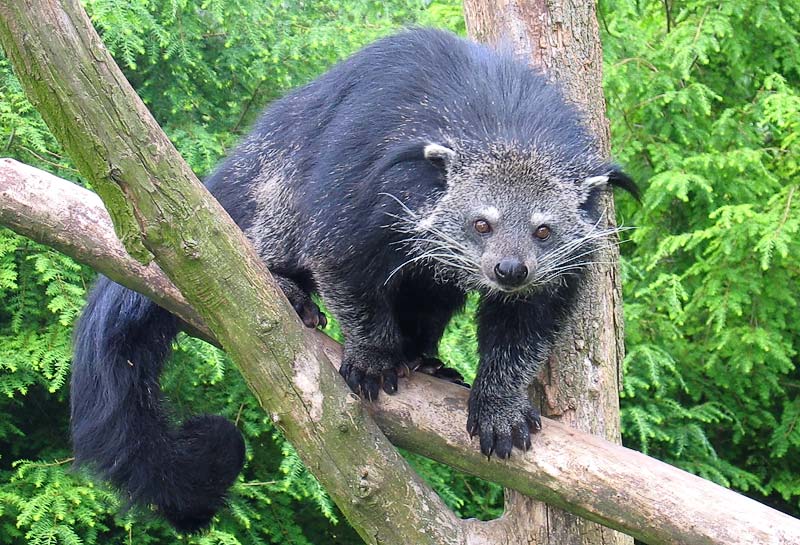
Binturong

Binturong

Arctictis binturong

Tassilo Rau, CC BY-SA 3.0, via Wikimedia Commons

Side by side

Banded Palm CivetBinturong
Scientific nameHemigalus derbyanus (Gray, 1837)Arctictis binturong (Raffles, 1822)
English nameBanded Palm CivetBinturong
GroupMammalsMammals
ClassMammalia MammalMammalia Mammal
OrderCarnivora CarnivoresCarnivora Carnivores
FamilyViverridae OyansViverridae Oyans
GenusHemigalus Banded CivetsArctictis Binturong
Named in18371822
Red List categoryNear ThreatenedVulnerable
Countries on record4 countries8 countries
GBIF occurrence records296 records408 records

Rows where the two agree are shown in grey.

Where each is found

Both recorded in 4 countries

Only Binturong (4)

From Catalogue of Life checklists and GBIF occurrence records. A country missing from a list means no record is held, which is not proof of absence.

Checked facts

Banded Palm CivetBinturong
Appearance
  • The binturong has a thick coat of coarse black hair. English Wikipedia
  • Its coat can include white or buff speckling that produces straw-coloured or grey appearances. English Wikipedia
  • The binturong has a bushy, prehensile tail that tapers and curls inward at its tip. English Wikipedia
  • Its snout is short and pointed, with an upward curve at the nose. English Wikipedia
  • Its ears are short and rounded, with white edges and noticeable black hair tufts. English Wikipedia
  • Its limbs have five clawed digits, with the third and fourth digits joined together. English Wikipedia
Size
Habitat
  • The species inhabits forests, particularly lowland forests. English Wikipedia
  • The species prefers tall forests. animaldiversity.org
  • The species occurs in evergreen forests in Thailand at elevations of 162–695 m. English Wikipedia
  • The species has been recorded in primary forest in Sumatra at elevations of 150 m and 800 m. English Wikipedia
  • The species has been recorded in forest fragments within an oil palm plantation in South Solok Regency, Indonesia. English Wikipedia
  • Regional detections of the species are positively associated with forest cover. pmc.ncbi.nlm.nih.gov
  • Local abundance is negatively associated with forest loss. pmc.ncbi.nlm.nih.gov
  • Local abundance is positively associated with distance from rivers. pmc.ncbi.nlm.nih.gov
  • Binturongs primarily inhabit lowland primary and secondary forests. English Wikipedia
  • In Laos, binturongs have been observed in extensive evergreen forests. English Wikipedia
  • In Palawan, binturongs inhabit primary and secondary lowland forests, including grassland–forest mosaics up to 400 m elevation. English Wikipedia
  • Binturongs inhabit the canopies of tall, dense tropical forests. animaldiversity.org
Diet
  • The binturong is omnivorous and consumes plants, insects and smaller animals. English Wikipedia
  • Its diet includes small mammals, rodents, birds, fish, earthworms, insects and fruits. English Wikipedia
  • Figs constitute a major component of the binturong's diet. English Wikipedia
  • Binturongs also consume carrion, eggs, tree shoots and leaves. animaldiversity.org
  • The binturong consumes fruits from the strangler fig tree (Ficus altissima). animaldiversity.org
Behaviour
Reproduction
Distribution
  • The species occurs in Myanmar, Thailand, Peninsular Malaysia, Sumatra, the Mentawai Islands, and Borneo. English Wikipedia
  • The species occurs from sea level to elevations of approximately 1,660 m. English Wikipedia
  • The species has been recorded on Sipora and the Mentawai Islands. English Wikipedia
  • The species has been extirpated from Singapore. English Wikipedia
  • The species has been recorded in peninsular Myanmar. inaturalist.org
  • Binturongs occur in India, Nepal, Bangladesh, Bhutan, Myanmar, Thailand, Malaysia, Laos, Cambodia, Vietnam, China, Indonesia and the Philippines. English Wikipedia
  • Binturongs typically occur at elevations between 0 and 3,000 m. English Wikipedia
Conservation
  • The banded palm civet is classified as Near Threatened on the IUCN Red List. English Wikipedia
  • The species' global population is thought to be decreasing. English Wikipedia
  • The species is protected under Appendix II of CITES. English Wikipedia
  • The species' population was estimated to have declined by approximately 30% over three generations in 2016. English Wikipedia
  • A 2022 study estimated that the species' distribution had contracted to less than 21% of its recognized IUCN Red List range. pmc.ncbi.nlm.nih.gov
  • Approximately 12% of the species' remaining estimated distribution falls within protected areas. pmc.ncbi.nlm.nih.gov
  • Habitat loss and degradation threaten the species. pmc.ncbi.nlm.nih.gov
  • Deforestation and habitat loss are associated with declining numbers of the species. animaldiversity.org
  • Hunting and consumption by local people occur in Sabah. English Wikipedia
Uses
  • Some people capture banded palm civets from their natural habitats to keep them as pets. English Wikipedia
  • The species is hunted and consumed by local people in Sabah. English Wikipedia
Similar species
  • Hose's palm civet is considered closely related to the banded palm civet and has a similar build and appearance. English Wikipedia
No checked fact yet
Other
  • The species' activity pattern overlaps with that of rodents and other civets. English Wikipedia
  • The species' regional detections are negatively associated with human population. pmc.ncbi.nlm.nih.gov
  • Binturongs are considered keystone species because they disperse strangler fig seeds. English Wikipedia

In brief

Banded Palm Civet

Hemigalus derbyanus occurs in Myanmar, Thailand, Peninsular Malaysia, Sumatra, the Mentawai Islands, and Borneo, from sea level to elevations of approximately 1,660 m. It is distinguished by seven or eight dark bands across its face and back and black rings on its tail. Full profile

Binturong

Binturongs occur in India, Nepal, Bangladesh, Bhutan, Myanmar, Thailand, Malaysia, Laos, Cambodia, Vietnam, China, Indonesia and the Philippines. The Binturong has a bushy, prehensile tail and is the largest species in the Viverridae family. Full profile

Compare something else

Page built on 29 November 2026 from the data on the two species pages, where every source is listed.

Cite this page

ScientificNames.org. (2026). Banded Palm Civet vs Binturong. Retrieved November 29, 2026, from https://scientificnames.org/compare/banded-palm-civet-vs-binturong