Comparison
Honey Badger vs Stoat
Honey Badger (Mellivora capensis) and Stoat (Mustela erminea) both belong to the family Mustelidae (mustelids) and part ways below it. Both are recorded in 1 country.
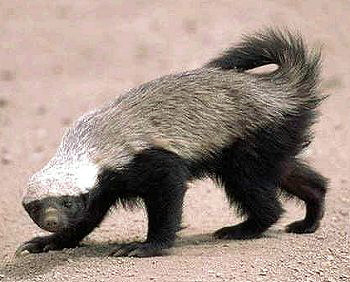


How they differ
The honey badger has short, sturdy legs, five toes on each foot and remarkably long forelimb claws, while the stoat has an elongated neck, five toes on each foot and claws that are large relative to its digits and cannot retract. The honey badger generally has a black lower body and a white or grey upper mantle, while the stoat has a sandy-brown summer coat with a white underside and may develop an entirely white winter coat except for its black tail tip. The honey badger is predominantly solitary and can be active at any time of day, while male and female stoats typically live separately but near one another. The honey badger is classified as Least Concern on the IUCN Red List, as is the stoat.
| Honey Badger | Stoat | |
|---|---|---|
| Appearance | The honey badger has short, sturdy legs and five toes on each foot, with remarkably long forelimb claws and short hind-leg claws. | The stoat has five toes on each foot, with claws that are large relative to its digits and cannot retract. |
| Coat | The honey badger generally has a black lower body and a white or grey upper mantle extending to the base of the tail. | The stoat has a sandy-brown summer coat on its back and head and a white underside; individuals in the northern part of their range develop an entirely white winter coat except for the black tip of the tail. |
| Behaviour | Honey badgers are predominantly solitary and may be active at any time of day depending on their location. | Male and female stoats typically live separately but near one another. |
| Territorial marking | Honey badgers scent-mark their territories using anal gland secretions, feces, and urine. | Stoats mark their territories using urine, faeces and scent marks. |
| Diet | Honey badgers consume insects, frogs, tortoises, turtles, lizards, rodents, snakes, birds, eggs, berries, roots, bulbs, bee larvae and honey. | Stoats predominantly eat mouse-like rodents and also prey on larger rodents, lagomorphs, small birds, fish, shrews, amphibians, lizards and insects. |
| Distribution | Honey badgers occur across most of sub-Saharan Africa and extend through Arabia, Iran, Western Asia, Turkmenistan, and the Indian Peninsula. | The stoat has a circumboreal distribution across North America, Europe and Asia. |
| Reproduction | Honey badgers can breed throughout the year rather than during a fixed mating season. | In the Northern Hemisphere, stoat mating occurs between April and July. |
Written from the checked facts listed further down. Statements that the sources did not support were removed.
Side by side
| Honey Badger | Stoat | |
|---|---|---|
| Scientific name | Mellivora capensis (Schreber, 1776) | Mustela erminea Linnaeus, 1758 |
| English name | Honey Badger | Stoat |
| Group | Mammals | Mammals |
| Class | Mammalia Mammal | Mammalia Mammal |
| Order | Carnivora Carnivores | Carnivora Carnivores |
| Family | Mustelidae Mustelids | Mustelidae Mustelids |
| Genus | Mellivora Ratels | Mustela Minks |
| Named in | 1776 | 1758 |
| Red List category | Least Concern | Least Concern |
| Environment | Not recorded | terrestrial |
| Countries on record | 37 countries | 48 countries |
| GBIF occurrence records | 2,204 records | 147,435 records |
Rows where the two agree are shown in grey.
Where each is found
Both recorded in 1 country
Only Honey Badger (36)
- Angola
- Benin
- Botswana
- Burkina Faso
- Cameroon
- Central African Republic
- Chad
- Democratic Republic of the Congo
- Equatorial Guinea
- Eswatini
- Ethiopia
- Gabon
- Guinea
- Iran
- Israel
- Ivory Coast
- Kenya
- Liberia
- Malawi
- Mauritania
- Morocco
- Mozambique
- Namibia
- Nepal
- Niger
- Nigeria
- Oman
- Republic of the Congo
- Senegal
- South Africa
- South Sudan
- Sudan
- Tanzania
- Western Sahara
- Zambia
- Zimbabwe
Only Stoat (47)
- Andorra
- Australia
- Austria
- Belarus
- Belgium
- Canada
- China
- Croatia
- Czechia
- Denmark
- Estonia
- Finland
- France
- Georgia
- Germany
- Greece
- Greenland
- Hungary
- Ireland
- Isle of Man
- Italy
- Japan
- Kazakhstan
- Kyrgyzstan
- Latvia
- Liechtenstein
- Lithuania
- Luxembourg
- Mongolia
- New Zealand
- Norway
- Pakistan
- Poland
- Portugal
- Romania
- Russia
- Slovakia
- Slovenia
- Spain
- Sweden
- Switzerland
- Tajikistan
- The Netherlands
- Turkey
- Ukraine
- United Kingdom
- United States
From Catalogue of Life checklists and GBIF occurrence records. A country missing from a list means no record is held, which is not proof of absence.
Checked facts
| Honey Badger | Stoat | |
|---|---|---|
| Appearance |
|
|
| Size |
|
|
| Habitat |
|
|
| Diet |
|
|
| Behaviour |
|
|
| Reproduction |
|
|
| Distribution |
|
|
| Conservation |
|
|
| Uses |
|
|
| Other |
| No checked fact yet |
In brief
Honey Badger
Mellivora capensis occurs across most of sub-Saharan Africa and extends through Arabia, Iran, Western Asia, Turkmenistan, and the Indian Peninsula. It is the only living species in the genus Mellivora and the sole living representative of the subfamily Mellivorinae. Full profile
Stoat
The Ermine has a circumboreal distribution across North America, Europe and Asia. The Ermine has a sandy-brown summer coat and develops an entirely white winter coat in the northern part of its range, except for the black tip of its tail. Full profile
Compare something else
Page built on 24 November 2026 from the data on the two species pages, where every source is listed.
Cite this page
ScientificNames.org. (2026). Honey Badger vs Stoat. Retrieved November 24, 2026, from https://scientificnames.org/compare/honey-badger-vs-stoat
“Honey Badger vs Stoat.” ScientificNames.org, 2026, scientificnames.org/compare/honey-badger-vs-stoat. Accessed 24 Nov. 2026.
ScientificNames.org. “Honey Badger vs Stoat.” Accessed November 24, 2026. https://scientificnames.org/compare/honey-badger-vs-stoat.
@misc{scientificnames_honey_badger_vs_stoat,
  author = {{ScientificNames.org}},
  title = {Honey Badger vs Stoat},
  year = {2026},
  url = {https://scientificnames.org/compare/honey-badger-vs-stoat},
  note = {Accessed 2026-11-24}
}