Species · Mammals
Honey Badger Mellivora capensis
The scientific name of the Honey Badger is Mellivora capensis. It is a species of mammal in the family Mustelidae (mustelids), order Carnivora. The name dates from 1776.
- Scientific name
- Mellivora capensis (Schreber, 1776)
- Common name
- Honey Badger
- Genus
- Mellivora
- Family
- Mustelidae (Mustelids)
- Order
- Carnivora
- Class
- Mammalia
- Red List category
- LC Least Concern
- Recorded in
- 37 countries
- Name status
- accepted in the Catalogue of Life
Overview
Mellivora capensis occurs across most of sub-Saharan Africa and extends through Arabia, Iran, Western Asia, Turkmenistan, and the Indian Peninsula. It is the only living species in the genus Mellivora and the sole living representative of the subfamily Mellivorinae.
Written 24 November 2026 from the sources listed below. Each statement was checked against the passage it cites; statements that could not be supported were removed.
Appearance
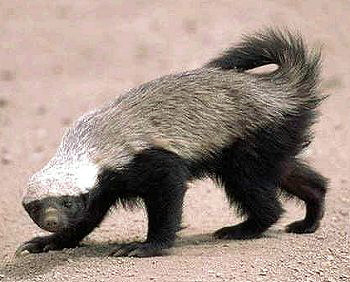
It has short, sturdy legs with five toes on each foot. Its forelimbs have remarkably long claws, while its hind-leg claws are short.[1][2]
The coat generally has a black lower body and a white or grey upper mantle extending to the base of the tail. Individuals belonging to the cottoni subspecies have an entirely black coat.[3][4]
Adults measure 55–77 cm in body length, with the tail adding approximately 12–30 cm to their total length. Shoulder height is approximately 23–28 cm.[5][6][7]
African males generally weigh 9–16 kg, while females weigh 5–10 kg. Males are larger than females, and African populations are slightly larger than Asian populations.[8][9][10]
Habitat
The Honey Badger inhabits tropical and subtropical green forests, thorn forests, open woodlands, riparian forests, grasslands, arid steppes, rocky hills, and deserts. It occupies elevations from sea level to approximately 4,050 m.[11][12]
It requires sheltering places such as burrows or rock crevices. It is not historically found in the extremely dry parts of the Sahara Desert or along the Mediterranean coast.[13][14]
Diet
The Honey Badger consumes insects, frogs, tortoises, turtles, lizards, rodents, snakes, birds, and eggs. It also eats berries, roots, and bulbs.[15][16]
It raids beehives to obtain bee larvae and honey. It consumes all parts of its prey, including bones, feathers, hair, and skin.[17][18]
Behaviour
The Honey Badger is predominantly solitary and may be active at any time of day depending on its location. In the Serengeti, individuals are mostly nocturnal during the dry season and active throughout the day during the wet season.[19][20][21]
It is a skilled digger capable of excavating tunnels in hard ground within ten minutes. Its burrows are generally 1–3 m long, with a single entrance and an unlined nesting chamber.[22][23]
Adult males have an average home range of 548 km², compared with 138 km² for females. Honey Badgers scent-mark their territories using anal gland secretions, feces, and urine.[24][25]
They can repel larger predators by releasing a pungent yellow liquid from their anal glands. They sometimes hunt in pairs in Africa.[26][27]
Reproduction and life cycle
Honey Badgers can breed throughout the year rather than during a fixed mating season. The estimated oestrus period of females is approximately 14 days, and gestation lasts approximately 50–70 days.[28][29][30]
Females move their cubs between dens during the first three months after birth. Cubs begin accompanying their mothers while foraging at approximately three months of age, and females care for their offspring for approximately 12–16 months.[31][32][33]
Male Honey Badgers generally reach sexual maturity at two to three years of age.[34]
Conservation
The Honey Badger is classified as Least Concern on the IUCN Red List. It is threatened by killings associated with beekeeping and farming, including poisoning and trapping.[35][36]
Uses
Honey Badgers are used in traditional medicine and consumed as bushmeat.[37]
Similar species
The Honey Badger is the only living species in the genus Mellivora and the sole living representative of the subfamily Mellivorinae.[38][39]
Classification of the Honey Badger
| Kingdom | Animalia |
|---|---|
| Phylum | Chordata |
| Subphylum | Vertebrata |
| Infraphylum | Gnathostomata |
| Parvphylum | Osteichthyes |
| Megaclass | Tetrapoda |
| Class | Mammalia (Mammal) |
| Subclass | Theria |
| Infraclass | Eutheria |
| Order | Carnivora (Carnivores) |
| Suborder | Caniformia (Dog-like Carnivores) |
| Family | Mustelidae (Mustelids) |
| Subfamily | Mellivorinae (Honey Badgers) |
| Genus | Mellivora (Ratels) |
| Species | Mellivora capensis (Schreber, 1776) |
Where the Honey Badger is found
Checklists and occurrence records place Mellivora capensis in 37 countries across Africa and Asia. GBIF holds 2,204 georeferenced records of it.
Countries
- Angola 75
- Benin 77
- Botswana 168
- Burkina Faso 9
- Cameroon 8
- Central African Republic 17
- Chad 6
- Democratic Republic of the Congo 59
- Equatorial Guinea 3
- Eswatini 3
- Ethiopia 11
- Gabon 9
- Guinea 5
- India 17
- Iran 5
- Israel 40
- Ivory Coast 22
- Kenya 189
- Liberia 6
- Malawi 4
- Mauritania 15
- Morocco 3
- Mozambique 5
- Namibia 166
- Nepal 13
- Niger 10
- Nigeria 8
- Oman 8
- Republic of the Congo 5
- Senegal 16
- South Africa 1,036
- South Sudan 10
- Sudan 8
- Tanzania 52
- Western Sahara 4
- Zambia 71
- Zimbabwe 41
Regions and cities with the most records
- Western Cape, South Africa 439
- Mpumalanga, South Africa 202
- Limpopo, South Africa 183
- Kilifi County, Kenya 125
- Oshikoto Region, Namibia 99
- Northern Cape, South Africa 64
- Bengo, Angola 61
- Somerset West, South Africa 61
- Stellenbosch, South Africa 55
- North-West, Botswana 53
- KwaZulu-Natal, South Africa 52
- Atakora, Benin 49
- Central Province, Zambia 37
- Kuils River, South Africa 32
- Wellington, South Africa 32
- Central, Botswana 31
- Ghanzi, Botswana 31
- North West, South Africa 31
- Paarl, South Africa 28
- Chobe, Botswana 27
- Otjozondjupa Region, Namibia 24
- Oshana Region, Namibia 17
- Eastern Cape, South Africa 16
- Mbomou, Central African Republic 16
- Arusha, Tanzania 15
- Worcester, South Africa 15
- Southern District, Israel 14
- Kgalagadi, Botswana 12
- Montagnes, Ivory Coast 11
- Mossel Bay, South Africa 11
- Bet Shemesh, Israel 10
- Alibori, Benin 9
- Battir, Palestinian Territory 9
- Cape Town, South Africa 9
- Est, Burkina Faso 9
- Modi‘in Makkabbim Re‘ut, Israel 9
Range as the checklists state it
Europe & Northern Asia (excluding China)
Southern Asia
Africa
A number beside a place is its count of GBIF occurrence records. A place without a number comes from a checklist alone. Records show where a species has been observed or collected, which can include escapes and vagrants.
Common names
English
- Honey Badger
- Ratel
Names in 43 other languages
- Afrikaans
- Heuningdas, Heuningratel
- Arabic
- غرير العسل, غريراء العسل
- Belarusian
- Медаед
- Chinese
- 蜜獾
- Czech
- Medojed kapský
- Danish
- Honninggrævling
- Dutch
- Honingdas
- Estonian
- Meemäger
- Finnish
- mesimäyrä
- French
- Blaireau à miel
- German
- Honigdachs
- Greek
- Ασβός του μελιού, Μελοασβός
- Gujarati
- ઘોર ખોદીયું
- Hebrew
- גירית הדבש
- Hungarian
- méhészborz
- Italian
- Mellivora, Ratele, Ratelo, Tasso del miele
- Japanese
- ミツアナグマ, ラーテル
- Kazakh
- Итаю
- Korean
- 라텔, 벌꿀오소리
- Norwegian Bokmål
- Honninggrevling
- Polish
- ratel miodożerny
- Portuguese
- Texugo-do-mel
- Russian
- Медоед, Ратель
- Spanish
- Tejón de la miel
- Swedish
- Honungsgrävling
- Thai
- ฮันนี่แบดเจอร์
- Tswana
- maTshwane, magogo, magogwe, magwagwe, moNamogwe
- Turkish
- Bal porsuğu
- Ukrainian
- Медоїд
- Zulu
- insele
- din
- chir
- hau
- dage
- kam
- ndingu
- kik
- Thegere
- kln
- chepkachamiit, kogto
- mer
- Ntheere
- mhw
- shanda
- nso
- kgoogo
- nus
- chuiir
- sna
- chidembo, chitsere, sere, tsere
- tso
- Xidzidzi
- ven
- Tshiselele
- wol
- Kund
Synonyms
One other scientific name has been used for this species and is now treated as a synonym of Mellivora capensis.
- Viverra capensis Schreber, 1776
Subspecies and varieties
- Mellivora capensis buechneri (Turkmenian Ratel) subspecies
- Mellivora capensis capensis (Cape Ratel) subspecies
- Mellivora capensis concisa (Lake Chad Ratel) subspecies
- Mellivora capensis cottoni (Black Ratel) subspecies
- Mellivora capensis inaurita (Nepalese Ratel) subspecies
- Mellivora capensis indica (Indian Ratel) subspecies
- Mellivora capensis leuconota (Western Ratel) subspecies
- Mellivora capensis maxwelli (Kenyan Ratel) subspecies
- Mellivora capensis pumilio (Arabian Ratel) subspecies
- Mellivora capensis wilsoni (Persian Ratel) subspecies
Related species
-
 WolverineGulo gulo
-
 StoatMustela erminea
-
 Sea OtterEnhydra lutris
- SableMartes zibellina
-
 European Pine MartenMartes martes
-
 Least WeaselMustela nivalis
-
 European BadgerMeles meles
-
 Giant OtterPteronura brasiliensis
Compare
Questions and answers
What is the scientific name of the Honey Badger?
The scientific name of the Honey Badger is Mellivora capensis. Written with its author, the full name is Mellivora capensis (Schreber, 1776).
Which family does the Honey Badger belong to?
Mellivora capensis belongs to the family Mustelidae, in the order Carnivora and the class Mammalia.
Where is the Honey Badger found?
Checklists and occurrence records place Mellivora capensis in 37 countries, including South Africa, Kenya, Botswana, Namibia, Benin and Angola.
What is the conservation status of the Honey Badger?
The IUCN Red List category recorded for Mellivora capensis is Least Concern (LC).
What other names does the Honey Badger have?
Mellivora capensis is also known in English as Ratel.
What is the diet of a honey badger?
The Honey Badger eats insects, frogs, tortoises, turtles, lizards, rodents, snakes, birds, eggs, berries, roots, and bulbs. It also raids beehives for bee larvae and honey.[15][16][17]
What is the natural habitat of a honey badger?
Its habitats include tropical and subtropical green forests, thorn forests, open woodlands, riparian forests, grasslands, arid steppes, rocky hills, and deserts.[11]
Sources
Passages the profile rests on
- The honey badger has short, sturdy legs and five toes on each foot. Source passage: “The honey badger has short and sturdy legs, with five toes on each foot.” — English Wikipedia
- Its forelimbs have remarkably long claws, whereas its hind-leg claws are short. Source passage: “The feet are armed with very strong claws, which are short on the hind legs and remarkably long on the forelimbs.” — English Wikipedia
- Its coat generally has a black lower body and a white or grey upper mantle extending to the base of the tail. Source passage: “the lower (ventral) half of the body is a dark black, with an upper mantle that is either grey or bright white. The lighter coloring extends the entire length of the body, stopping at the base of the tail.” — animaldiversity.org
- Individuals belonging to the cottoni subspecies have an entirely black coat. Source passage: “Honey badgers of the cottoni subspecies are unique in being completely black.” — English Wikipedia
- Adult honey badgers measure 55–77 cm in body length. Source passage: “Adults measure 23 to 28 cm (9.1 to 11.0 in) in shoulder height and 55–77 cm (22–30 in) in body length” — English Wikipedia
- The tail adds approximately 12–30 cm to the honey badger's total length. Source passage: “with the tail adding another 12–30 cm (4.7–11.8 in).” — English Wikipedia
- Adult honey badgers measure approximately 23–28 cm at the shoulder. Source passage: “Adults measure 23 to 28 cm (9.1 to 11.0 in) in shoulder height” — English Wikipedia
- African males generally weigh 9–16 kg, while females weigh 5–10 kg. Source passage: “In Africa, males weigh 9 to 16 kg (20 to 35 lb) while females weigh 5 to 10 kg (11 to 22 lb) on average.” — English Wikipedia
- Honey badgers from African populations are slightly larger than those from Asian populations. Source passage: “measurements taken on honey badgers in Africa showing them to be slightly larger than individuals from Asian populations.” — animaldiversity.org
- Male honey badgers are larger than females. Source passage: “This species exhibits sexual dimorphism, with the males being larger than the females.” — animaldiversity.org
- Honey badgers inhabit tropical and subtropical green forests, thorn forests, open woodlands, riparian forests, grasslands, arid steppes, rocky hills, and deserts. Source passage: “including tropical and subtropical green forests, thorn forests, open woodlands, riparian forests or grasslands, arid steppes, rocky hills, and deserts.” — animaldiversity.org
- Honey badgers occupy elevations from sea level to approximately 4,050 m. Source passage: “Honey badgers occupy elevations ranging from sea level to 4,050 meters.” — animaldiversity.org
- Honey badgers require sheltering places such as burrows or rock crevices. Source passage: “They require habitats with burrows, rock crevices, or other places in which they can shelter.” — animaldiversity.org
- Honey badgers are not historically found in the extremely dry parts of the Sahara Desert or along the Mediterranean coast. Source passage: “It is not historically found in the incredibly dry areas of the Sahara Desert nor is it found along the coast of the Mediterranean.” — animaldiversity.org
- Honey badgers consume insects, frogs, tortoises, turtles, lizards, rodents, snakes, birds, and eggs. Source passage: “feeds on insects, frogs, tortoises, turtles, lizards, rodents, snakes, birds and eggs.” — English Wikipedia
- Honey badgers also eat berries, roots, and bulbs. Source passage: “It also eats berries, roots and bulbs.” — English Wikipedia
- Honey badgers raid beehives to obtain bee larvae and honey. Source passage: “It often raids beehives in search of both bee larvae and honey.” — English Wikipedia
- Honey badgers consume all parts of their prey, including bones, feathers, hair, and skin. Source passage: “It devours all parts of its prey, including skin, hair, feathers, flesh and bones” — English Wikipedia
- Honey badgers are predominantly solitary animals. Source passage: “The honey badger is a solitary animal” — English Wikipedia
- Honey badgers may be active at any time of day depending on their location. Source passage: “that can be active at any time of day, depending on the location.” — English Wikipedia
- Honey badgers in the Serengeti are mostly nocturnal during the dry season and active throughout the day during the wet season. Source passage: “in the dry season, it was mostly nocturnal, in contrast to the wet season, when it remained active throughout the day” — English Wikipedia
- Honey badgers are skilled diggers capable of excavating tunnels in hard ground within ten minutes. Source passage: “The honey badger is a skilled digger, able to dig tunnels into hard ground in 10 minutes.” — English Wikipedia
- Honey badger burrows are generally 1–3 m long and have a single entrance and an unlined nesting chamber. Source passage: “These burrows usually have only one entry, are usually only 1–3 m (3 ft 3 in – 9 ft 10 in) long with a nesting chamber that is not lined with any bedding.” — English Wikipedia
- Adult male honey badgers have an average home range of 548 km², compared with 138 km² for females. Source passage: “Adult males have an average home range of 548 km2 (212 sq mi), compared to females' average of 138 km2 (53 sq mi).” — English Wikipedia
- Honey badgers scent-mark their territories using anal gland secretions, feces, and urine. Source passage: “They frequently scent-mark their territories with anal gland excretions, feces and urine.” — English Wikipedia
- Honey badgers can repel larger predators by releasing a pungent yellow liquid from their anal glands. Source passage: “In some instances, honey badgers deter large predators by unleashing a pungent yellow liquid from the anal glands.” — English Wikipedia
- Honey badgers sometimes hunt in pairs in Africa. Source passage: “but has been seen in Africa hunting in pairs.” — English Wikipedia
- Honey badgers can breed throughout the year rather than during a fixed mating season. Source passage: “The honey badger does not have a specific mating period, and instead breeds at any time of the year.” — English Wikipedia
- Female honey badgers have an estimated oestrus period of approximately 14 days. Source passage: “Females have an estimated oestrus period of about 14 days.” — English Wikipedia
- The gestation period of honey badgers is approximately 50–70 days. Source passage: “The gestation period ranges from 50 to 70 days.” — animaldiversity.org
- Female honey badgers move their cubs between dens during the first three months after birth. Source passage: “The mother will periodically (average of every 3 days) move her cub to a new den, carrying it with her mouth.” — animaldiversity.org
- Honey badger cubs begin accompanying their mothers while foraging at approximately three months of age. Source passage: “Once the cub begins to accompany its mother to forage, at around 3 months of age” — animaldiversity.org
- Female honey badgers care for their offspring for approximately 12–16 months. Source passage: “The cub will remain with its mother for 12 to 16 months” — animaldiversity.org
- Male honey badgers generally reach sexual maturity at two to three years of age. Source passage: “where males take two to three years.” — animaldiversity.org
- The honey badger is classified as Least Concern on the IUCN Red List. Source passage: “As of 2016, the honey badger is listed as least concern on the IUCN Red List due to its extensive range.” — English Wikipedia
- Honey badgers are threatened by killings associated with beekeeping and farming, including poisoning and trapping. Source passage: “It is mostly threatened by killings from beekeepers and farmers, sometimes with the use of poisons or traps” — English Wikipedia
- Honey badgers are used in traditional medicine and consumed as bushmeat. Source passage: “and is used in traditional medicine and as bushmeat.” — English Wikipedia
- The honey badger is the only living species in the genus Mellivora. Source passage: “The honey badger is the only living species of the genus Mellivora.” — English Wikipedia
- The honey badger is the sole living representative of the subfamily Mellivorinae. Source passage: “It is the sole living representative of the Mellivorinae subfamily of the Mustelidae.” — English Wikipedia
Data
- Catalogue of Life, 2026-10-16 XR cc by
- Global Biodiversity Information Facility CC BY 4.0
- Wikidata CC0
- GeoNames CC BY 4.0
- Wikimedia Commons per image; credit shown with each image
- Within the Catalogue of Life, this name comes from The Integrated Taxonomic Information System cc0
References
- Die Säugethiere vol.3 18 p.pl. 125[1776]; see also text, 3(26):450[1777] where the name was published
- Wilson, Don E., and DeeAnn M. Reeder, eds. (1993). Mammal Species of the World: A Taxonomic and Geographic Reference, 2nd Ed., 3rd Printing.
- Wilson, Don E., and F. Russell Cole. (2000). Common Names of Mammals of the World.
- Vanderhaar, Jana M., and Yeen Ten Hwang. (2003). Mellivora capensis. Mammalian Species, No. 721.
- Wilson, Don E., and DeeAnn M. Reeder, eds. (2005). Mammal Species of the World: A Taxonomic and Geographic Reference, 3rd Ed., Vols. 1 & 2.
- Larivière, S., and A. P. Jennings / Don E. Wilson and Russell A. Mittermeier, eds. (2009). Family Mustelidae (Weasels and relatives). Handbook of the Mammals of the World. Vol. 1: Carnivores.
- Kingdon, Jonathan, and Michael Hoffmann, eds. (2013). Mammals of Africa, Vol. 5: Carnivores, Pangolins, Equids and Rhinoceroses.
- Sato, Jun J. / Proulx, G., and E. Do Linh San, eds. (2016). Chapter 1: The Systematics and Taxonomy of the World’s Badger Species - A Review. Badgers: Systematics, Biology, Conservation and Research Techniques.
- Burgin, Connor J., Don E. Wilson, Russell A. Mittermeier, Anthony B. Rylands, et al. (2020). Illustrated Checklist of the Mammals of the World. Vol. 1. Monotremata to Rodentia.
This species in other databases
Page built on 24 November 2026. See how the catalog is made and all sources and licences.
Cite this page
ScientificNames.org. (2026). Mellivora capensis (Honey Badger). Retrieved November 24, 2026, from https://scientificnames.org/species/mellivora-capensis
“Mellivora capensis (Honey Badger).” ScientificNames.org, 2026, scientificnames.org/species/mellivora-capensis. Accessed 24 Nov. 2026.
ScientificNames.org. “Mellivora capensis (Honey Badger).” Accessed November 24, 2026. https://scientificnames.org/species/mellivora-capensis.
@misc{scientificnames_mellivora_capensis_honey_badger,
  author = {{ScientificNames.org}},
  title = {Mellivora capensis (Honey Badger)},
  year = {2026},
  url = {https://scientificnames.org/species/mellivora-capensis},
  note = {Accessed 2026-11-24}
}