Comparison

Spotted-necked Otter vs Honey Badger

Spotted-necked Otter (Hydrictis maculicollis) and Honey Badger (Mellivora capensis) both belong to the family Mustelidae (mustelids) and part ways below it. Both are recorded in 16 countries.

Spotted-necked Otter

Spotted-necked Otter

Hydrictis maculicollis

derekkeats, CC BY-SA 2.0, via Wikimedia Commons

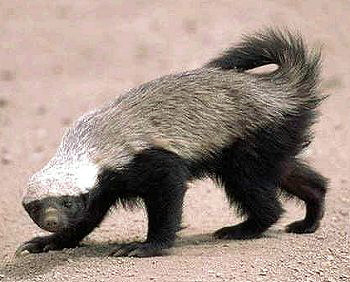
Honey Badger

Honey Badger

Mellivora capensis

en:User:Jaganath, CC BY-SA 3.0, via Wikimedia Commons

Side by side

Spotted-necked OtterHoney Badger
Scientific nameHydrictis maculicollis (Lichtenstein, 1835)Mellivora capensis (Schreber, 1776)
English nameSpotted-necked OtterHoney Badger
GroupMammalsMammals
ClassMammalia MammalMammalia Mammal
OrderCarnivora CarnivoresCarnivora Carnivores
FamilyMustelidae MustelidsMustelidae Mustelids
GenusHydrictis Spotted-necked OttersMellivora Ratels
Named in18351776
Red List categoryNear ThreatenedLeast Concern
Environmentfreshwater, terrestrialNot recorded
Countries on record18 countries37 countries
GBIF occurrence records391 records2,204 records

Rows where the two agree are shown in grey.

Where each is found

Both recorded in 16 countries

Only Spotted-necked Otter (2)

Only Honey Badger (21)

From Catalogue of Life checklists and GBIF occurrence records. A country missing from a list means no record is held, which is not proof of absence.

Checked facts

Spotted-necked OtterHoney Badger
Appearance
  • The spotted-necked otter has a chocolate to reddish-brown coat with creamy or white blotches across its chest and throat. English Wikipedia
  • The species has a broad head, short muzzle, small rounded ears, and a hairless nose pad. English Wikipedia
  • The species has a sleek body and webbed paws. English Wikipedia
  • Its toes are strongly webbed, with webbing extending to the tips of the digits, and it has well-developed claws. animaldiversity.org
  • The species has large sharp upper canine teeth, curved lower canines, and sharp carnassial teeth adapted for eating fish. English Wikipedia
  • The honey badger has short, sturdy legs and five toes on each foot. English Wikipedia
  • Its forelimbs have remarkably long claws, whereas its hind-leg claws are short. English Wikipedia
  • Its coat generally has a black lower body and a white or grey upper mantle extending to the base of the tail. animaldiversity.org
  • Individuals belonging to the cottoni subspecies have an entirely black coat. English Wikipedia
Size
Habitat
  • Honey badgers inhabit tropical and subtropical green forests, thorn forests, open woodlands, riparian forests, grasslands, arid steppes, rocky hills, and deserts. animaldiversity.org
  • Honey badgers occupy elevations from sea level to approximately 4,050 m. animaldiversity.org
  • Honey badgers require sheltering places such as burrows or rock crevices. animaldiversity.org
  • Honey badgers are not historically found in the extremely dry parts of the Sahara Desert or along the Mediterranean coast. animaldiversity.org
Diet
  • Honey badgers consume insects, frogs, tortoises, turtles, lizards, rodents, snakes, birds, and eggs. English Wikipedia
  • Honey badgers also eat berries, roots, and bulbs. English Wikipedia
  • Honey badgers raid beehives to obtain bee larvae and honey. English Wikipedia
  • Honey badgers consume all parts of their prey, including bones, feathers, hair, and skin. English Wikipedia
Behaviour
  • The species is typically solitary but sometimes occurs in small family groups. animaldiversity.org
  • Males and females remain separated for at least part of the year. English Wikipedia
  • Individuals normally hunt alone, except when mothers train their young. English Wikipedia
  • The species is diurnal and hunts using sight in clear water. English Wikipedia
  • Its hunting dives in clear water generally last less than 20 seconds. English Wikipedia
  • The species carries larger prey onto shore but eats smaller prey while treading water. English Wikipedia
  • Individuals generally travel along established paths on land and rarely move more than 10 m from water banks. English Wikipedia
  • The species marks habitual paths through sites where individuals defecate and urinate. English Wikipedia
  • Individuals shelter overnight in short burrows, rock crevices, or dense vegetation. English Wikipedia
  • The species produces high-pitched whistles and rapid shrill chatters. English Wikipedia
  • Its vocalizations include harsh mewing contact calls and high-pitched distress calls. animaldiversity.org
  • The species engages in play both alone and with other otters. animaldiversity.org
  • Its preferred feeding periods are two to three hours before dusk or after dawn. animaldiversity.org
  • Honey badgers are predominantly solitary animals. English Wikipedia
  • Honey badgers may be active at any time of day depending on their location. English Wikipedia
  • Honey badgers in the Serengeti are mostly nocturnal during the dry season and active throughout the day during the wet season. English Wikipedia
  • Honey badgers are skilled diggers capable of excavating tunnels in hard ground within ten minutes. English Wikipedia
  • Honey badger burrows are generally 1–3 m long and have a single entrance and an unlined nesting chamber. English Wikipedia
  • Adult male honey badgers have an average home range of 548 km², compared with 138 km² for females. English Wikipedia
  • Honey badgers scent-mark their territories using anal gland secretions, feces, and urine. English Wikipedia
  • Honey badgers can repel larger predators by releasing a pungent yellow liquid from their anal glands. English Wikipedia
  • Honey badgers sometimes hunt in pairs in Africa. English Wikipedia
Reproduction
  • Honey badgers can breed throughout the year rather than during a fixed mating season. English Wikipedia
  • Female honey badgers have an estimated oestrus period of approximately 14 days. English Wikipedia
  • The gestation period of honey badgers is approximately 50–70 days. animaldiversity.org
  • Female honey badgers move their cubs between dens during the first three months after birth. animaldiversity.org
  • Honey badger cubs begin accompanying their mothers while foraging at approximately three months of age. animaldiversity.org
  • Female honey badgers care for their offspring for approximately 12–16 months. animaldiversity.org
  • Male honey badgers generally reach sexual maturity at two to three years of age. animaldiversity.org
Distribution
  • Honey badgers occur across most of sub-Saharan Africa, from South Africa's Western Cape to southern Morocco and southwestern Algeria. English Wikipedia
  • The species' range extends beyond Africa through Arabia, Iran, Western Asia, Turkmenistan, and the Indian Peninsula. English Wikipedia
Conservation
  • The species is declining primarily because of habitat destruction and pollution affecting clear-water habitats. English Wikipedia
  • Entanglement and death in nylon fishing nets are documented threats to the species. animaldiversity.org
  • Soil erosion near river sources is a documented threat. animaldiversity.org
  • Fish farming and fur trapping contribute to the species' decline. animaldiversity.org
  • The honey badger is classified as Least Concern on the IUCN Red List. English Wikipedia
  • Honey badgers are threatened by killings associated with beekeeping and farming, including poisoning and trapping. English Wikipedia
Uses
  • Honey badgers are used in traditional medicine and consumed as bushmeat. English Wikipedia
OtherNo checked fact yet
  • The honey badger is the only living species in the genus Mellivora. English Wikipedia
  • The honey badger is the sole living representative of the subfamily Mellivorinae. English Wikipedia

In brief

Spotted-necked Otter

Hydrictis maculicollis is native to sub-Saharan Africa and inhabits lakes and rivers, including Lake Victoria and Lake Tanganyika. It is distinguished by its chocolate to reddish-brown coat with creamy or white blotches across its chest and throat. Full profile

Honey Badger

Mellivora capensis occurs across most of sub-Saharan Africa and extends through Arabia, Iran, Western Asia, Turkmenistan, and the Indian Peninsula. It is the only living species in the genus Mellivora and the sole living representative of the subfamily Mellivorinae. Full profile

Compare something else

Page built on 29 November 2026 from the data on the two species pages, where every source is listed.

Cite this page

ScientificNames.org. (2026). Spotted-necked Otter vs Honey Badger. Retrieved November 29, 2026, from https://scientificnames.org/compare/spotted-necked-otter-vs-honey-badger