Comparison

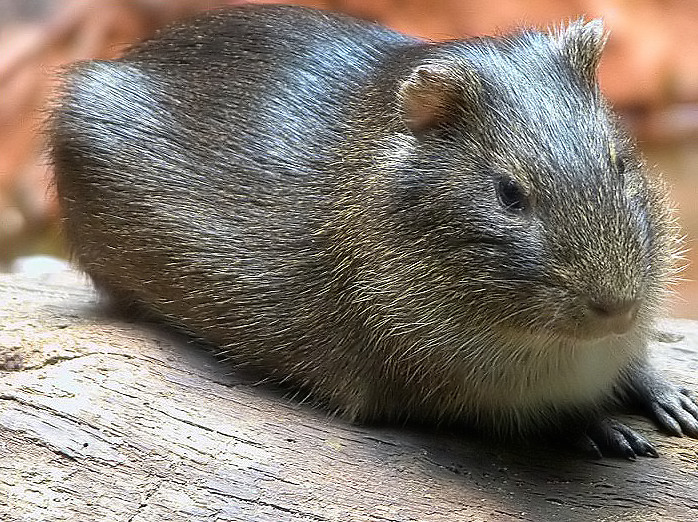
Capybara vs Brazilian Guinea Pig

Capybara (Hydrochoerus hydrochaeris) and Brazilian Guinea Pig (Cavia aperea) both belong to the family Caviidae (maras) and part ways below it. Both are recorded in 11 countries.

Capybara

Capybara

Hydrochoerus hydrochaeris

Charles J. Sharp, CC BY-SA 4.0, via Wikimedia Commons

Brazilian Guinea Pig

Brazilian Guinea Pig

Cavia aperea

Petra Karstedt (= PetraK; www.Tiermotive.de), CC BY-SA 2.0 de, via Wikimedia Commons

Side by side

CapybaraBrazilian Guinea Pig
Scientific nameHydrochoerus hydrochaeris (Linnaeus, 1766)Cavia aperea Erxleben, 1777
English nameCapybaraBrazilian Guinea Pig
GroupMammalsMammals
ClassMammalia MammalMammalia Mammal
OrderRodentia RodentRodentia Rodent
FamilyCaviidae MarasCaviidae Maras
GenusHydrochoerus CapybarasCavia Cavy
Named in17661777
Red List categoryLeast ConcernLeast Concern
Countries on record12 countries11 countries
GBIF occurrence records28,406 records8,944 records

Rows where the two agree are shown in grey.

Where each is found

Both recorded in 11 countries

Only Capybara (1)

From Catalogue of Life checklists and GBIF occurrence records. A country missing from a list means no record is held, which is not proof of absence.

Checked facts

CapybaraBrazilian Guinea Pig
Appearance
  • The capybara has a heavy, barrel-shaped body and a broad head. English Wikipedia
  • Its upper body has reddish-brown fur that becomes yellowish-brown underneath. English Wikipedia
  • Its coarse fur measures between 30 and 120 mm in length. English Wikipedia
  • The capybara has slightly webbed feet and a vestigial tail. English Wikipedia
  • Its hind legs are slightly longer than its forelegs. English Wikipedia
  • The capybara has three toes on each rear foot and four on each front foot. English Wikipedia
  • Its blunt muzzle has nostrils, while its eyes and ears are positioned near the top of its head. English Wikipedia
  • The capybara has sweat glands on the surface of the hairy portions of its skin. English Wikipedia
No checked fact yet
SizeNo checked fact yet
Habitat
  • Capybaras inhabit savannas and dense forests near and within freshwater bodies. English Wikipedia
  • Capybaras occupy seasonally flooded savannas, wetlands, and gallery forests. English Wikipedia
  • Their freshwater habitats include rivers, lakes, ponds, streams, swamps, and reservoirs. English Wikipedia
  • Capybaras are primarily found in lowland environments. English Wikipedia
  • Flooded grasslands, marsh edges, and lowland forests with year-round water are favored habitats. animaldiversity.org
  • The species also occupies dry forests, scrub, and grasslands throughout South America. animaldiversity.org
No checked fact yet
Diet
  • Capybaras are herbivores that feed mainly on grasses and aquatic plants. English Wikipedia
  • Their diet also includes fruit and tree bark. English Wikipedia
  • During the dry season, capybaras switch from grasses to more abundant reeds. English Wikipedia
  • Capybaras consume their own feces to obtain nutrients and assist the digestion of cellulose. English Wikipedia
  • An adult capybara can consume between 6 and 8 pounds of grass daily. roswell-nm.gov
  • During dry periods, capybaras may eat reeds, grains, melons, and squashes. roswell-nm.gov
No checked fact yet
Behaviour
  • Capybaras are highly social animals that commonly live in groups of 10 to 20 individuals. English Wikipedia
  • Capybara groups can contain as many as 100 individuals. English Wikipedia
  • Capybaras are strong swimmers and can remain underwater for up to five minutes. English Wikipedia
  • Capybaras rest on dry land in the morning, enter water during the hot early afternoon, and graze during the late afternoon and night. English Wikipedia
  • Capybara groups maintain territories containing water, grazing grassland, and dry resting areas. English Wikipedia
  • Capybaras communicate through barks, chirps, whistles, huffs, and purrs. English Wikipedia
  • Capybaras use scent marking to communicate through their morrillo and anal glands. English Wikipedia
  • Capybaras often hide in water with only their eyes and nostrils exposed. animaldiversity.org
  • Capybaras spend the hottest part of the day in water because their large body size makes them susceptible to heat stress. animaldiversity.org
No checked fact yet
Reproduction
  • Capybaras mate in water. English Wikipedia
  • The gestation period of capybaras lasts between 130 and 150 days. English Wikipedia
  • A typical capybara litter contains four young, although litter sizes range from one to eight. English Wikipedia
  • Newborn capybaras are born on land and join their group within hours of birth. English Wikipedia
  • Young capybaras can begin eating grass within one week of birth. English Wikipedia
  • Young capybaras are weaned at approximately 16 weeks. English Wikipedia
  • Capybaras breed throughout the year, with breeding activity peaking at the beginning of the rainy season. animaldiversity.org
  • Young capybaras remain with their parents' group until approximately one year of age. animaldiversity.org
No checked fact yet
Distribution
  • The capybara is native to every South American country except Chile. English Wikipedia
No checked fact yet
Conservation
  • The capybara is not considered a threatened species, and its population is stable throughout most of its South American range. English Wikipedia
  • Hunting has reduced capybara numbers in some areas. English Wikipedia
  • Capybara farming in some areas helps protect wetland habitats. English Wikipedia
No checked fact yet
UsesNo checked fact yet
Similar species
  • The lesser capybara is the closest named species relative of the greater capybara within the genus Hydrochoerus. English Wikipedia
  • Guinea pigs and rock cavies are close relatives of the capybara. English Wikipedia
No checked fact yet
Name originNo checked fact yet
OtherNo checked fact yet

In brief

Capybara

The Capybara belongs to the family Caviidae and is the largest living rodent. It is native to every South American country except Chile. It has a heavy, barrel-shaped body, slightly webbed feet, and a vestigial tail. Full profile

Compare something else

Page built on 24 November 2026 from the data on the two species pages, where every source is listed.

Cite this page

ScientificNames.org. (2026). Capybara vs Brazilian Guinea Pig. Retrieved November 24, 2026, from https://scientificnames.org/compare/capybara-vs-brazilian-guinea-pig