Species · Mammals
Capybara Hydrochoerus hydrochaeris
The scientific name of the Capybara is Hydrochoerus hydrochaeris. It is a species of mammal in the family Caviidae (maras), order Rodentia. The name dates from 1766.
- Scientific name
- Hydrochoerus hydrochaeris (Linnaeus, 1766)
- Common name
- Capybara
- Genus
- Hydrochoerus
- Family
- Caviidae (Maras)
- Order
- Rodentia
- Class
- Mammalia
- Red List category
- LC Least Concern
- Recorded in
- 12 countries
- Name status
- accepted in the Catalogue of Life

Overview
The Capybara belongs to the family Caviidae and is the largest living rodent. It is native to every South American country except Chile. It has a heavy, barrel-shaped body, slightly webbed feet, and a vestigial tail.
Written 24 November 2026 from the sources listed below. Each statement was checked against the passage it cites; statements that could not be supported were removed.
Appearance
The Capybara has a heavy, barrel-shaped body and a broad head. Its upper body has reddish-brown fur that becomes yellowish-brown underneath, and its coarse fur measures between 30 and 120 mm in length.[1][2][3]
Its feet are slightly webbed, and it has a vestigial tail. Its hind legs are slightly longer than its forelegs, with three toes on each rear foot and four on each front foot.[4][5][6]
Its blunt muzzle has nostrils, while its eyes and ears are positioned near the top of its head. Sweat glands occur on the surface of the hairy portions of its skin.[7][8]
Adult Capybaras measure between 106 and 134 cm in body length and stand between 50 and 62 cm tall at the withers. Typical adult body weight ranges from 35 to 66 kg, and females are slightly heavier than males.[9][10][11][12]
A wild female recorded in Brazil weighed 91 kg.[13]
Habitat
Capybaras inhabit savannas and dense forests near and within freshwater bodies. They occupy seasonally flooded savannas, wetlands, and gallery forests.[14][15]
Their freshwater habitats include rivers, lakes, ponds, streams, swamps, and reservoirs. They are primarily found in lowland environments, including flooded grasslands, marsh edges, and lowland forests with year-round water.[16][17][18]
The species also occupies dry forests, scrub, and grasslands throughout South America. It is native to every South American country except Chile.[19][20]
Diet
Capybaras are herbivores that feed mainly on grasses and aquatic plants. Their diet also includes fruit and tree bark.[21][22]
During the dry season, Capybaras switch from grasses to more abundant reeds. During dry periods, they may also eat grains, melons, and squashes.[23][24]
Capybaras consume their own feces to obtain nutrients and assist the digestion of cellulose. An adult can consume between 6 and 8 pounds of grass daily.[25][26]
Behaviour
Capybaras are highly social animals that commonly live in groups of 10 to 20 individuals. Groups can contain as many as 100 individuals.[27][28]
Capybaras are strong swimmers and can remain underwater for up to five minutes. They often hide in water with only their eyes and nostrils exposed.[29][30]
Capybaras rest on dry land in the morning, enter water during the hot early afternoon, and graze during the late afternoon and night. They spend the hottest part of the day in water because their large body size makes them susceptible to heat stress.[31][32]
Capybara groups maintain territories containing water, grazing grassland, and dry resting areas. They communicate through barks, chirps, whistles, huffs, and purrs.[33][34]
Capybaras use scent marking to communicate through their morrillo and anal glands.[35]
Reproduction and life cycle
Capybaras mate in water. They breed throughout the year, with breeding activity peaking at the beginning of the rainy season.[36][37]
The gestation period lasts between 130 and 150 days. A typical litter contains four young, although litter sizes range from one to eight.[38][39]
Newborn Capybaras are born on land and join their group within hours of birth. Young can begin eating grass within one week and are weaned at approximately 16 weeks.[40][41][42]
Young Capybaras remain with their parents' group until approximately one year of age.[43]
Conservation
The Capybara is not considered a threatened species, and its population is stable throughout most of its South American range. Hunting has reduced Capybara numbers in some areas.[44][45]
Capybara farming in some areas helps protect wetland habitats.[46]
Uses
Capybaras are hunted for their meat and hides. Their fatty skin is also used as a source of grease.[47][48]
Capybaras are farmed for their meat and skins in South America. Their meat is considered an important protein source in some areas, and their meat and leather are described as high-quality products.[49][50][51]
Similar species
The lesser capybara is the closest named species relative of the greater capybara within the genus Hydrochoerus. Guinea pigs and rock cavies are also close relatives of the Capybara.[52][53]
Classification of the Capybara
| Kingdom | Animalia |
|---|---|
| Phylum | Chordata |
| Subphylum | Vertebrata |
| Infraphylum | Gnathostomata |
| Parvphylum | Osteichthyes |
| Megaclass | Tetrapoda |
| Class | Mammalia (Mammal) |
| Subclass | Theria |
| Infraclass | Eutheria |
| Order | Rodentia (Rodent) |
| Suborder | Hystricomorpha |
| Infraorder | Hystricognathi (Hystricognath Rodents) |
| Family | Caviidae (Maras) |
| Subfamily | Hydrochoerinae (Capybaras) |
| Genus | Hydrochoerus (Capybaras) |
| Species | Hydrochoerus hydrochaeris (Linnaeus, 1766) |
Where the Capybara is found
Checklists and occurrence records place Hydrochoerus hydrochaeris in 12 countries across South America. GBIF holds 28,406 georeferenced records of it.
Countries
- Argentina 3,693
- Bolivia 936
- Brazil 11,806
- Colombia 10,152
- Ecuador 225
- French Guiana 173
- Guyana 47
- Paraguay 93
- Peru 620
- Suriname 52
- Uruguay 420
- Venezuela 189
Regions and cities with the most records
- São Paulo, Brazil 4,382
- Casanare Department, Colombia 4,242
- Santander Department, Colombia 4,196
- Barrancabermeja, Colombia 3,766
- Mato Grosso do Sul, Brazil 1,397
- Mato Grosso, Brazil 1,178
- Corrientes, Argentina 1,053
- Plano Piloto, Brazil 901
- Brasília, Brazil 895
- Guará, Brazil 887
- Paranoá, Brazil 850
- Jardim Botânico, Brazil 824
- Itapoã, Brazil 820
- Buenos Aires, Argentina 799
- Entre Rios, Argentina 795
- Meta Department, Colombia 782
- Rio Grande do Sul, Brazil 778
- São Sebastião, Brazil 753
- Beni Department, Bolivia 652
- Sobradinho, Brazil 622
- Rio de Janeiro, Brazil 569
- Sobradinho II, Brazil 562
- Paraná, Brazil 545
- Minas Gerais, Brazil 510
- Madre de Dios, Peru 509
- Vinhedo, Brazil 478
- Araras, Brazil 434
- Santa Catarina, Brazil 434
- Jundiaí, Brazil 403
- Valinhos, Brazil 395
- Trinidad, Bolivia 383
- Louveira, Brazil 382
- São Paulo, Brazil 381
- Águas Claras, Brazil 375
- Campinas, Brazil 373
- Don Torcuato, Argentina 364
7 more countries have a few records outside this range
These countries hold a few records of Hydrochoerus hydrochaeris but lie outside the range the checklists give for it. Such records are often zoo or garden specimens, museum material or vagrants, so the species is not counted as occurring there.
Range as the checklists state it
South America
A number beside a place is its count of GBIF occurrence records. A place without a number comes from a checklist alone. Records show where a species has been observed or collected, which can include escapes and vagrants.
Common names
English
- Capybara
- Greater Capybara
Names in 26 other languages
- Afrikaans
- Watervark
- Arabic
- خنزير الماء, كـابيبارا
- Breton
- Kapibara
- Chinese
- 水豚
- Croatian
- Vodenprase
- Danish
- Flodsvin
- Dutch
- Capibara, Waterzwijn
- Esperanto
- Akvoporko, Kapibaro
- Estonian
- Kapibaara, Veesiga
- Finnish
- Kapybara, Vesisika
- French
- Grand capybara
- German
- Wasserschwein
- Greek
- Υδρόχοιρος (Καπιμπάρα)
- Hebrew
- קפיבארה, קפיבארה מצויה
- Hungarian
- vízidisznó
- Japanese
- オニテンジクネズミ, カピバラ
- Korean
- 카피바라
- Lithuanian
- Didžioji kapibara
- Norwegian Bokmål
- Kapivar
- Polish
- Kapibara wielka
- Portuguese
- Capivara
- Russian
- Капибара
- Spanish
- Cacó, Capibara grande, Capincho, Carpincho, Chiguire, Chigüire, Chigüiro, Chigüiro (generalizado)
- Ukrainian
- Капібара
- grn
- kapi'yvá
- srm
- Kapiwa
Synonyms
4 other scientific names have been used for this species and are now treated as synonyms of Hydrochoerus hydrochaeris.
- Hydrochaeris hydrochaeris (Linnaeus, 1766)
- Hydrochoeris hydrochaeris Linnaeus, 1766
- Hydrochoerus capybara (Pallas, 1766)
- Sus hydrochaeris Linnaeus, 1766
Related species
-
 Lesser CapybaraHydrochoerus isthmius
-
 Guinea PigCavia porcellus
-
 Patagonian MaraDolichotis patagonum
-
 Montane Guinea PigCavia tschudii
-
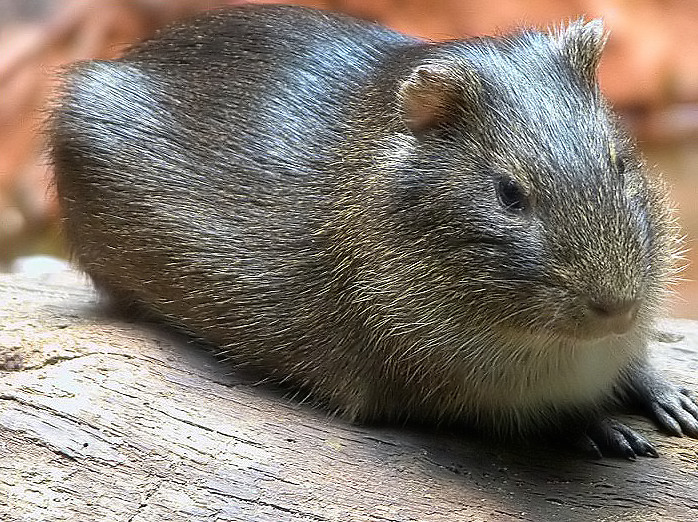 Brazilian Guinea PigCavia aperea
-
 Rock CavyKerodon rupestris
-
 Greater Guinea PigCavia magna
-
 Santa Catarina's Guinea PigCavia intermedia
Compare
Questions and answers
What is the scientific name of the Capybara?
The scientific name of the Capybara is Hydrochoerus hydrochaeris. Written with its author, the full name is Hydrochoerus hydrochaeris (Linnaeus, 1766).
Which family does the Capybara belong to?
Hydrochoerus hydrochaeris belongs to the family Caviidae, in the order Rodentia and the class Mammalia.
Where is the Capybara found?
Checklists and occurrence records place Hydrochoerus hydrochaeris in 12 countries, including Brazil, Colombia, Argentina, Bolivia, Peru and Uruguay.
What is the conservation status of the Capybara?
The IUCN Red List category recorded for Hydrochoerus hydrochaeris is Least Concern (LC).
What other names does the Capybara have?
Hydrochoerus hydrochaeris is also known in English as Greater Capybara.
Is a capybara a rat or a guinea pig?
The Capybara is a rodent. Guinea pigs and rock cavies are close relatives of the Capybara.[54][53]
What is the common name for a capybara?
Its common name is Capybara.[55]
What kind of diet does a capybara have?
The Capybara is a herbivore that feeds mainly on grasses and aquatic plants. Its diet also includes fruit and tree bark.[21][22]
What kind of habitat does a capybara live in?
The Capybara inhabits savannas, wetlands, dense forests, and grasslands near or within freshwater bodies. It is primarily found in lowland environments.[14][15][17][19]
Is a capybara an herbivore, carnivore, or omnivore?
The Capybara is an herbivore.[21]
Sources
Passages the profile rests on
- The capybara has a heavy, barrel-shaped body and a broad head. Source passage: “The capybara has a heavy, barrel-shaped body and a broad head” — English Wikipedia
- Its upper body has reddish-brown fur that becomes yellowish-brown underneath. Source passage: “with reddish-brown fur on the upper part of its body that turns yellowish-brown underneath.” — English Wikipedia
- Its coarse fur measures between 30 and 120 mm in length. Source passage: “Its coarse fur ranges in length from 30 to 120mm.” — English Wikipedia
- The capybara has slightly webbed feet and a vestigial tail. Source passage: “Capybaras have slightly webbed feet and vestigial tails.” — English Wikipedia
- Its hind legs are slightly longer than its forelegs. Source passage: “Their hind legs are slightly longer than their forelegs” — English Wikipedia
- The capybara has three toes on each rear foot and four on each front foot. Source passage: “they have three toes on their rear feet and four toes on their front feet.” — English Wikipedia
- Its blunt muzzle has nostrils, while its eyes and ears are positioned near the top of its head. Source passage: “Their muzzles are blunt, with nostrils, and the eyes and ears are near the top of their heads.” — English Wikipedia
- The capybara has sweat glands on the surface of the hairy portions of its skin. Source passage: “Its sweat glands can be found in the surface of the hairy portions of its skin, an unusual trait among rodents.” — English Wikipedia
- Adult capybaras measure between 106 and 134 cm in body length. Source passage: “Adult capybaras grow to 106 to 134 cm (3.48 to 4.40 ft) in length” — English Wikipedia
- Adult capybaras stand between 50 and 62 cm tall at the withers. Source passage: “stand 50 to 62 cm (20 to 24 in) tall at the withers” — English Wikipedia
- Typical adult body weight ranges from 35 to 66 kg. Source passage: “typically weigh 35 to 66 kg (77 to 146 lb)” — English Wikipedia
- Female capybaras are slightly heavier than males. Source passage: “Females are slightly heavier than males.” — English Wikipedia
- A wild female recorded in Brazil weighed 91 kg. Source passage: “The top recorded weights are 91 kg (201 lb) for a wild female from Brazil” — English Wikipedia
- Capybaras inhabit savannas and dense forests near and within freshwater bodies. Source passage: “It is a semiaquatic herbivore that inhabits savannas and dense forests, living near and in bodies of freshwater” — English Wikipedia
- Capybaras occupy seasonally flooded savannas, wetlands, and gallery forests. Source passage: “They are found in habitats such as seasonally flooded savannas, wetlands, and gallery forests” — English Wikipedia
- Their freshwater habitats include rivers, lakes, ponds, streams, swamps, and reservoirs. Source passage: “including rivers, lakes, ponds, streams, swamps and reservoirs.” — English Wikipedia
- Capybaras are primarily found in lowland environments. Source passage: “Capybaras live mostly in lowlands” — English Wikipedia
- Flooded grasslands, marsh edges, and lowland forests with year-round water are favored habitats. Source passage: “flooded grasslands are a favored habitat, as are marsh edges and lowland forests where grazing is good and there is water year-round.” — animaldiversity.org
- The species also occupies dry forests, scrub, and grasslands throughout South America. Source passage: “However, they occupy a range of habitats, including dry forest, scrub, and grasslands throughout South America.” — animaldiversity.org
- The capybara is native to every South American country except Chile. Source passage: “native to all countries in South America except Chile.” — English Wikipedia
- Capybaras are herbivores that feed mainly on grasses and aquatic plants. Source passage: “Capybaras are herbivores, grazing mainly on grasses and aquatic plants” — English Wikipedia
- Their diet also includes fruit and tree bark. Source passage: “as well as fruit and tree bark.” — English Wikipedia
- During the dry season, capybaras switch from grasses to more abundant reeds. Source passage: “While they eat grass during the wet season, they have to switch to more abundant reeds during the dry season.” — English Wikipedia
- During dry periods, capybaras may eat reeds, grains, melons, and squashes. Source passage: “During the dry season, when fresh grasses and water plants dry up, a capybara will eat reeds, grains, melons and squashes.” — roswell-nm.gov
- Capybaras consume their own feces to obtain nutrients and assist the digestion of cellulose. Source passage: “Capybaras are autocoprophagous, meaning they eat their own feces as a source of bacterial gut flora, to help digest the cellulose” — English Wikipedia
- An adult capybara can consume between 6 and 8 pounds of grass daily. Source passage: “An adult capybara can eat 6-8 pounds of grass per day.” — roswell-nm.gov
- Capybaras are highly social animals that commonly live in groups of 10 to 20 individuals. Source passage: “The capybara is a highly social species that usually lives in groups of 10–20 individuals” — English Wikipedia
- Capybara groups can contain as many as 100 individuals. Source passage: “but can be found in groups as large as 100.” — English Wikipedia
- Capybaras are strong swimmers and can remain underwater for up to five minutes. Source passage: “Capybaras are superb swimmers and can hold their breath underwater for up to five minutes at a time.” — English Wikipedia
- Capybaras often hide in water with only their eyes and nostrils exposed. Source passage: “They often hide in the water, with just their nostrils and eyes exposed” — animaldiversity.org
- Capybaras rest on dry land in the morning, enter water during the hot early afternoon, and graze during the late afternoon and night. Source passage: “In the morning, they rest on dry land. They then spend the hot early afternoon in the water to keep cool, after which they graze during the late afternoon and night until the Sun rises.” — English Wikipedia
- Capybaras spend the hottest part of the day in water because their large body size makes them susceptible to heat stress. Source passage: “Because of their large body size, capybaras are susceptible to heat stress. Activity is primarily crepuscular and the hottest part of the day is spent in the water.” — animaldiversity.org
- Capybara groups maintain territories containing water, grazing grassland, and dry resting areas. Source passage: “They normally include the different elements necessary for the capybaras' lifestyle, including a permanent body of water, grassland to graze on and an area of dry land used for resting.” — English Wikipedia
- Capybaras communicate through barks, chirps, whistles, huffs, and purrs. Source passage: “Capybaras communicate using barks, chirps, whistles, huffs, and purrs.” — English Wikipedia
- Capybaras use scent marking to communicate through their morrillo and anal glands. Source passage: “Capybaras scent-mark by rubbing their morrillos on objects, or by walking over scrub and marking it with their anal glands.” — English Wikipedia
- Capybaras mate in water. Source passage: “Capybaras mate only in water” — English Wikipedia
- Capybaras breed throughout the year, with breeding activity peaking at the beginning of the rainy season. Source passage: “Capybaras breed throughout the year, with a peak in breeding activity at the beginning of the rainy season.” — animaldiversity.org
- The gestation period of capybaras lasts between 130 and 150 days. Source passage: “Capybara gestation is 130–150 days” — English Wikipedia
- A typical capybara litter contains four young, although litter sizes range from one to eight. Source passage: “produces a litter of four young on average, but may produce between one and eight in a single litter.” — English Wikipedia
- Newborn capybaras are born on land and join their group within hours of birth. Source passage: “Birth is on land and the female rejoins the group within a few hours of delivering the newborn capybaras” — English Wikipedia
- Young capybaras can begin eating grass within one week of birth. Source passage: “Within a week, the young can eat grass” — English Wikipedia
- Young capybaras are weaned at approximately 16 weeks. Source passage: “until weaned around 16 weeks.” — English Wikipedia
- Young capybaras remain with their parents' group until approximately one year of age. Source passage: “Young capybaras stay with their parents' group until they are about a year old.” — animaldiversity.org
- The capybara is not considered a threatened species, and its population is stable throughout most of its South American range. Source passage: “Capybaras are not considered a threatened species; their population is stable throughout most of their South American range” — English Wikipedia
- Hunting has reduced capybara numbers in some areas. Source passage: “though in some areas hunting has reduced their numbers.” — English Wikipedia
- Capybara farming in some areas helps protect wetland habitats. Source passage: “In some areas, they are farmed, which has the effect of ensuring the wetland habitats are protected.” — English Wikipedia
- Capybaras are hunted for their meat and hides. Source passage: “It is hunted for its meat and hide” — English Wikipedia
- The fatty skin of capybaras is also used as a source of grease. Source passage: “and for grease from its thick fatty skin.” — English Wikipedia
- Capybaras are farmed for their meat and skins in South America. Source passage: “Capybaras are farmed for meat and skins in South America.” — English Wikipedia
- Capybara meat is considered an important protein source in some areas. Source passage: “in other areas it is considered an important source of protein.” — English Wikipedia
- Capybara meat and leather are described as high-quality products. Source passage: “Capybaras are hunted for their meat and leather, both of which are said to be very high-quality.” — animaldiversity.org
- The lesser capybara is the closest named species relative of the greater capybara within the genus Hydrochoerus. Source passage: “Together with the lesser capybara, it constitutes the genus Hydrochoerus.” — English Wikipedia
- Guinea pigs and rock cavies are close relatives of the capybara. Source passage: “Its other close relatives include guinea pigs and rock cavies” — English Wikipedia
- The capybara is the largest living rodent. Source passage: “The capybara ( kap-ih-BAR-uh) or greater capybara (Hydrochoerus hydrochaeris) is the largest living rodent” — English Wikipedia
- The common name capybara derives from the Tupi word ka'apiûara. Source passage: “Its common name is derived from Tupi ka'apiûara” — English Wikipedia
Data
- Catalogue of Life, 2026-10-16 XR cc by
- Global Biodiversity Information Facility CC BY 4.0
- Wikidata CC0
- GeoNames CC BY 4.0
- Wikimedia Commons per image; credit shown with each image
- Within the Catalogue of Life, this name comes from The Integrated Taxonomic Information System cc0
References
- Woods, Charles A., and C. William Kilpatrick / Wilson, Don E., and DeeAnn M. Reeder, eds. (2005). Infraorder Hystricognathi Brandt, 1855. Mammal Species of the World: A Taxonomic and Geographic Reference, 3rd Ed., Vol. 2.
- Wilson, Don E., T. E. Lacher Jr., and R. A. Mittermeier, eds. (2016). Handbook of the Mammals of the World. Vol. 6: Lagomorphs and Rodents I.
This species in other databases
Page built on 24 November 2026. See how the catalog is made and all sources and licences.
Cite this page
ScientificNames.org. (2026). Hydrochoerus hydrochaeris (Capybara). Retrieved November 24, 2026, from https://scientificnames.org/species/hydrochoerus-hydrochaeris
“Hydrochoerus hydrochaeris (Capybara).” ScientificNames.org, 2026, scientificnames.org/species/hydrochoerus-hydrochaeris. Accessed 24 Nov. 2026.
ScientificNames.org. “Hydrochoerus hydrochaeris (Capybara).” Accessed November 24, 2026. https://scientificnames.org/species/hydrochoerus-hydrochaeris.
@misc{scientificnames_hydrochoerus_hydrochaeris_capybara,
  author = {{ScientificNames.org}},
  title = {Hydrochoerus hydrochaeris (Capybara)},
  year = {2026},
  url = {https://scientificnames.org/species/hydrochoerus-hydrochaeris},
  note = {Accessed 2026-11-24}
}