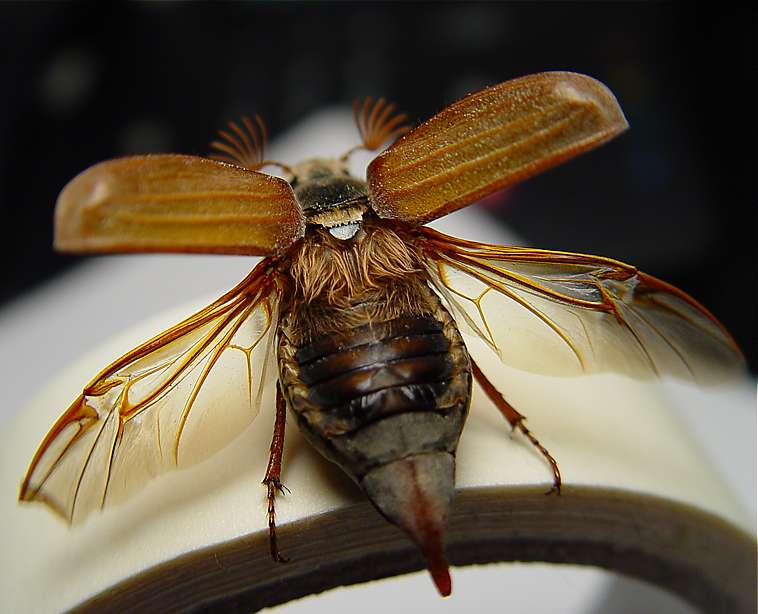
| Appearance | - Its antennae consist of ten segments, with the terminal segment longer in males than in females. English Wikipedia
- The beetle has long white hairs on its hind legs and lower body. English Wikipedia
- The front legs have three small teeth at their ends. English Wikipedia
| - Male adults have seven flattened, leaf-shaped antenna extensions, whereas females have six. English Wikipedia
- The male has larger, fan-shaped antennae than the female. English Wikipedia
- The larva has a white body, a black abdominal extremity, and a curved C-shaped posture. English Wikipedia
- The larva has a large brown head, strong mandibles, and well-developed hairy legs. English Wikipedia
|
|---|
| Size | No checked fact yet | - Adult cockchafers measure between 25 and 30 mm in length. English Wikipedia
- First-stage larvae measure 10–20 mm, second-stage larvae 30–35 mm, and final-stage larvae 40–46 mm. English Wikipedia
|
|---|
| Habitat | | - The species occurs particularly in temperate European regions with soil conditions suitable for larval development. English Wikipedia
|
|---|
| Diet | - Larvae feed on the roots of grasses and small-grain cereal crops. English Wikipedia
- Larvae feed on wheat, red clover, white clover, ryegrass, alfalfa, and oat roots. pmc.ncbi.nlm.nih.gov
- Adult beetles feed mainly on the leaves of Nothofagus antarctica, N. betuloides, N. dombeyi, and N. obliqua. English Wikipedia
- Adults feed mainly on Nothofagus obliqua leaves during the austral summer. pmc.ncbi.nlm.nih.gov
- Larval growth is correlated with the proportion of particulate organic matter in soil. English Wikipedia
| - Adult cockchafers feed on leaves of oak, sycamore, maple, hornbeam, beech, and plum trees. English Wikipedia
- Adults also feed on chestnut leaves occasionally. English Wikipedia
- Adult cockchafers consume leaves from deciduous trees and shrubs, including hazelnut. English Wikipedia
- Larvae feed on plant roots, including potato roots. English Wikipedia
- Larvae particularly consume roots of grasses, cereals, and other crops. English Wikipedia
- Cockchafer larvae feed on strawberry roots and can damage strawberry crops. English Wikipedia
|
|---|
| Behaviour | | - Male cockchafers generally swarm during mating season, while females remain stationary and feed on leaves. English Wikipedia
- Male cockchafers use plant-released green leaf volatiles to locate females feeding on leaves. English Wikipedia
- Larvae use plant volatiles and carbon dioxide to locate plant roots. English Wikipedia
- Male cockchafers emerge from the soil when temperatures become favourable in April or May. English Wikipedia
- Adult cockchafers typically disperse no more than 2–3 km from their emergence location. English Wikipedia
- Cockchafer larvae can move horizontally through soil by as much as 30 cm per day. English Wikipedia
- Cockchafer larvae undergo winter hibernation by burrowing deep into the soil. English Wikipedia
|
|---|
| Reproduction | - Virgin females release 1,4-hydroquinone and 1,4-benzoquinone, which attract males. English Wikipedia
- Volatile compounds released by damaged Nothofagus obliqua plants enhance male beetles' ability to locate females. English Wikipedia
- After copulation, females travel to crops such as red clover to deposit fertilized eggs. English Wikipedia
- The seasonal flight period associated with reproduction extends from 11 November to 27 January. English Wikipedia
- Gravid females deposit fertilized eggs approximately 2–3 cm below the soil surface in crop fields. pmc.ncbi.nlm.nih.gov
| - Females begin laying eggs approximately two to three weeks after adult emergence. English Wikipedia
- Females deposit their eggs in fields approximately 15–25 cm below the soil surface. English Wikipedia
- Each female can lay between 60 and 80 eggs. English Wikipedia
- Mating between cockchafers lasts several hours. English Wikipedia
- Female cockchafers lay eggs in batches containing 10–38 eggs. English Wikipedia
- Egg maturation takes approximately 5–8 days at 27 °C and 23–32 days at 15 °C. English Wikipedia
- Cockchafers develop through egg, larval, pupal, and adult stages. English Wikipedia
- Eggs hatch approximately four to six weeks after being laid. English Wikipedia
- The larva pupates underground during summer and develops into an adult over approximately six weeks. English Wikipedia
|
|---|
| Distribution | | |
|---|
| Conservation | No checked fact yet | - Cockchafer populations in Europe declined between the 1940s and 1970s following the use of toxic pesticides and expansion of agricultural land. English Wikipedia
- Cockchafer populations began recovering in some European areas after highly toxic pesticides were banned. English Wikipedia
|
|---|
| Uses | No checked fact yet | - Cockchafers were consumed in parts of Europe during the nineteenth century, including raw, sugared, candied, and in soup. English Wikipedia
|
|---|
| Similar species | No checked fact yet | - Melolontha hippocastani is a closely related and morphologically similar species that shares physical and behavioural characteristics with M. melolontha. English Wikipedia
- Melolontha hippocastani has a brown pronotum, whereas M. melolontha has a black pronotum. English Wikipedia
|
|---|
| Name origin | No checked fact yet | - The name cockchafer combines the word cock, referring to size or vigour, with chafer, referring to an insect of this type. English Wikipedia
- The scientific name Melolontha derives from the Ancient Greek word mēlolónthē, meaning cockchafer. English Wikipedia
|
|---|
| Other | - Hylamorpha elegans is the only species currently described in the genus Hylamorpha. English Wikipedia
- The species is commonly called San Juan Verde. pmc.ncbi.nlm.nih.gov
- The adult antennae contain four types of sensilla: chaetica, trichoidea, placodea, and coeloconica. English Wikipedia
- HeleOBP9 and HeleCSP2 are significantly expressed in the larval head but not in the antennae or legs. pmc.ncbi.nlm.nih.gov
- Adult beetles possess four characterized odorant-binding proteins named HeleOBP1, HeleOBP3, HeleOBP4, and HeleOBP6. English Wikipedia
- HeleOBP1 and HeleOBP3 show elevated expression in the antennae. English Wikipedia
- HeleOBP4 and HeleOBP6 show increased expression in the mouthparts. English Wikipedia
| No checked fact yet |
|---|