Comparison
Arrow-finned Squid vs Humboldt Squid
Arrow-finned Squid (Illex oxygonius) and Humboldt Squid (Dosidicus gigas) both belong to the family Ommastrephidae (flying squids) and part ways below it.

Arrow-finned Squid
Illex oxygonius
Michael Vecchione, Clyde F.E. Roper, & Michael J. Sweeney, Public domain, via Wikimedia Commons

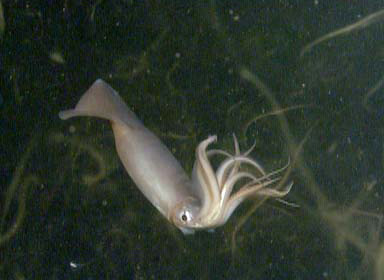
Humboldt Squid
Dosidicus gigas
Image courtesy of NOAA/MBARI 2006, Public domain, via Wikimedia Commons

Side by side
| Arrow-finned Squid | Humboldt Squid | |
|---|---|---|
| Scientific name | Illex oxygonius Roper, Lu & Mangold, 1969 | Dosidicus gigas (A. d'Orbigny, 1835) |
| English name | Arrow-finned Squid | Humboldt Squid |
| Group | Molluscs | Molluscs |
| Class | Cephalopoda Cephalopod | Cephalopoda Cephalopod |
| Order | Oegopsida | Oegopsida |
| Family | Ommastrephidae Flying Squids | Ommastrephidae Flying Squids |
| Genus | Illex Shortfin Squids | Dosidicus |
| Named in | 1969 | 1835 |
| Red List category | Least Concern | Data Deficient |
| Environment | marine | marine |
| Countries on record | 1 country | 5 countries |
| GBIF occurrence records | 37 records | 89,997 records |
Rows where the two agree are shown in grey.
Where each is found
Only Arrow-finned Squid (1)
Only Humboldt Squid (5)
From Catalogue of Life checklists and GBIF occurrence records. A country missing from a list means no record is held, which is not proof of absence.
Checked facts
| Arrow-finned Squid | Humboldt Squid | |
|---|---|---|
| Appearance | No checked fact yet |
|
| Size | No checked fact yet |
|
| Habitat | No checked fact yet |
|
| Diet | No checked fact yet |
|
| Behaviour | No checked fact yet |
|
| Reproduction | No checked fact yet |
|
| Distribution | No checked fact yet |
|
| Conservation | No checked fact yet |
|
| Uses | No checked fact yet |
|
| Other | No checked fact yet |
|
In brief
Humboldt Squid
Dosidicus gigas occurs in the eastern Pacific Ocean from northern California to southern Chile and inhabits ocean depths ranging from approximately 200 to 700 metres. It is distinguished by its ability to rapidly change its body coloration and produce red-and-white flashes across its entire body. Full profile
Compare something else
Page built on 26 November 2026 from the data on the two species pages, where every source is listed.
Cite this page
ScientificNames.org. (2026). Arrow-finned Squid vs Humboldt Squid. Retrieved November 26, 2026, from https://scientificnames.org/compare/arrow-finned-squid-vs-humboldt-squid
“Arrow-finned Squid vs Humboldt Squid.” ScientificNames.org, 2026, scientificnames.org/compare/arrow-finned-squid-vs-humboldt-squid. Accessed 26 Nov. 2026.
ScientificNames.org. “Arrow-finned Squid vs Humboldt Squid.” Accessed November 26, 2026. https://scientificnames.org/compare/arrow-finned-squid-vs-humboldt-squid.
@misc{scientificnames_arrow_finned_squid_vs_humboldt_squid,
  author = {{ScientificNames.org}},
  title = {Arrow-finned Squid vs Humboldt Squid},
  year = {2026},
  url = {https://scientificnames.org/compare/arrow-finned-squid-vs-humboldt-squid},
  note = {Accessed 2026-11-26}
}