Comparison

Indian Cobra vs Cape Cobra

Indian Cobra (Naja naja) and Cape Cobra (Naja nivea) both belong to the genus Naja (cobras) and part ways below it.
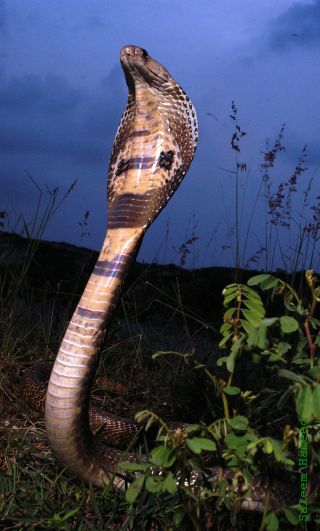
Indian Cobra

Indian Cobra

Naja naja

Saleem Hameed, CC BY 2.5, via Wikimedia Commons

Cape Cobra

Cape Cobra

Naja nivea

Ryan van Huyssteen, CC BY-SA 4.0, via Wikimedia Commons

Side by side

Indian CobraCape Cobra
Scientific nameNaja naja (Linnaeus, 1758)Naja nivea (Linnaeus, 1758)
English nameIndian CobraCape Cobra
GroupReptilesReptiles
ClassReptilia ReptileReptilia Reptile
OrderSquamata SnakesSquamata Snakes
FamilyElapidae CobrasElapidae Cobras
GenusNaja CobrasNaja Cobras
Named in17581758
Red List categoryLeast ConcernLeast Concern
EnvironmentterrestrialNot recorded
Countries on record15 countries4 countries
GBIF occurrence records2,471 records1,907 records

Rows where the two agree are shown in grey.

Where each is found

Only Indian Cobra (15)

Only Cape Cobra (4)

From Catalogue of Life checklists and GBIF occurrence records. A country missing from a list means no record is held, which is not proof of absence.

Checked facts

Indian CobraCape Cobra
Appearance
  • The Cape cobra varies in colour from light yellow and golden brown to dark brown and black. sanbi.org
  • Individuals may have speckles in shades of brown and orange. sanbi.org
  • Young Cape cobras have one or two dark throat bands. sanbi.org
  • The Cape cobra can raise its upper body and spread its ribs to form a broad hood. sanbi.org
SizeNo checked fact yet
Habitat
  • The Indian cobra inhabits dense and open forests, plains, agricultural lands, rocky terrain, and wetlands. English Wikipedia
  • The species also occurs in populated villages and city outskirts. English Wikipedia
  • Its documented habitat range extends from sea level to 2,000 metres in altitude. English Wikipedia
  • The Indian cobra is frequently found near water. English Wikipedia
  • Its preferred hiding places include embankment holes, tree hollows, termite mounds, rock piles, and small mammal dens. English Wikipedia
  • The species is absent from true desert regions. English Wikipedia
  • Sri Lankan populations inhabit terrestrial habitats at elevations of up to 1,500 metres. pmc.ncbi.nlm.nih.gov
  • Cape cobras commonly shelter in rodent burrows, abandoned termite mounds and rock crevices. English Wikipedia
  • In Lesotho, the species occurs at elevations reaching approximately 2,500 metres above sea level. English Wikipedia
Diet
  • The Indian cobra feeds on rodents, plovers, grebes, lizards, and frogs. English Wikipedia
  • The species sometimes enters buildings while searching for rodents. English Wikipedia
  • The Cape cobra is a generalist predator that consumes other snakes, rodents, lizards, birds and carrion. English Wikipedia
  • Cape cobras raid sociable weaver nests for food. English Wikipedia
  • Cape cobras sometimes consume their own offspring. English Wikipedia
  • The species hunts young birds and eggs in trees and shrubs. sanbi.org
  • The staple foods of Cape cobras include rodents and birds, with frogs, lizards and other snakes also consumed. sanbi.org
Behaviour
  • The Indian cobra bites its prey quickly and subsequently waits for its venom to paralyse or kill it. English Wikipedia
  • The species swallows its prey whole. English Wikipedia
  • Cape cobras are primarily active during daylight hours. English Wikipedia
  • During very hot weather, Cape cobras may become active during twilight. English Wikipedia
  • The species is primarily terrestrial but can climb trees and bushes. English Wikipedia
  • Cape cobras are usually solitary outside the mating season. sanbi.org
  • When threatened, Cape cobras raise their heads and spread their necks into a hood. sanbi.org
  • Cape cobras may hiss and strike readily when defending themselves. sanbi.org
  • When a perceived threat remains motionless, a Cape cobra may retreat rather than continue its defensive display. English Wikipedia
  • Cape cobras are generally more aggressive during the mating season. English Wikipedia
Reproduction
Distribution
  • The Indian cobra is native to the Indian subcontinent. English Wikipedia
  • Its documented distribution includes India, Pakistan, Sri Lanka, Bangladesh, and southern Nepal. English Wikipedia
  • The Cape cobra is endemic to southern Africa. English Wikipedia
  • In South Africa, the species occurs throughout the Western Cape, Northern Cape, Eastern Cape, Free State and North West provinces. English Wikipedia
  • The species also occurs in southern Namibia, southwestern Botswana and western Lesotho. English Wikipedia
  • The Cape cobra occurs in western Gauteng, South Africa. sanbi.org
Conservation
  • The Indian cobra is protected under India's Wildlife Protection Act of 1972. English Wikipedia
  • Cape cobras help farming communities by controlling rodent pests. sanbi.org
Uses
  • Cape cobras provide a natural form of rodent pest control on farms. sanbi.org
Similar species
  • The Oriental rat snake (Ptyas mucosa) is frequently mistaken for the Indian cobra. English Wikipedia
  • The monocled cobra can be distinguished from the Indian cobra by its O-shaped hood marking. English Wikipedia
No checked fact yet
Other
  • The Cape cobra delivers a powerful neurotoxic venom through biting. sanbi.org

In brief

Indian Cobra

The Indian Cobra (Naja naja) is a reptile in the family Elapidae, order Squamata, and genus Naja. It is native to the Indian subcontinent, with a documented distribution in India, Pakistan, Sri Lanka, Bangladesh, and southern Nepal. It is a moderately sized, heavy-bodied snake with a relatively large hood that expands when threatened. Full profile

Cape Cobra

The Cape Cobra is endemic to southern Africa, occurring in South Africa, southern Namibia, southwestern Botswana and western Lesotho. It can raise its upper body and spread its ribs to form a broad hood, and delivers neurotoxic venom through biting. Full profile

Compare something else

Page built on 27 November 2026 from the data on the two species pages, where every source is listed.

Cite this page

ScientificNames.org. (2026). Indian Cobra vs Cape Cobra. Retrieved November 27, 2026, from https://scientificnames.org/compare/indian-cobra-vs-cape-cobra