Comparison
Indian Cobra vs Tiger Snake
Indian Cobra (Naja naja) and Tiger Snake (Notechis scutatus) both belong to the family Elapidae (cobras) and part ways below it.
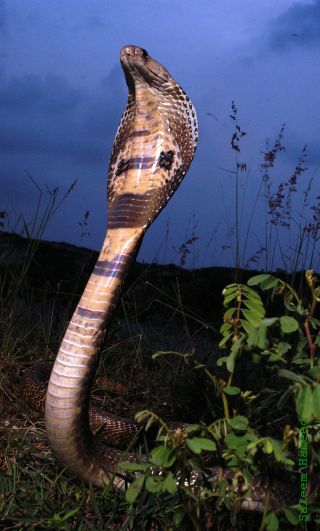


How they differ
The Indian cobra has a relatively large hood that it expands when threatened, whereas the tiger snake flattens its neck and upper body during threat displays. The Indian cobra has an elliptical, depressed head that is only slightly distinct from the neck, whereas the tiger snake has a flat, blunt head that is slightly distinct from its robust body. The Indian cobra is native to the Indian subcontinent, whereas the tiger snake occurs in southeastern and southwestern Australia, including Tasmania and islands in Bass Strait.
| Indian Cobra | Tiger Snake | |
|---|---|---|
| Appearance | The Indian cobra is moderately sized, heavy-bodied, and has a relatively large hood, with many individuals displaying two circular eye-like patterns connected by a curved line. | The tiger snake has highly variable body colours, sometimes with contrasting or indistinct pale-to-dark bands, and some populations consist almost entirely of individuals without body bands. |
| Head | The Indian cobra has an elliptical, depressed head that is only slightly distinct from the neck, with a short, rounded snout and large nostrils. | The common tiger snake has a flat, blunt head that is slightly distinct from its robust body. |
| Diet | The Indian cobra feeds on rodents, plovers, grebes, lizards, and frogs. | The tiger snake consumes fish, frogs, tadpoles, lizards, birds, mammals and carrion. |
| Prey capture | The Indian cobra bites its prey quickly and subsequently waits for its venom to paralyse or kill it. | The tiger snake uses venom to kill prey and may also use constriction to subdue it. |
| Habitat | The Indian cobra inhabits dense and open forests, plains, agricultural lands, rocky terrain, and wetlands. | The tiger snake inhabits marshes, riparian environments, temperate habitats, open forests, open heaths, tussock grasslands and woodlands. |
| Water association | The Indian cobra is frequently found near water. | The tiger snake is commonly associated with creeks, dams, drains, lagoons, wetlands and swamps. |
| Shelter | The Indian cobra prefers embankment holes, tree hollows, termite mounds, rock piles, and small mammal dens as hiding places. | The tiger snake shelters in fallen timber, dense matted vegetation and abandoned animal burrows. |
| Conservation | The Indian cobra is protected under India's Wildlife Protection Act of 1972. | Tiger snakes are protected species in most Australian states. |
Written from the checked facts listed further down. Statements that the sources did not support were removed.
Side by side
| Indian Cobra | Tiger Snake | |
|---|---|---|
| Scientific name | Naja naja (Linnaeus, 1758) | Notechis scutatus (Peters, 1861) |
| English name | Indian Cobra | Tiger Snake |
| Group | Reptiles | Reptiles |
| Class | Reptilia Reptile | Reptilia Reptile |
| Order | Squamata Snakes | Squamata Snakes |
| Family | Elapidae Cobras | Elapidae Cobras |
| Genus | Naja Cobras | Notechis Tiger Snakes |
| Named in | 1758 | 1861 |
| Red List category | Least Concern | Least Concern |
| Environment | terrestrial | Not recorded |
| Countries on record | 15 countries | 1 country |
| GBIF occurrence records | 2,471 records | 13,914 records |
Rows where the two agree are shown in grey.
Where each is found
Only Indian Cobra (15)
- Bangladesh
- Bhutan
- China
- India
- Indonesia
- Malaysia
- Myanmar
- Nepal
- Pakistan
- Philippines
- Singapore
- Sri Lanka
- Taiwan
- Thailand
- Vietnam
Only Tiger Snake (1)
From Catalogue of Life checklists and GBIF occurrence records. A country missing from a list means no record is held, which is not proof of absence.
Checked facts
| Indian Cobra | Tiger Snake | |
|---|---|---|
| Appearance |
|
|
| Habitat |
|
|
| Diet |
|
|
| Behaviour |
|
|
| Reproduction |
|
|
| Distribution |
|
|
| Conservation |
|
|
| Uses |
| No checked fact yet |
| Similar species |
|
|
| Other |
|
|
In brief
Indian Cobra
The Indian Cobra (Naja naja) is a reptile in the family Elapidae, order Squamata, and genus Naja. It is native to the Indian subcontinent, with a documented distribution in India, Pakistan, Sri Lanka, Bangladesh, and southern Nepal. It is a moderately sized, heavy-bodied snake with a relatively large hood that expands when threatened. Full profile
Tiger Snake
Tiger Snake (Notechis scutatus (Peters, 1861)) is a reptile belonging to the family Elapidae, order Squamata and class Reptilia. The species occurs in Western Australia, South Australia, Victoria, New South Wales and Tasmania, including islands in Bass Strait. Tiger Snakes have highly variable body colours, and some populations have contrasting or indistinct bands while others consist almost entirely of individuals without bands. Full profile
Compare something else
Page built on 24 November 2026 from the data on the two species pages, where every source is listed.
Cite this page
ScientificNames.org. (2026). Indian Cobra vs Tiger Snake. Retrieved November 24, 2026, from https://scientificnames.org/compare/indian-cobra-vs-tiger-snake
“Indian Cobra vs Tiger Snake.” ScientificNames.org, 2026, scientificnames.org/compare/indian-cobra-vs-tiger-snake. Accessed 24 Nov. 2026.
ScientificNames.org. “Indian Cobra vs Tiger Snake.” Accessed November 24, 2026. https://scientificnames.org/compare/indian-cobra-vs-tiger-snake.
@misc{scientificnames_indian_cobra_vs_tiger_snake,
  author = {{ScientificNames.org}},
  title = {Indian Cobra vs Tiger Snake},
  year = {2026},
  url = {https://scientificnames.org/compare/indian-cobra-vs-tiger-snake},
  note = {Accessed 2026-11-24}
}