Comparison
Indian Ginseng vs Jimsonweed
Indian Ginseng (Withania somnifera) and Jimsonweed (Datura stramonium) both belong to the subfamily Solanoideae and part ways below it. Both are recorded in 52 countries.


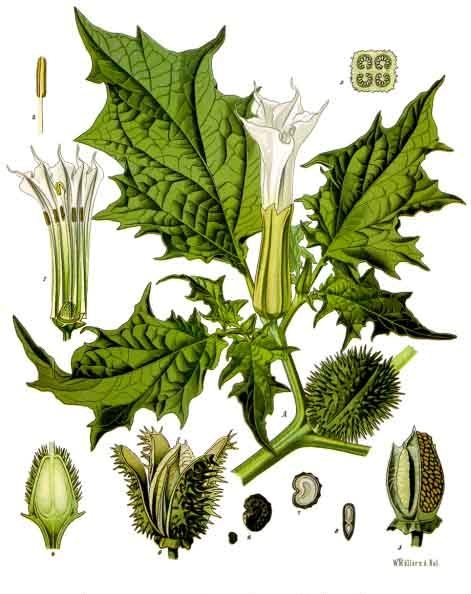
Jimsonweed
Datura stramonium
Franz Eugen Köhler, Köhler's Medizinal-Pflanzen, Public domain, via Wikimedia Commons

How they differ
Winter-cherry (Withania somnifera) is an evergreen shrub, whereas Fireweed (Datura stramonium) is an annual herbaceous species. Winter-cherry (Withania somnifera) is native to the Middle East, North Africa, other African regions, southern Europe, the Indian subcontinent, and Southeast Asia, whereas Fireweed (Datura stramonium) is native to Central America.
| Indian Ginseng | Jimsonweed | |
|---|---|---|
| Appearance | Winter-cherry (Withania somnifera) has branches covered with fine hairs that extend radially from a central stem. | Fireweed (Datura stramonium) has spiny, egg-shaped fruit capsules covered with short, sharp spines. |
| Behaviour | Bees, birds, and butterflies frequently visit winter-cherry (Withania somnifera). | Nocturnal moths feed on the flowers of Fireweed (Datura stramonium), which generally open at night and emit a pleasant fragrance. |
| Habitat | Winter-cherry (Withania somnifera) prefers dry, stony soil and grows in full sun or partial shade. | Fireweed (Datura stramonium) prefers nitrogen-enriched habitats and occurs in waste ground and cultivated land. |
| Other | Withanolides are among the principal phytochemical constituents of winter-cherry (Withania somnifera). | All parts of Fireweed (Datura stramonium) contain dangerous levels of tropane alkaloids, including atropine, hyoscyamine, and scopolamine. |
| Reproduction | Winter-cherry (Withania somnifera) can be propagated from seeds in early spring. | Fireweed (Datura stramonium) produces egg-shaped seed capsules measuring approximately 3 to 8 cm in diameter. |
| Uses | Winter-cherry (Withania somnifera) is used in Ayurvedic medicine as an adaptogen and nerve tonic. | Fireweed (Datura stramonium) has been used as a hallucinogen to induce intense visionary experiences. |
Written from the checked facts listed further down. Statements that the sources did not support were removed.
Side by side
| Indian Ginseng | Jimsonweed | |
|---|---|---|
| Scientific name | Withania somnifera (L.) Dunal | Datura stramonium L. |
| English name | Indian Ginseng | Jimsonweed |
| Group | Flowering plants | Flowering plants |
| Class | Magnoliopsida | Magnoliopsida |
| Order | Solanales | Solanales |
| Family | Solanaceae Nightshades | Solanaceae Nightshades |
| Genus | Withania | Datura Jimsonweed |
| Countries on record | 71 countries | 149 countries |
| GBIF occurrence records | 7,241 records | 176,154 records |
Rows where the two agree are shown in grey.
Where each is found
Both recorded in 52 countries
- Afghanistan
- Algeria
- Angola
- Australia
- Cabo Verde
- Chad
- China
- Cyprus
- Egypt
- Eswatini
- Ethiopia
- France
- Germany
- Greece
- India
- Iran
- Iraq
- Israel
- Italy
- Kenya
- Lebanon
- Lesotho
- Libya
- Madagascar
- Malawi
- Mali
- Mauritania
- Mauritius
- Morocco
- Mozambique
- Myanmar
- Namibia
- Nepal
- Nigeria
- Pakistan
- Portugal
- Saudi Arabia
- South Africa
- South Sudan
- Spain
- Sri Lanka
- Sudan
- Syria
- Tanzania
- Tunisia
- Turkey
- Uganda
- United Arab Emirates
- United Kingdom
- Yemen
- Zambia
- Zimbabwe
Only Indian Ginseng (19)
- Bahrain
- Bangladesh
- Botswana
- Burundi
- Cameroon
- Democratic Republic of the Congo
- Djibouti
- Eritrea
- Jordan
- Macao
- Niger
- Oman
- Palestinian Territory
- Qatar
- Reunion
- Rwanda
- Senegal
- Somalia
- Western Sahara
Only Jimsonweed (97)
- Albania
- Andorra
- Anguilla
- Argentina
- Armenia
- Austria
- Bahamas
- Barbados
- Belarus
- Belgium
- Belize
- Benin
- Bermuda
- Bhutan
- Bolivia
- Bonaire, Saint Eustatius and Saba
- Brazil
- Bulgaria
- Canada
- Central African Republic
- Chile
- Colombia
- Costa Rica
- Croatia
- Cuba
- Czechia
- Denmark
- Dominican Republic
- Ecuador
- El Salvador
- Estonia
- Fiji
- French Guiana
- Georgia
- Ghana
- Gibraltar
- Guadeloupe
- Guatemala
- Guernsey
- Guinea
- Haiti
- Honduras
- Hungary
- Ireland
- Ivory Coast
- Jamaica
- Japan
- Jersey
- Kazakhstan
- Kosovo
- Kyrgyzstan
- Laos
- Latvia
- Liechtenstein
- Lithuania
- Luxembourg
- Malta
- Martinique
- Mexico
- Montenegro
- Montserrat
- New Caledonia
- New Zealand
- Nicaragua
- North Macedonia
- Norway
- Panama
- Peru
- Poland
- Puerto Rico
- Romania
- Russia
- Saint Barthelemy
- Saint Helena
- Saint Kitts and Nevis
- San Marino
- Serbia
- Seychelles
- Slovakia
- Slovenia
- South Korea
- Sweden
- Switzerland
- Taiwan
- Tajikistan
- Thailand
- The Netherlands
- Togo
- Tonga
- Trinidad and Tobago
- Turkmenistan
- Turks and Caicos Islands
- U.S. Virgin Islands
- Ukraine
- United States
- Uzbekistan
- Venezuela
From Catalogue of Life checklists and GBIF occurrence records. A country missing from a list means no record is held, which is not proof of absence.
Checked facts
| Indian Ginseng | Jimsonweed | |
|---|---|---|
| Appearance |
|
|
| Size |
| No checked fact yet |
| Habitat |
|
|
| Behaviour |
|
|
| Reproduction |
|
|
| Distribution |
|
|
| Conservation | No checked fact yet |
|
| Uses |
|
|
| Name origin | No checked fact yet |
|
| Other |
|
|
In brief
Indian Ginseng
Indian Ginseng is an evergreen shrub. It is native to the Middle East, North Africa, other African regions, southern Europe, the Indian subcontinent, and Southeast Asia. Its principal phytochemical constituents include withanolides, and forty withanolides and twelve alkaloids have been isolated from the species. Full profile
Jimsonweed
Datura stramonium L. is an annual flowering herb in the family Solanaceae, commonly called jimsonweed. It is native to Central America and grows wild in warm and temperate regions worldwide. It is distinguished by its fragrant, trumpet-shaped flowers and spiny seed capsules containing numerous black seeds. Full profile
Compare something else
Page built on 24 November 2026 from the data on the two species pages, where every source is listed.
Cite this page
ScientificNames.org. (2026). Indian Ginseng vs Jimsonweed. Retrieved November 24, 2026, from https://scientificnames.org/compare/indian-ginseng-vs-jimsonweed
“Indian Ginseng vs Jimsonweed.” ScientificNames.org, 2026, scientificnames.org/compare/indian-ginseng-vs-jimsonweed. Accessed 24 Nov. 2026.
ScientificNames.org. “Indian Ginseng vs Jimsonweed.” Accessed November 24, 2026. https://scientificnames.org/compare/indian-ginseng-vs-jimsonweed.
@misc{scientificnames_indian_ginseng_vs_jimsonweed,
  author = {{ScientificNames.org}},
  title = {Indian Ginseng vs Jimsonweed},
  year = {2026},
  url = {https://scientificnames.org/compare/indian-ginseng-vs-jimsonweed},
  note = {Accessed 2026-11-24}
}