Comparison

Inland Taipan vs Common Krait

Inland Taipan (Oxyuranus microlepidotus) and Common Krait (Bungarus caeruleus) both belong to the family Elapidae (cobras) and part ways below it.

Inland Taipan

Inland Taipan

Oxyuranus microlepidotus

Photo by XLerate, CC BY-SA 3.0, via Wikimedia Commons

Common Krait

Common Krait

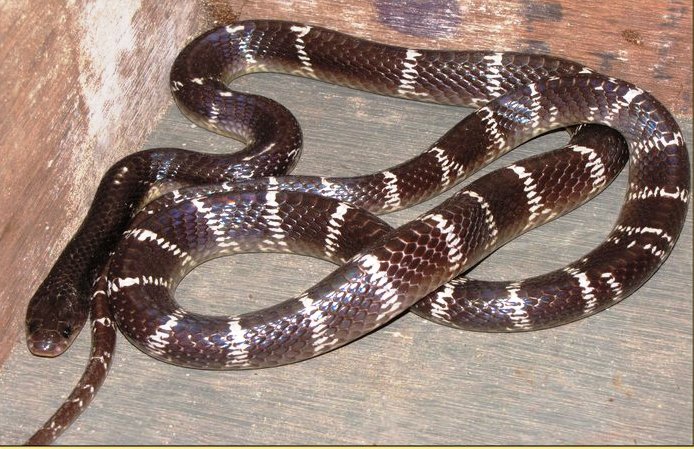
Bungarus caeruleus

Jayendra Chiplunkar, CC BY-SA 3.0, via Wikimedia Commons

How they differ

The inland taipan has a seasonally changing colour ranging from dark brown to brownish light green, while the common krait generally has a black or bluish-black body with narrow white crossbands. The inland taipan generally attempts to escape when threatened and raises its anterior body into a low, tight S-shaped curve when cornered, while the common krait may coil tightly with its head tucked underneath. The inland taipan feeds almost exclusively on small to medium-sized mammals in the wild, while the common krait feeds primarily on other snakes and also consumes small rodents, lizards, birds and frogs. The inland taipan is endemic to semiarid regions of central-eastern Australia, while the common krait occurs in India, Pakistan, Bangladesh, Sri Lanka and Nepal.

Inland TaipanCommon Krait
AppearanceThe inland taipan has varying shades of brown and grey on its back, flanks and tail, with broad blackish margins on many dorsal scales forming broken, backward-sloping chevron-like markings.The common krait generally has a black or bluish-black body with approximately 40 thin white crossbars.
Scale arrangementThe inland taipan has 23 rows of dorsal scales at midbody, and its dorsal scales are smooth and lack keels.The common krait has highly polished scales arranged in 15–17 rows, with an enlarged hexagonal vertebral row.
Threat responseThe inland taipan usually attempts to escape when threatened and raises its anterior body into a low, tight S-shaped curve when cornered or prevented from escaping.The common krait generally avoids confrontation, is non-aggressive and may coil tightly with its head tucked underneath when threatened.
DietThe inland taipan feeds almost exclusively on small to medium-sized mammals in the wild, including long-haired rats, plains rats and the introduced house mouse.The common krait feeds primarily on other snakes, including venomous kraits and vipers, and also consumes small rodents, lizards, birds and frogs.
DistributionThe inland taipan is endemic to semiarid regions of central-eastern Australia, with recorded Queensland localities including Diamantina National Park, Durrie Station, Morney Plains Station and Astrebla Downs National Park.The common krait occurs in India, Pakistan, Bangladesh, Sri Lanka and Nepal, with a reported western range extending to Afghanistan and potentially parts of Iran.
ConservationThe inland taipan was assessed as Least Concern on the IUCN Red List in 2018 and is legally protected in Australia.The common krait is reported to have a stable population despite localized habitat fragmentation and persecution.

Written from the checked facts listed further down. Statements that the sources did not support were removed.

Side by side

Inland TaipanCommon Krait
Scientific nameOxyuranus microlepidotus (Mccoy, 1879)Bungarus caeruleus (Schneider, 1801)
English nameInland TaipanCommon Krait
GroupReptilesReptiles
ClassReptilia ReptileReptilia Reptile
OrderSquamata SnakesSquamata Snakes
FamilyElapidae CobrasElapidae Cobras
GenusOxyuranus TaipanBungarus Deathpickers
Named in18791801
Red List categoryLeast ConcernLeast Concern
Countries on record1 country8 countries
GBIF occurrence records275 records1,003 records

Rows where the two agree are shown in grey.

Where each is found

Only Inland Taipan (1)

Only Common Krait (8)

From Catalogue of Life checklists and GBIF occurrence records. A country missing from a list means no record is held, which is not proof of absence.

Checked facts

Inland TaipanCommon Krait
Appearance
  • The inland taipan's overall colour ranges from dark brown to brownish light green depending on the season. English Wikipedia
  • Its back, flanks and tail display varying shades of brown and grey. English Wikipedia
  • Many of its dorsal scales have broad blackish margins that form broken, backward-sloping chevron-like markings. English Wikipedia
  • Its dorsal scales are smooth and lack keels. English Wikipedia
  • Its rounded snout, head and neck are generally darker than its body. English Wikipedia
  • Its head is glossy black in winter and dark brown in summer. English Wikipedia
  • Its eyes have dark brown to blackish irises and lack a distinct pale ring around the pupil. English Wikipedia
  • The species has 23 rows of dorsal scales at midbody. English Wikipedia
  • Its subcaudal scales number between 55 and 70 and are divided. English Wikipedia
  • The common krait generally has a black or bluish-black body with narrow white crossbands. English Wikipedia
  • The common krait has a cylindrical body that tapers towards a short, rounded tail. English Wikipedia
  • The common krait has a flat head and relatively small eyes with rounded pupils. English Wikipedia
  • The common krait has highly polished scales arranged in 15–17 rows, with an enlarged hexagonal vertebral row. English Wikipedia
  • The common krait typically has approximately 40 thin white crossbars, which may be indistinct or absent near the front of the body. English Wikipedia
  • Young common kraits have conspicuous white crossbars across the anterior part of their bodies. English Wikipedia
  • The upper lips and belly of the common krait are white. English Wikipedia
  • Albino individuals of the common krait occur but are extremely rare. English Wikipedia
Size
  • The average body length of the common krait is approximately 0.9 m. English Wikipedia
  • The common krait can reach a maximum recorded length of 1.75 m. English Wikipedia
  • Male common kraits are longer than females and have proportionately longer tails. English Wikipedia
Habitat
  • The species inhabits cracking-clay plains in semiarid regions near the Queensland–South Australia border. English Wikipedia
  • Abandoned mammal burrows and deep rock crevices are among the sheltered sites used for egg laying. English Wikipedia
  • The common krait inhabits scrub jungles, grasslands, agricultural fields, semi-desert environments and rocky terrain. English Wikipedia
  • The common krait occurs in suburban gardens and human-modified landscapes such as plantations and cultivated lands. English Wikipedia
  • The common krait takes refuge in termite mounds, rat burrows and locations beneath debris. English Wikipedia
  • The common krait is particularly associated with habitats near streams, canals and ponds. English Wikipedia
  • During the monsoon season, the common krait may enter houses in search of shelter or prey. English Wikipedia
Diet
  • The common krait feeds primarily on other snakes, including venomous kraits and vipers. English Wikipedia
  • The common krait also consumes small rodents, lizards, birds and frogs. English Wikipedia
Behaviour
  • The inland taipan generally has a shy, reclusive and placid disposition. English Wikipedia
  • The species usually attempts to escape when threatened. English Wikipedia
  • When cornered or prevented from escaping, it raises its anterior body into a low, tight S-shaped curve. English Wikipedia
  • During prey capture, the species can deliver as many as eight envenoming bites in one attack. English Wikipedia
  • During attacks, the snake commonly maintains physical contact with its prey while restraining it with its body. English Wikipedia
  • The species exhibits seasonal colour changes associated with thermoregulation. English Wikipedia
  • The common krait is nocturnal and is most active during the night. English Wikipedia
  • During daylight hours, the common krait remains inactive and hides in concealed locations. English Wikipedia
  • The common krait generally avoids confrontation and is non-aggressive. English Wikipedia
  • When threatened, the common krait may coil tightly with its head tucked underneath. English Wikipedia
  • The common krait rarely bites unless provoked. English Wikipedia
  • Common krait bites have been frequently recorded among people sleeping on the ground. English Wikipedia
  • Common krait bites investigated in Anuradhapura occurred at night while victims were asleep on the floor. pmc.ncbi.nlm.nih.gov
Reproduction
  • The inland taipan is an egg-laying species. English Wikipedia
  • Females typically produce clutches containing 10–24 eggs. English Wikipedia
  • Egg incubation lasts approximately two months, with its duration influenced by temperature and humidity. English Wikipedia
  • Female reproductive output is partly dependent on food availability. English Wikipedia
Distribution
  • The species is endemic to semiarid regions of central-eastern Australia. English Wikipedia
  • In Queensland, the species has been recorded in the Channel Country bioregion. English Wikipedia
  • Recorded Queensland localities include Diamantina National Park, Durrie Station, Morney Plains Station and Astrebla Downs National Park. English Wikipedia
  • In South Australia, the species has been observed in the Marree–Innamincka NRM district. English Wikipedia
  • South Australian localities include Goyder Lagoon, the Tirari Desert, Sturt Stony Desert, Coongie Lakes and Innamincka Regional Reserve. English Wikipedia
  • An isolated population occurs near Coober Pedy in South Australia. English Wikipedia
  • The common krait occurs in India, Pakistan, Bangladesh, Sri Lanka and Nepal. English Wikipedia
  • The reported western extent of the common krait's range includes Afghanistan and potentially parts of Iran. English Wikipedia
Conservation
  • The common krait is reported to have a stable population despite localized habitat fragmentation and persecution. English Wikipedia
OtherNo checked fact yet
  • The common krait is highly venomous. English Wikipedia
  • The common krait's venom is predominantly neurotoxic. English Wikipedia
  • Phospholipases A2 account for approximately 64.5% of the common krait's venom proteome. English Wikipedia
  • The common krait is identified as the deadliest snake commonly found in Sri Lanka's dry zone. pmc.ncbi.nlm.nih.gov
  • In a prospective Anuradhapura study, 210 farmers bitten by common kraits were investigated over three years. pmc.ncbi.nlm.nih.gov
  • In the Anuradhapura study, 16 patients, representing 7.6% of the investigated cases, died. pmc.ncbi.nlm.nih.gov

In brief

Inland Taipan

Oxyuranus microlepidotus inhabits semiarid regions of central-eastern Australia, including cracking-clay plains near the Queensland–South Australia border. It is a dietary specialist that feeds almost exclusively on small to medium-sized mammals in the wild. Full profile

Common Krait

The Common Krait (Bungarus caeruleus) is a highly venomous snake in the family Elapidae, order Squamata and class Reptilia. It occurs in India, Pakistan, Bangladesh, Sri Lanka and Nepal, with a reported western extent including Afghanistan and potentially parts of Iran. It is predominantly nocturnal and feeds primarily on other snakes, including venomous kraits and vipers. Full profile

Compare something else

Page built on 24 November 2026 from the data on the two species pages, where every source is listed.

Cite this page

ScientificNames.org. (2026). Inland Taipan vs Common Krait. Retrieved November 24, 2026, from https://scientificnames.org/compare/inland-taipan-vs-common-krait