Comparison
Irish Moss vs Turkish Towel
Irish Moss (Chondrus crispus) and Turkish Towel (Chondracanthus exasperatus) both belong to the family Gigartinaceae and part ways below it. Both are recorded in 2 countries.
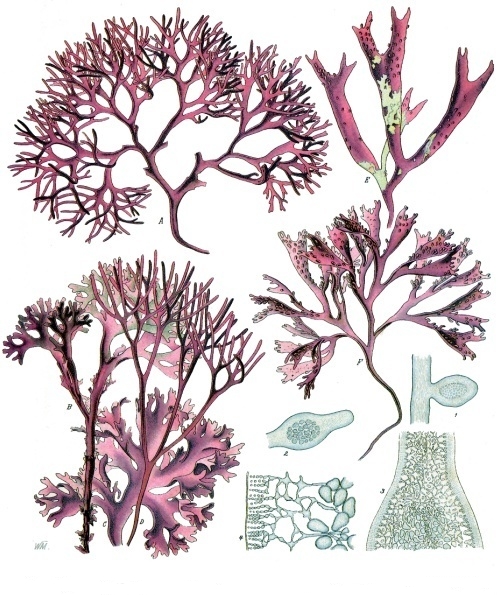
Irish Moss
Chondrus crispus
Franz Eugen Köhler, Köhler's Medizinal-Pflanzen, Public domain, via Wikimedia Commons

Turkish Towel
Chondracanthus exasperatus
How they differ
Irish Moss (Chondrus crispus) has dichotomously divided, fan-like branches, whereas Turkish Towel (Chondracanthus exasperatus) has leathery, membranous, lance-shaped, originally described unbranched blades. Irish Moss (Chondrus crispus) has a soft, cartilaginous texture when fresh, whereas Turkish Towel (Chondracanthus exasperatus) has rough blades densely covered with small papillae. Irish Moss (Chondrus crispus) can reach slightly more than 20 cm in length, whereas the originally described blades of Turkish Towel (Chondracanthus exasperatus) measure approximately 0.61–0.91 metres in length.
| Irish Moss | Turkish Towel | |
|---|---|---|
| Appearance | Irish Moss (Chondrus crispus) has branches between 2 and 15 mm wide with a firm texture. | Turkish Towel (Chondracanthus exasperatus) has thick blade margins bearing rounded teeth and appendages. |
| Colouration | Irish Moss (Chondrus crispus) can turn green under strong sunlight. | Turkish Towel (Chondracanthus exasperatus) becomes greenish under ultraviolet light. |
| Habitat | Irish Moss (Chondrus crispus) grows on rocks from the middle intertidal zone into the subtidal zone. | Turkish Towel (Chondracanthus exasperatus) occurs in the upper subtidal to lower intertidal zone. |
| Depth | Irish Moss (Chondrus crispus) grows into the subtidal zone. | Turkish Towel (Chondracanthus exasperatus) has been recorded at depths reaching 20 metres. |
| Diet | Irish Moss (Chondrus crispus) is readily consumed by the crustacean Idotea baltica when alternative food is unavailable. | Turkish Towel (Chondracanthus exasperatus) is avoided by the amphipods Megalorchestia californiana and Traskorchestia spp. |
| Uses | Irish Moss (Chondrus crispus) is traditionally used fresh as a thickening ingredient in carrageen pudding in Scotland and Ireland. | Turkish Towel (Chondracanthus exasperatus) has intact blades used in baths and thalassotherapy. |
| Cultivation | Irish Moss (Chondrus crispus) is harvested commercially for carrageenan used in pharmaceutical and food industries. | Turkish Towel (Chondracanthus exasperatus) can be cultivated in air when sprayed with seawater. |
Written from the checked facts listed further down. Statements that the sources did not support were removed.
Side by side
| Irish Moss | Turkish Towel | |
|---|---|---|
| Scientific name | Chondrus crispus (Linnaeus) J. Stackhouse | Chondracanthus exasperatus (Harvey & Bailey) Hughey |
| English name | Irish Moss | Turkish Towel |
| Group | Algae and other plants | Algae and other plants |
| Class | Florideophyceae | Florideophyceae |
| Order | Gigartinales | Gigartinales |
| Family | Gigartinaceae | Gigartinaceae |
| Genus | Chondrus | Chondracanthus |
| Countries on record | 22 countries | 3 countries |
| GBIF occurrence records | 41,723 records | 3,145 records |
Rows where the two agree are shown in grey.
Where each is found
Both recorded in 2 countries
Only Irish Moss (20)
- Belgium
- Denmark
- Faroe Islands
- France
- Germany
- Guernsey
- Iceland
- Ireland
- Isle of Man
- Italy
- Jersey
- Norway
- Portugal
- Romania
- Russia
- Saint Pierre and Miquelon
- Spain
- Sweden
- The Netherlands
- United Kingdom
Only Turkish Towel (1)
From Catalogue of Life checklists and GBIF occurrence records. A country missing from a list means no record is held, which is not proof of absence.
Checked facts
| Irish Moss | Turkish Towel | |
|---|---|---|
| Appearance |
|
|
| Size |
|
|
| Habitat |
|
|
| Diet |
|
|
| Behaviour |
|
|
| Reproduction |
|
|
| Lifespan | No checked fact yet |
|
| Conservation | No checked fact yet |
|
| Uses |
|
|
| Similar species |
| No checked fact yet |
| Name origin | No checked fact yet |
|
| Other |
| No checked fact yet |
In brief
Irish Moss
Chondrus crispus grows on rocks from the middle intertidal zone into the subtidal zone and occurs on coastal shores and in coastal waters. Full profile
Turkish Towel
Chondracanthus exasperatus grows on rocks in semi-exposed or semi-protected coastal habitats, from the upper subtidal to lower intertidal zone, at depths reaching 20 metres. Its leathery blades have a rough surface densely covered with small papillae and are purplish-red in their original description. Full profile
Compare something else
Page built on 24 November 2026 from the data on the two species pages, where every source is listed.
Cite this page
ScientificNames.org. (2026). Irish Moss vs Turkish Towel. Retrieved November 24, 2026, from https://scientificnames.org/compare/irish-moss-vs-turkish-towel
“Irish Moss vs Turkish Towel.” ScientificNames.org, 2026, scientificnames.org/compare/irish-moss-vs-turkish-towel. Accessed 24 Nov. 2026.
ScientificNames.org. “Irish Moss vs Turkish Towel.” Accessed November 24, 2026. https://scientificnames.org/compare/irish-moss-vs-turkish-towel.
@misc{scientificnames_irish_moss_vs_turkish_towel,
  author = {{ScientificNames.org}},
  title = {Irish Moss vs Turkish Towel},
  year = {2026},
  url = {https://scientificnames.org/compare/irish-moss-vs-turkish-towel},
  note = {Accessed 2026-11-24}
}