Species · Algae and other plants
Irish Moss Chondrus crispus
The scientific name of the Irish Moss is Chondrus crispus. It is a species of plant in the family Gigartinaceae, order Gigartinales.
- Scientific name
- Chondrus crispus (Linnaeus) J. Stackhouse
- Common name
- Irish Moss
- Genus
- Chondrus
- Family
- Gigartinaceae
- Order
- Gigartinales
- Class
- Florideophyceae
- Recorded in
- 22 countries
- Name status
- accepted in the Catalogue of Life
Overview
Chondrus crispus grows on rocks from the middle intertidal zone into the subtidal zone and occurs on coastal shores and in coastal waters.
Written 24 November 2026 from the sources listed below. Each statement was checked against the passage it cites; statements that could not be supported were removed.
Appearance
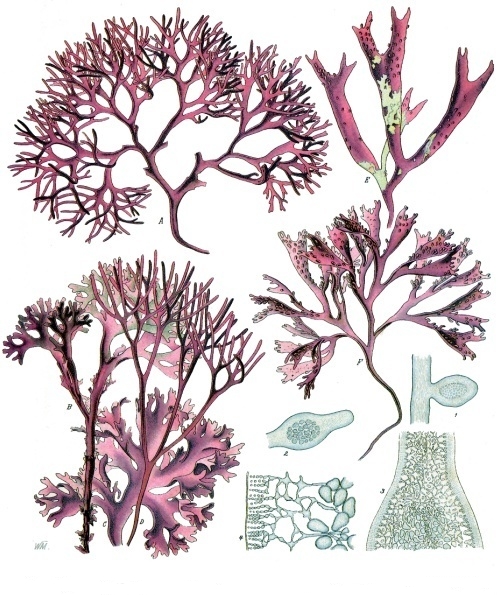
Fresh Irish Moss has a soft, cartilaginous texture and coloration ranging from greenish-yellow through red to dark purple or purplish-brown. Its branches form a dichotomously divided, fan-like structure and are between 2 and 15 mm wide, with a firm texture.[1][2][3][4]
Its coloration can range from bright green near the water surface to deep red at greater depths, and it can turn green under strong sunlight. The tips of gametophyte fronds often display blue iridescence, while fertile sporophytes display a spotty pattern.[5][6][7][8]
Female reproductive structures occur at frond tips as cystocarps approximately 2 mm in diameter. The alga can reach slightly more than 20 cm in length.[9][10]
Habitat
Irish Moss grows on rocks from the middle intertidal zone into the subtidal zone. It occurs in rock pools and on rocky shores, including habitats with bedrock, large and very large boulders, and small boulders.[11][12][13]
It occurs in open coastal waters, straits, sounds, estuaries and enclosed coastal embayments. It can survive under minimal sunlight.[14][15]
Diet
The crustacean Idotea baltica readily consumes Irish Moss when alternative food is unavailable.[16]
Behaviour
Irish Moss can grow as an epiphyte on kelps.[17]
Reproduction and life cycle
Irish Moss has a life cycle that includes sexual haploid gametophyte and asexual diploid sporophyte stages. Male and female gametophytes produce gametes that fuse to form a diploid carposporophyte, which develops on the female gametophyte after fertilization.[18][19][20]
Female gametophytes produce carpospores through the carposporophyte stage. The sporophyte undergoes meiosis to produce haploid tetraspores that develop into gametophytes.[21][22]
Uses
Irish Moss is traditionally used fresh as a thickening ingredient in carrageen pudding in Scotland and Ireland. Its carrageenan-rich cell walls allow the alga to form a jelly when boiled.[23][24]
The species is harvested commercially for carrageenan used in the pharmaceutical and food industries. Carrageenan is used industrially as a thickener and stabilizer in milk products and processed foods.[25][26]
Its carrageenan can also be used as a thickener in calico printing and paper marbling.[27]
Similar species
Mastocarpus stellatus is a similar species. It can be distinguished by its strongly channelled and often twisted fronds, rounded stipe and papillate reproductive bodies.[28][29]
Classification of the Irish Moss
| Kingdom | Plantae |
|---|---|
| Phylum | Rhodophyta (Red Algae) |
| Subphylum | Eurhodophytina |
| Class | Florideophyceae |
| Subclass | Rhodymeniophycidae |
| Order | Gigartinales |
| Family | Gigartinaceae |
| Genus | Chondrus |
| Species | Chondrus crispus (Linnaeus) J. Stackhouse |
This name was added to the Catalogue of Life from a contributing dataset by automated merging and has not yet been reviewed by its editors.
Where the Irish Moss is found
Checklists and occurrence records place Chondrus crispus in 22 countries. GBIF holds 41,723 georeferenced records of it.
Countries
- Belgium 19
- Canada 3,015
- Denmark 1,161
- Faroe Islands 117
- France 4,445
- Germany 253
- Guernsey 63
- Iceland 86
- Ireland 1,814
- Isle of Man 148
- Italy 3
- Jersey 117
- Norway 2,174
- Portugal 675
- Romania 3
- Russia 21
- Saint Pierre and Miquelon 6
- Spain 727
- Sweden 9,972
- The Netherlands 1,116
- United Kingdom 11,175
- United States 4,613
Regions and cities with the most records
- Västra Götaland, Sweden 3,051
- England, United Kingdom 1,502
- Wales, United Kingdom 1,220
- Maine, United States 899
- Scotland, United Kingdom 881
- New Hampshire, United States 871
- Nova Scotia, Canada 815
- Mölndal, Sweden 686
- Massachusetts, United States 487
- Northern Ireland, United Kingdom 426
- Plymouth, United Kingdom 391
- Bangor, United Kingdom 384
- Lynn, United States 378
- Revere, United States 373
- Everett, United States 351
- Malden, United States 347
- Boston, United States 345
- Zeeland, The Netherlands 343
- South Peabody, United States 340
- Somerville, United States 332
- Cambridge, United States 331
- Medford, United States 324
- Dorchester, United States 312
- Halland, Sweden 294
- Brest, France 284
- Brookline, United States 266
- Quincy, United States 263
- Gothenburg, Sweden 256
- Folkestone, United Kingdom 247
- Pays de la Loire, France 240
- Middelburg, The Netherlands 238
- Viana do Castelo, Portugal 238
- Peabody, United States 236
- Torquay, United Kingdom 223
- Margate, United Kingdom 217
- Saint Peters, United Kingdom 215
7 more countries have a few records outside this range
These countries hold a few records of Chondrus crispus but lie outside the range the checklists give for it. Such records are often zoo or garden specimens, museum material or vagrants, so the species is not counted as occurring there.
A number beside a place is its count of GBIF occurrence records. A place without a number comes from a checklist alone. Records show where a species has been observed or collected, which can include escapes and vagrants.
Common names
English
- Irish Moss
- Carrageen
- Carrageen (Irish Moss)
- Carragheen
- Sea Moss
Names in 30 other languages
- Arabic
- الطحلب الأيرلندي
- Asturian
- carragán
- Bulgarian
- ирландски мъх
- Catalan
- molsa d'Irlanda
- Chinese
- 皺波角叉菜, 皺葉角叉菜
- Croatian
- Irska mahovina
- Czech
- puchratka kadeřavá
- Danish
- Blomkålstang, Carrageentang
- Dutch
- Iers mos
- Finnish
- Irlanninsammal, iirinpunaviuhka
- French
- Chondrus, Goémon frisé, Mousse perle
- Galician
- Carrapucho
- German
- Knorpeltang
- Hungarian
- ír moszat
- Icelandic
- Fjörugrös
- Irish
- Carraigín
- Japanese
- ヤハズツノマタ
- Korean
- 아일랜드이끼, 주름진두발, 카라긴
- Lithuanian
- Vaistinis drebulotis
- Norwegian Bokmål
- krusflik
- Polish
- Chrząstnica kędzierzawa
- Portuguese
- Botelho-crespo, Musgo-da-irlanda, Musgo-gordo, alga-perlada
- Russian
- Ирландский мох, Хондрус курчавый
- Scottish Gaelic
- cairgean, cairgeanan
- Spanish
- Musgo de Irlanda
- Swedish
- brosktång, karragenalg, karragentång, pärlmossa
- Ukrainian
- Ірландський мох
- Vietnamese
- Tảo Ireland
- Welsh
- Gwymon melys
- ldn
- analel
Synonyms
9 other scientific names have been used for this species and are now treated as synonyms of Chondrus crispus.
- Chondrus norvegicus (Gunnerus) Lyngbye
- Chondrus platynus (C. Agardh) Ruprecht
- Ficus crispus Linnaeus
- Fucus lacerus Stackhouse
- Fucus norvegicus Gunnerus
- Halymenia platynus C. Agardh
- Polymorpha crispa (Stackhouse) Stackhouse
- Polymorpha norvegicus (Gunnerus) Stackhouse
- Sphaerococcus norvegicus (Gunnerus) C. Agardh
Questions and answers
What is the scientific name of the Irish Moss?
The scientific name of the Irish Moss is Chondrus crispus. Written with its author, the full name is Chondrus crispus (Linnaeus) J. Stackhouse.
Which family does the Irish Moss belong to?
Chondrus crispus belongs to the family Gigartinaceae, in the order Gigartinales and the class Florideophyceae.
Where is the Irish Moss found?
Checklists and occurrence records place Chondrus crispus in 22 countries, including United Kingdom, Sweden, United States, France, Canada and Norway.
What other names does the Irish Moss have?
Chondrus crispus is also known in English as Carrageen, Carrageen (Irish Moss), Carragheen and Sea Moss.
Sources
Passages the profile rests on
- The alga has a soft, cartilaginous texture when fresh. Source passage: “In its fresh condition it is soft and cartilaginous” — English Wikipedia
- Its fresh coloration ranges from greenish-yellow through red to dark purple or purplish-brown. Source passage: “varying in color from a greenish-yellow, through red, to a dark purple or purplish-brown.” — English Wikipedia
- Its branches form a dichotomously divided, fan-like structure. Source passage: “branches four or five times in a dichotomous, fan-like manner.” — English Wikipedia
- Its branches are between 2 and 15 mm wide and have a firm texture. Source passage: “The branches are 2–15 mm broad and firm in texture” — English Wikipedia
- Its coloration can range from bright green near the water surface to deep red at greater depths. Source passage: “the color ranges from bright green towards the surface of the water, to deep red at greater depths.” — English Wikipedia
- The tips of gametophyte fronds often display blue iridescence. Source passage: “The gametophytes (see below) often show a blue iridescence at the tip of the fronds” — English Wikipedia
- Fertile sporophytes display a spotty pattern. Source passage: “fertile sporophytes show a spotty pattern.” — English Wikipedia
- The alga can turn green under strong sunlight. Source passage: “has a tendency to turn green in strong sunlight.” — marlin.ac.uk
- Its female reproductive structures occur at frond tips as cystocarps approximately 2 mm in diameter. Source passage: “Female fruiting bodies (carposporangia) occur terminally in cystocarps that protrude strongly as concave-convex swellings 2 mm in diameter.” — marlin.ac.uk
- The alga can reach slightly more than 20 cm in length. Source passage: “reaching up to a little more than 20 centimetres” — English Wikipedia
- The alga grows on rocks from the middle intertidal zone into the subtidal zone. Source passage: “found growing on rock from the middle intertidal zone into the subtidal zone” — English Wikipedia
- It occurs in rock pools and on rocky shores. Source passage: “found on rocky shores and in pools.” — marlin.ac.uk
- Its recorded habitats include bedrock, large and very large boulders, rock pools and small boulders. Source passage: “Bedrock, Large to very large boulders, Rockpools, Small boulders” — marlin.ac.uk
- It can survive under minimal sunlight. Source passage: “It is able to survive with minimal sunlight.” — English Wikipedia
- It occurs in open coastal waters, straits, sounds, estuaries and enclosed coastal embayments. Source passage: “Open coast, Strait or Sound, Estuary, Enclosed coast or Embayment” — marlin.ac.uk
- The crustacean Idotea baltica readily consumes this alga when alternative food is unavailable. Source passage: “Idotea baltica readily consumed Chondrus crispus when no other food was available” — marlin.ac.uk
- The alga can grow as an epiphyte on kelps. Source passage: “Chondrus crispus can sometimes be epiphytic on kelps.” — marlin.ac.uk
- Its life cycle includes sexual haploid gametophyte and asexual diploid sporophyte stages. Source passage: “The two distinct stages are the sexual haploid gametophyte stage and the asexual diploid sporophyte stage.” — English Wikipedia
- A carposporophyte stage develops on the female gametophyte after fertilization. Source passage: “a third stage – the carposporophyte – is formed on the female gametophyte after fertilization.” — English Wikipedia
- Male and female gametophytes produce gametes that fuse to form a diploid carposporophyte. Source passage: “The male and female gametophytes produce gametes which fuse to form a diploid carposporophyte” — English Wikipedia
- The sporophyte undergoes meiosis to produce haploid tetraspores that develop into gametophytes. Source passage: “The sporophyte then undergoes meiosis to produce haploid tetraspores (which can be male or female) that develop into gametophytes.” — English Wikipedia
- Its female gametophytes produce carpospores through the carposporophyte stage. Source passage: “which forms carpospores, which develops into the sporophyte.” — English Wikipedia
- The species is traditionally used fresh as a thickening ingredient in carrageen pudding in Scotland and Ireland. Source passage: “C. crispus is traditionally used fresh as a thickening agent in carrageen pudding, a milk-based dish eaten in Scotland and Ireland.” — English Wikipedia
- Its carrageenan-rich cell walls allow the alga to form a jelly when boiled. Source passage: “Because of the abundant cell wall polysaccharides, it will form a jelly when boiled” — English Wikipedia
- Its carrageenan is used industrially as a thickener and stabilizer in milk products and processed foods. Source passage: “commonly used as a thickener and stabilizer in milk products, such as ice cream and processed foods.” — English Wikipedia
- The species is harvested commercially for carrageenan used in pharmaceutical and food industries. Source passage: “Together with Mastocarpus stellatus, Chondrus crispus is harvested commercially as carrageen to be used in the pharmaceutical and food industries.” — marlin.ac.uk
- Its carrageenan can be used as a thickener in calico printing and paper marbling. Source passage: “It may also be used as a thickener in calico printing and paper marbling” — English Wikipedia
- Mastocarpus stellatus is a similar species that can be distinguished by its strongly channelled and often twisted fronds. Source passage: “Mastocarpus stellatus (Stackhouse) Guiry is a similar species which can be readily distinguished by its strongly channelled and often somewhat twisted thalli.” — English Wikipedia
- Mastocarpus stellatus can be distinguished by its rounded stipe, channelled fronds and papillate reproductive bodies. Source passage: “the latter species has a rounded stipe, channeled fronds and papillate reproductive bodies.” — marlin.ac.uk
- Carrageenan constitutes approximately 55% of the species' dry weight. Source passage: “carrageenan, which constitutes 55% of its dry weight.” — English Wikipedia
- The species contains nearly 10% protein and approximately 15% mineral matter by dry weight. Source passage: “nearly 10% dry weight protein and about 15% dry weight mineral matter” — English Wikipedia
Data
- Catalogue of Life, 2026-10-16 XR cc by
- Global Biodiversity Information Facility CC BY 4.0
- Wikidata CC0
- GeoNames CC BY 4.0
- Wikimedia Commons per image; credit shown with each image
- Within the Catalogue of Life, this name comes from The Integrated Taxonomic Information System cc0
References
- 1797 where the name was published
This species in other databases
Page built on 24 November 2026. See how the catalog is made and all sources and licences.
Cite this page
ScientificNames.org. (2026). Chondrus crispus (Irish Moss). Retrieved November 24, 2026, from https://scientificnames.org/species/chondrus-crispus
“Chondrus crispus (Irish Moss).” ScientificNames.org, 2026, scientificnames.org/species/chondrus-crispus. Accessed 24 Nov. 2026.
ScientificNames.org. “Chondrus crispus (Irish Moss).” Accessed November 24, 2026. https://scientificnames.org/species/chondrus-crispus.
@misc{scientificnames_chondrus_crispus_irish_moss,
  author = {{ScientificNames.org}},
  title = {Chondrus crispus (Irish Moss)},
  year = {2026},
  url = {https://scientificnames.org/species/chondrus-crispus},
  note = {Accessed 2026-11-24}
}