Comparison

Javan Spitting Cobra vs Forest Cobra

Javan Spitting Cobra (Naja sputatrix) and Forest Cobra (Naja melanoleuca) both belong to the genus Naja (cobras) and part ways below it.
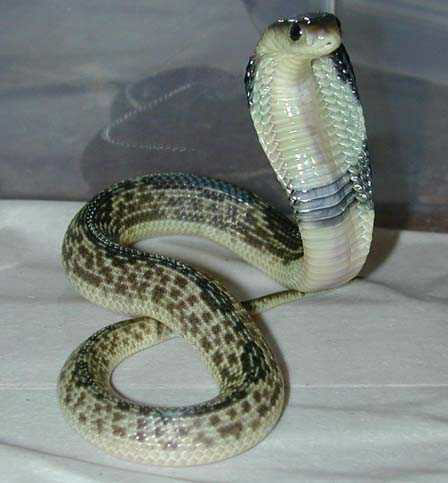
Javan Spitting Cobra

Javan Spitting Cobra

Naja sputatrix

Department of Sustainability & Environment, CC BY 2.0, via Wikimedia Commons

Forest Cobra

Forest Cobra

Naja melanoleuca

Traumrune, CC BY-SA 3.0, via Wikimedia Commons

Side by side

Javan Spitting CobraForest Cobra
Scientific nameNaja sputatrix Boie, 1827Naja melanoleuca Hallowell, 1857
English nameJavan Spitting CobraForest Cobra
GroupReptilesReptiles
ClassReptilia ReptileReptilia Reptile
OrderSquamata SnakesSquamata Snakes
FamilyElapidae CobrasElapidae Cobras
GenusNaja CobrasNaja Cobras
Named in18271857
Red List categoryLeast ConcernLeast Concern
Countries on record2 countries26 countries
GBIF occurrence records333 records1,810 records

Rows where the two agree are shown in grey.

Where each is found

Only Javan Spitting Cobra (2)

Only Forest Cobra (26)

From Catalogue of Life checklists and GBIF occurrence records. A country missing from a list means no record is held, which is not proof of absence.

Checked facts

Javan Spitting CobraForest Cobra
Appearance
  • The forest cobra has a large, broad, flattened head that is slightly distinct from its neck. English Wikipedia
  • The forest cobra has a moderately thick body and a slender, medium-length tail. English Wikipedia
  • The forest cobra has long cervical ribs that expand to form a wedge-shaped hood. English Wikipedia
  • Its dorsal scales are smooth, glossy, and strongly oblique. English Wikipedia
  • Forest cobras from Sierra Leone east to western Kenya and south to Angola are generally glossy black with cream or white markings on the chin, throat, and front of the belly. English Wikipedia
  • The western African savanna colour morph has black and yellow bands, a black tail, and yellow lips, chin, and throat. English Wikipedia
  • The eastern African coastal colour morph is brownish or blackish-brown above, with a yellow or cream belly speckled heavily with brown or black. English Wikipedia
  • Completely black specimens have been documented in western Africa. English Wikipedia
  • The forest cobra has between 19 and 21 dorsal scales. animaldiversity.org
Size
Habitat
  • The species occurs predominantly in tropical forests and wet forests. English Wikipedia
  • The species also occupies more arid regions, dry woodlands, and cultivated hill country. English Wikipedia
  • On Komodo Island, the species has been observed in dry savanna and deciduous monsoon forest. English Wikipedia
  • On Komodo Island, specimens have been recorded from sea level up to 650 metres elevation. English Wikipedia
  • Forest cobras inhabit tropical and subtropical rainforests in western and central Africa. English Wikipedia
  • The species also inhabits mangrove environments in western Africa. English Wikipedia
  • Lowland forests and moist savannas are preferred habitats of the forest cobra. English Wikipedia
  • Forest cobras occur across elevations ranging from sea level to 2,800 metres. English Wikipedia
  • Forest cobras frequently inhabit areas near rivers and streams, particularly in otherwise dry environments. animaldiversity.org
  • Forest cobras can inhabit fruit plantations and shelter in their trees. animaldiversity.org
Diet
  • The species predominantly preys on small mammals, including rats and mice. English Wikipedia
  • Its diet also includes frogs, other snakes, and lizards. English Wikipedia
  • A study examining 80 Javan specimens found that most prey items were mammals. English Wikipedia
Behaviour
  • The forest cobra is primarily active during daylight in uninhabited areas. English Wikipedia
  • Forest cobras may become nocturnal when active in urban areas. English Wikipedia
  • The forest cobra is an agile climber capable of ascending trees to heights of at least 10 metres. English Wikipedia
  • Forest cobras are capable swimmers and readily enter water. English Wikipedia
  • When threatened, the forest cobra raises its forebody and spreads its hood. animaldiversity.org
  • When inactive, forest cobras shelter in holes, brush piles, hollow logs, and rock clusters. animaldiversity.org
  • Forest cobras use their tongues to collect airborne scent molecules, which they analyze using the Jacobson's organ. animaldiversity.org
  • Forest cobras can detect vibrations ranging from 50 to 1,000 hertz. animaldiversity.org
Reproduction
  • The forest cobra is an egg-laying species. English Wikipedia
  • Female forest cobras lay between 11 and 26 eggs during summer. English Wikipedia
  • Individual forest cobra eggs measure approximately 3 to 6 centimetres in length. English Wikipedia
  • Forest cobra eggs may be deposited in hollow trees, termite mounds, or holes in the ground. English Wikipedia
  • Forest cobra eggs generally incubate for 55 to 70 days. English Wikipedia
  • Forest cobras breed seasonally between October and February. animaldiversity.org
  • Female forest cobras coil around and protect their eggs until the hatchlings emerge. animaldiversity.org
  • Newly hatched forest cobras are independent and can hunt without parental assistance. animaldiversity.org
  • Forest cobra hatchlings generally undergo their first shedding between seven and ten days after hatching. animaldiversity.org
  • Forest cobras generally reach sexual maturity between two and four years of age. animaldiversity.org
  • Forest cobras are polygynandrous, with both sexes potentially mating with multiple partners. animaldiversity.org
Distribution
  • The species is native to Java and the Indonesian islands of Bali, Lombok, Sumbawa, Komodo, Flores, Lomblen, and Alor. English Wikipedia
No checked fact yet
Conservation
  • The species is listed under Appendix II of CITES. English Wikipedia
  • The species is not considered threatened with extinction under its CITES Appendix II classification, although trade requires strict regulation. English Wikipedia
  • Forest cobra habitat is being lost as a result of increasing human development. animaldiversity.org
UsesNo checked fact yet
Other

In brief

Javan Spitting Cobra

Naja sputatrix is native to Java and the Indonesian islands of Bali, Lombok, Sumbawa, Komodo, Flores, Lomblen, and Alor. It is terrestrial and nocturnal, and readily spits venom when threatened. Full profile

Forest Cobra

The Forest Cobra is a reptile in the family Elapidae, order Squamata, class Reptilia, and subgenus Boulengerina. It inhabits tropical and subtropical rainforests, mangrove environments, lowland forests, and moist savannas in western and central Africa. It has a broad, flattened head, long cervical ribs that form a hood, and a moderately thick body. Full profile

Compare something else

Page built on 29 November 2026 from the data on the two species pages, where every source is listed.

Cite this page

ScientificNames.org. (2026). Javan Spitting Cobra vs Forest Cobra. Retrieved November 29, 2026, from https://scientificnames.org/compare/javan-spitting-cobra-vs-forest-cobra