Species · Reptiles
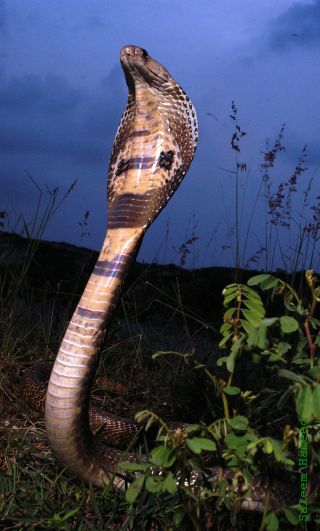
Forest Cobra Naja melanoleuca
The scientific name of the Forest Cobra is Naja melanoleuca. It is a species of reptile in the family Elapidae (cobras), order Squamata. The name dates from 1857.
- Scientific name
- Naja melanoleuca Hallowell, 1857
- Common name
- Forest Cobra
- Genus
- Naja
- Family
- Elapidae (Cobras)
- Order
- Squamata
- Class
- Reptilia
- Red List category
- LC Least Concern
- Recorded in
- 26 countries
- Name status
- accepted in the Catalogue of Life

Overview
The forest cobra (Naja melanoleuca), also commonly called the black cobra and the black and white-lipped cobra, is a species of
Classification of the Forest Cobra
| Kingdom | Animalia |
|---|---|
| Phylum | Chordata |
| Subphylum | Vertebrata |
| Infraphylum | Gnathostomata |
| Parvphylum | Osteichthyes |
| Megaclass | Tetrapoda |
| Class | Reptilia (Reptile) |
| Order | Squamata (Snakes) |
| Suborder | Serpentes (Snakes) |
| Infraorder | Alethinophidia |
| Family | Elapidae (Cobras) |
| Genus | Naja (Cobras) |
| Species | Naja melanoleuca Hallowell, 1857 |
Where the Forest Cobra is found
Checklists and occurrence records place Naja melanoleuca in 26 countries across Africa. GBIF holds 1,810 georeferenced records of it.
Countries
- Angola 13
- Benin 184
- Cameroon 341
- Central African Republic 107
- Democratic Republic of the Congo 379
- Equatorial Guinea 52
- Gabon 98
- Gambia 4
- Ghana 77
- Guinea 16
- Ivory Coast 50
- Kenya 36
- Liberia 52
- Malawi 10
- Mozambique 7
- Nigeria 77
- Republic of the Congo 67
- Rwanda 5
- Sao Tome and Principe 5
- Senegal 7
- Sierra Leone 7
- South Africa 91
- South Sudan 8
- Tanzania 24
- Uganda 83
- Zambia 10
Regions and cities with the most records
- South-West, Cameroon 34
- Ebute Ikorodu, Nigeria 32
- Lagos, Nigeria 32
- Lekki, Nigeria 32
- Obalende, Nigeria 32
- Lagos, Nigeria 31
- KwaZulu-Natal, South Africa 30
- Atakora, Benin 26
- Zou, Benin 26
- Bas-Uele, Democratic Republic of the Congo 22
- Likouala, Republic of the Congo 22
- Atlantique, Benin 19
- Borgou, Benin 18
- Ouémé, Benin 18
- Eastern, Ghana 16
- Kakamega County, Kenya 16
- Khwisero, Kenya 16
- Mumias, Kenya 16
- Ogooué-Maritime, Gabon 15
- Donga, Benin 14
- Ekpé, Benin 14
- Porto-Novo, Benin 14
- Abomey, Benin 13
- Alibori, Benin 13
- Collines, Benin 13
- Kumba, Cameroon 13
- Bohicon, Benin 12
- Kouffo, Benin 12
- South, Cameroon 12
- Tshopo, Democratic Republic of the Congo 12
- Cotonou, Benin 10
- Kribi, Cameroon 10
- Inkisi, Democratic Republic of the Congo 9
- Littoral, Cameroon 9
- Loum, Cameroon 9
- Mono, Benin 9
Range as the checklists state it
Nigeria, Cameroon, Central African Republic, Equatorial Guinea, Gabon, Republic of Congo (Brazzaville), Democratic Republic of the Congo (Kinshasa) (Zaire), N Angola, Rwanda, Republic of South Sudan (RSS)
A number beside a place is its count of GBIF occurrence records. A place without a number comes from a checklist alone. Records show where a species has been observed or collected, which can include escapes and vagrants.
Common names
English
- Forest Cobra
- Black and White Cobra
- Central Africa Forest Cobra
- Central African Forest Cobra
Names in 13 other languages
- Bengali
- কালো কোবরা
- Chinese
- 森林眼鏡蛇
- Czech
- kobra černá
- Danish
- Centralafrikank Skovkobra
- Finnish
- Mustahuulikobra
- French
- Cobra des forêts
- German
- Schwarzweiße Hutschlange, Schwarzweiße Kobra, Waldkobra, Weißlippenkobra
- Hungarian
- erdei kobra
- Italian
- Cobra della foresta
- Norwegian Bokmål
- Svartleppekobra
- Polish
- kobra czarnobiała
- Portuguese
- Cobra-da-floresta
- Russian
- Чёрно-белая кобра
Synonyms
10 other scientific names have been used for this species and are now treated as synonyms of Naja melanoleuca.
- Boulengerina melanoleuca (Hallowell, 1857)
- Naia haie var. melanoleuca Hallowell, 1857
- Naia melanoleuca Hallowell, 1857
- Naja haje melanoleuca Hallowell, 1857
- Naja haje var. leucosticta Fischer, 1885
- Naja haje var. melanoleuca Hallowell, 1857
- Naja leucostica Bethencourt-Ferreira, 1930
- Naja melanoleuca aurata Stucki-Stirn, 1979
- Naja melanoleuca melanoleuca Capocaccia, 1961
- Naja annulata Buchholz & Peters, 1876 ambiguous synonym
Related species
-
 Indian CobraNaja naja
-
 Egyptian CobraNaja haje
-
 Monocled CobraNaja kaouthia
-
 Caspian CobraNaja oxiana
-
 Cape CobraNaja nivea
-
 Philippine CobraNaja philippinensis
-
 Red Spitting CobraNaja pallida
-
 Black-necked Spitting CobraNaja nigricollis
Compare
Questions and answers
What is the scientific name of the Forest Cobra?
The scientific name of the Forest Cobra is Naja melanoleuca. Written with its author, the full name is Naja melanoleuca Hallowell, 1857.
Which family does the Forest Cobra belong to?
Naja melanoleuca belongs to the family Elapidae, in the order Squamata and the class Reptilia.
Where is the Forest Cobra found?
Checklists and occurrence records place Naja melanoleuca in 26 countries, including Democratic Republic of the Congo, Cameroon, Benin, Central African Republic, Gabon and South Africa.
What is the conservation status of the Forest Cobra?
The IUCN Red List category recorded for Naja melanoleuca is Least Concern (LC).
What other names does the Forest Cobra have?
Naja melanoleuca is also known in English as Black and White Cobra, Central Africa Forest Cobra and Central African Forest Cobra.
Sources
Data
- Catalogue of Life, 2026-10-16 XR cc by
- Global Biodiversity Information Facility CC BY 4.0
- Wikidata CC0
- English Wikipedia CC BY-SA 4.0
- GeoNames CC BY 4.0
- Wikimedia Commons per image; credit shown with each image
- Within the Catalogue of Life, this name comes from The Reptile Database cc by
References
- Hallowell, E. (1857) Notes of a collection of reptiles from the Gaboon country, West Africa, recently presented to the Academy of Natural Sciences of Philadelphia, by Dr. Henry A. Ford. Proceedings of Academy of Natural Sciences, Philadelphia, 9, 48 - 72. where the name was published
- Hallowell, E. (1857). Notes of a collection of reptiles from the Gaboon country, West Africa, recently presented to the Academy of Natural Sciences of Philadelphia, by Dr. Herny A. Ford. Proc. Acad. Nat. Sci. Philadelphia 9: 48-72.
- Peters, & Wilhem Carl Hartwig. (1876). Eine zweite Mittheilung über die von Hrn. Professor Dr. R. Buchholz in Westafrica gesammelten Amphibien. Monatsber. Königl. Akad. Wiss. Berlin 1876 (Februar): 117-123.
- Sauvage, H.-E. (1884). Notice sure une collection de reptiles et de poissons recueillie a Majumba, Congo. Bull. Soc. Zool. France, 1884: 199-.
- Fischer, J. G. (1885). Ichthyologische und herpetologische Bemerkungen. V. Herpetologische Bemerkungen. Jahrb. Hamburg. Wiss. Anst. 2: 82-121.
- Boettger, O. (1889). Herpetologische Miscellen. [I Epirus, II Corfu, III Kamerun, IV Gross-Namaland, V Transvaal, VI. Pondoland, VII Madagascar, VIII Madras, IX Java, X Nias, XI Nordwest-Peru]. Bericht Senckenb. Naturf. Ges. (Frankfurt): 267-316.
- Matschie, P. (1893). Die Reptilien und Amphibien des Togogebietes. Mitth. Deutsch. Schutzgeb., 6: 207-215.
- Boulenger, G. A. (1896). Catalogue of the snakes in the British Museum, Vol. 3. London (Taylor & Francis), Xiv + 727 Pp.
- Boulenger, G. A. (1906). Report on the reptiles collected by the late L. Fea in West Africa. Ann. Mus. Civ. Stor. Nat. Genova (3) 2: 196-216.
- Schmidt, K. P. (1923). Contributions to the herpetology of the Belgian Congo based on the collection of the American Museum Congo Expedition, 1909-1915. Part II. Snakes, with field notes by Herbert Lang and James P. Chapin. Bull. Amer. Mus. Nat. Hist. 49 (1): 1-146.
- Loveridge, & Arthur. (1929). East African reptiles and amphibians in the United States National Museum. Bull. US Natl. Mus. (151): 1-135.
- Witte, & de, G. F. (1933). Reptiles récoltés au Conge Belge par le Dr. H. Schouteden et par M. G.-F. Witte. Ann. Mus. Conge Belge Zool. Ser. 1 Tome III: 53-100.
- Hewitt, J. (1935). Some new forms of batrachians and reptiles from South Africa. Rec. Albany Mus. 4: 283-357.
- Loveridge, A. (1936). African reptiles and amphibians in the Field Museum of Natural History. Zool. Ser. Field Mus. Nat. Hist., Chicago, 22 (1): 1-122.
- Mitchell, B. L. (1950). Some reptiles and amphibians of Nyasaland. The Nyasaland Journal 3 (2): 46-57.
- Laurent, R. F. (1955). Diagnoses preliminaires des quelques Serpents venimeux. Rev. Zool. Bot. Afr., 51: 127-139.
- Loveridge, A. (1956). On snakes collected in the Anglo-Egyptian Sudan by J.S. Owen, Esq. Sudan Notes Rec. 36: 37-56 [1955].
- Broadley, D. G. (1957). Occurence of the Forest Cobra (Naja melanoleuca) in Rhodesia. J. Herp. Assoc. Rhodesia 1: 4–5.
- Loveridge, A. (1957). On a third collection of reptiles taken in Tanganyika by C.J.P. Ionides, Esq. Tanganyika Notes and Records 43: 1-19.
- Broadley, D. G. (1959). The herpetology of Southern Rhodesia. Part I--the snakes. Bull. Mus. Comp. Zool. Harvard 120 (1): 1-100 [Reprint 1972].
- Capocaccia, L. (1961). Contributo allo studio dei serpenti delle isole del Golfo di Guinea. Ann. Mus. Civ. Stor. Nat. Genova, 72: 285-309.
- Broadley, D. G. (1962). On some reptile collections from the North-Western and North-Eastern Districts of Southern Rhodesia 1958-1961, with descriptions of four new lizards. Occ. Pap. Nat. Mus. South. Rhodesia 26 (B): 787-843.
- Leloup, P. (1962). The Egg-Laying of Naja melanoleuca. Herpetologica 18 (1): 71.
- Menzies, J. I. (1966). The snakes of Sierra Leone. Copeia 1966 (2): 169-179.
- Broadley, D. G. (1968). A review of the African cobras of the genus Naja (Serpentes: Elapinae). Arnoldia (Rhodesia) (Ser. 3) 29: 1-14.
This species in other databases
Page built on 24 November 2026. See how the catalog is made and all sources and licences.
Cite this page
ScientificNames.org. (2026). Naja melanoleuca (Forest Cobra). Retrieved November 24, 2026, from https://scientificnames.org/species/naja-melanoleuca
“Naja melanoleuca (Forest Cobra).” ScientificNames.org, 2026, scientificnames.org/species/naja-melanoleuca. Accessed 24 Nov. 2026.
ScientificNames.org. “Naja melanoleuca (Forest Cobra).” Accessed November 24, 2026. https://scientificnames.org/species/naja-melanoleuca.
@misc{scientificnames_naja_melanoleuca_forest_cobra,
  author = {{ScientificNames.org}},
  title = {Naja melanoleuca (Forest Cobra)},
  year = {2026},
  url = {https://scientificnames.org/species/naja-melanoleuca},
  note = {Accessed 2026-11-24}
}