Comparison
Jericho-rose vs Radish
Jericho-rose (Anastatica hierochuntica) and Radish (Raphanus sativus) both belong to the subfamily Brassicoideae and part ways below it. Both are recorded in 20 countries.
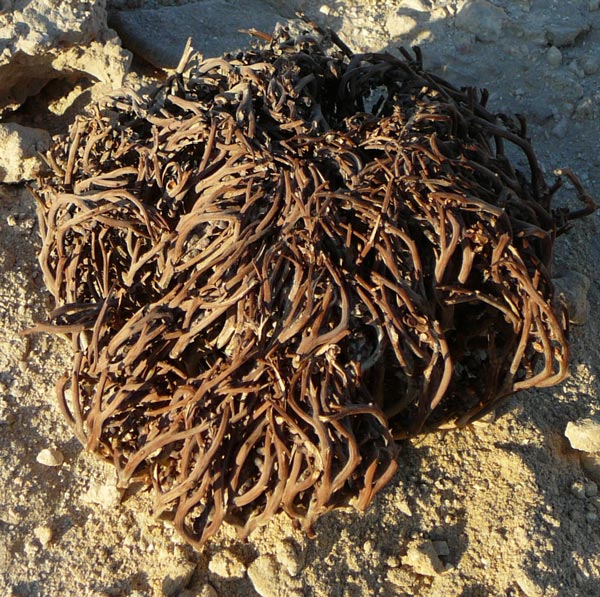
Jericho-rose
Anastatica hierochuntica
The original uploader was Nikswieweg at German Wikipedia. (Original text: Klaus Polak), CC BY-SA 2.0 de, via Wikimedia Commons


Side by side
| Jericho-rose | Radish | |
|---|---|---|
| Scientific name | Anastatica hierochuntica L. | Raphanus sativus L. |
| English name | Jericho-rose | Radish |
| Group | Flowering plants | Flowering plants |
| Class | Magnoliopsida | Magnoliopsida |
| Order | Capparales | Capparales |
| Family | Brassicaceae Crucifer | Brassicaceae Crucifer |
| Genus | Anastatica | Raphanus Radish |
| Countries on record | 23 countries | 149 countries |
| GBIF occurrence records | 1,278 records | 46,932 records |
Rows where the two agree are shown in grey.
Where each is found
Both recorded in 20 countries
- Algeria
- Bahrain
- Egypt
- Iran
- Iraq
- Israel
- Jordan
- Kuwait
- Libya
- Morocco
- Oman
- Pakistan
- Palestinian Territory
- Qatar
- Saudi Arabia
- Sudan
- Syria
- Tunisia
- United Arab Emirates
- Yemen
Only Jericho-rose (3)
Only Radish (129)
- Afghanistan
- Albania
- Angola
- Argentina
- Armenia
- Australia
- Austria
- Azerbaijan
- Bangladesh
- Barbados
- Belarus
- Belgium
- Benin
- Bermuda
- Bhutan
- Bolivia
- Bonaire, Saint Eustatius and Saba
- Brazil
- Bulgaria
- Cabo Verde
- Cambodia
- Cameroon
- Canada
- Central African Republic
- Chile
- China
- Colombia
- Costa Rica
- Croatia
- Cuba
- Cyprus
- Czechia
- Denmark
- Dominican Republic
- Ecuador
- El Salvador
- Estonia
- Ethiopia
- Fiji
- Finland
- France
- French Guiana
- French Polynesia
- Georgia
- Germany
- Greece
- Greenland
- Guadeloupe
- Guam
- Guatemala
- Guernsey
- Haiti
- Honduras
- Hong Kong
- Hungary
- Iceland
- India
- Indonesia
- Ireland
- Isle of Man
- Italy
- Japan
- Jersey
- Kazakhstan
- Kenya
- Kyrgyzstan
- Laos
- Latvia
- Lebanon
- Liechtenstein
- Lithuania
- Luxembourg
- Madagascar
- Malaysia
- Marshall Islands
- Martinique
- Mauritius
- Mayotte
- Mexico
- Moldova
- Mongolia
- Mozambique
- Myanmar
- Nepal
- New Caledonia
- New Zealand
- Nicaragua
- Niue
- North Korea
- North Macedonia
- Norway
- Palau
- Panama
- Paraguay
- Peru
- Philippines
- Poland
- Portugal
- Puerto Rico
- Reunion
- Romania
- Russia
- Saint Barthelemy
- Serbia
- Slovakia
- Slovenia
- South Africa
- South Korea
- South Sudan
- Spain
- Sri Lanka
- Sweden
- Switzerland
- Taiwan
- Tajikistan
- Tanzania
- Thailand
- The Netherlands
- Turkey
- Turkmenistan
- Uganda
- Ukraine
- United Kingdom
- United States
- Uruguay
- Uzbekistan
- Venezuela
- Vietnam
- Zimbabwe
From Catalogue of Life checklists and GBIF occurrence records. A country missing from a list means no record is held, which is not proof of absence.
Checked facts
| Jericho-rose | Radish | |
|---|---|---|
| Appearance |
|
|
| Size |
| No checked fact yet |
| Habitat | No checked fact yet |
|
| Diet | No checked fact yet |
|
| Behaviour |
|
|
| Reproduction |
|
|
| Lifespan |
| No checked fact yet |
| Distribution |
|
|
| Uses |
|
|
| Similar species |
| No checked fact yet |
| Other | No checked fact yet |
|
In brief
Jericho-rose
The Jericho-rose is a small gray annual flowering herb with minute white flowers. The species occurs in arid regions of the Middle East and the Sahara Desert. Its branches contract into a ball when dry and reopen when exposed to moisture. Full profile
Radish
Radish varieties are distributed globally and are cultivated and consumed worldwide. Radish is distinguished by its swollen taproot, which varies in shape and skin colour, and usually has crisp, white flesh with a pungent, peppery flavour when raw. Full profile
Compare something else
Page built on 27 November 2026 from the data on the two species pages, where every source is listed.
Cite this page
ScientificNames.org. (2026). Jericho-rose vs Radish. Retrieved November 27, 2026, from https://scientificnames.org/compare/jericho-rose-vs-radish
“Jericho-rose vs Radish.” ScientificNames.org, 2026, scientificnames.org/compare/jericho-rose-vs-radish. Accessed 27 Nov. 2026.
ScientificNames.org. “Jericho-rose vs Radish.” Accessed November 27, 2026. https://scientificnames.org/compare/jericho-rose-vs-radish.
@misc{scientificnames_jericho_rose_vs_radish,
  author = {{ScientificNames.org}},
  title = {Jericho-rose vs Radish},
  year = {2026},
  url = {https://scientificnames.org/compare/jericho-rose-vs-radish},
  note = {Accessed 2026-11-27}
}