Comparison

Kob vs Puku

Kob (Kobus kob) and Puku (Kobus vardonii) both belong to the genus Kobus (kobs) and part ways below it. Both are recorded in 3 countries.

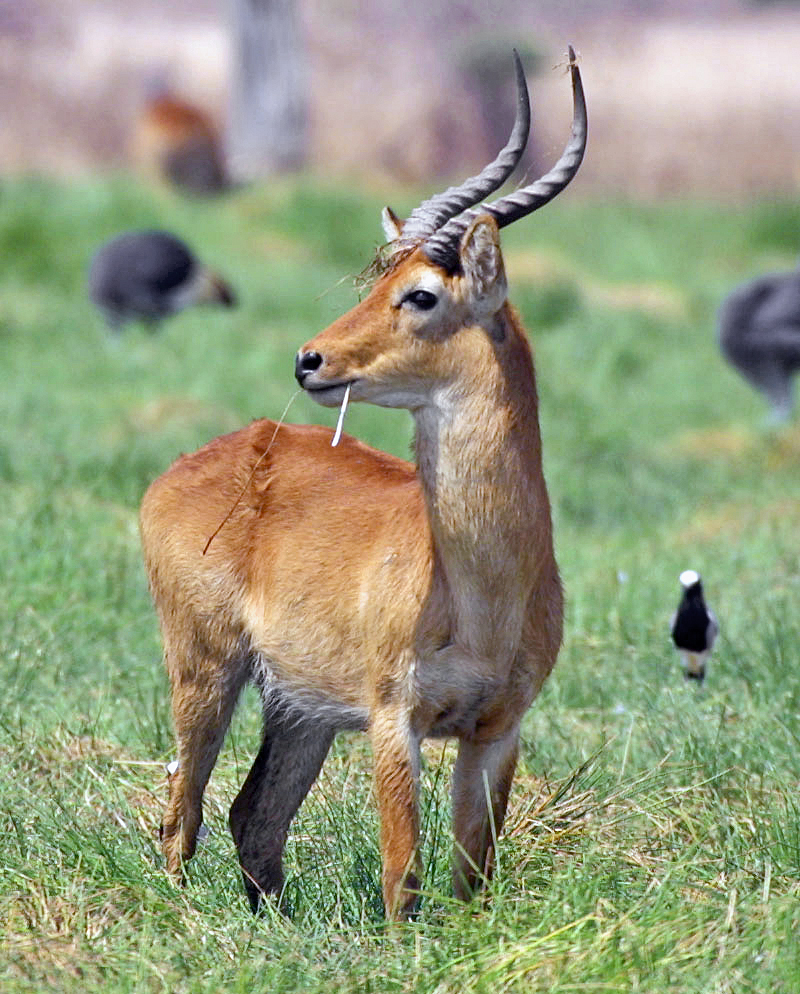
Kob

Kob

Kobus kob

Charles J. Sharp, CC BY-SA 4.0, via Wikimedia Commons

Puku

Puku

Kobus vardonii

Taken and submitted by Paul Maritz (paulmaz), CC BY-SA 3.0, via Wikimedia Commons

Side by side

KobPuku
Scientific nameKobus kob (Erxleben, 1777)Kobus vardonii (Livingstone, 1857)
English nameKobPuku
GroupMammalsMammals
ClassMammalia MammalMammalia Mammal
OrderArtiodactyla ArtiodactylsArtiodactyla Artiodactyls
FamilyBovidae GoatsBovidae Goats
GenusKobus KobsKobus Kobs
Named in17771857
Red List categoryLeast ConcernNear Threatened
Countries on record21 countries8 countries
GBIF occurrence records8,534 records2,765 records

Rows where the two agree are shown in grey.

Where each is found

Both recorded in 3 countries

Only Kob (18)

Only Puku (5)

From Catalogue of Life checklists and GBIF occurrence records. A country missing from a list means no record is held, which is not proof of absence.

Checked facts

KobPuku
AppearanceNo checked fact yet
Size
  • Male kobs have shoulder heights of 90–100 cm and an average body weight of 94 kg. English Wikipedia
  • Female kobs have shoulder heights of 82–92 cm and an average body weight of 63 kg. English Wikipedia
No checked fact yet
Habitat
Diet
  • Kobs are herbivores that feed on grasses and reeds. animaldiversity.org
  • Kobs preferentially graze on Hyparrhenia, Brachiaria brizantha, Setaria gayanus, Chloris gayana, Echinochloa, and Digitaria grasses. English Wikipedia
Behaviour
  • Kobs are primarily active during morning and evening hours. animaldiversity.org
  • Kobs may become inactive during the hottest part of the day. English Wikipedia
  • Kobs form groups consisting of females and calves or groups consisting exclusively of males. English Wikipedia
  • Kob herds commonly contain five to forty individuals. English Wikipedia
  • Female kobs occupy large, overlapping home ranges and apparently move according to food availability. animaldiversity.org
  • Male kobs generally move within more restricted areas and remain near lek sites. animaldiversity.org
  • Kobs may migrate along watercourses to reach grazing areas. animaldiversity.org
  • A kob population in southeastern Sudan travelled 150–200 km during the dry season. animaldiversity.org
Reproduction
  • Female kobs experience their first ovulation at approximately 13–14 months of age. English Wikipedia
  • Female kob estrous cycles occur at intervals of 20–26 days until fertilization. English Wikipedia
  • Female kobs give birth to a single offspring after a gestation period of approximately nine months. animaldiversity.org
  • Kob gestation lasts approximately eight months according to the documented life-history account. English Wikipedia
  • Newborn kob calves hide in dense vegetation during their first month. English Wikipedia
  • Kob calves join groups of young animals as they grow older. English Wikipedia
  • Young kobs enter female herds at approximately three to four months of age. English Wikipedia
  • Kob calves remain with their mothers until approximately six to seven months of age, when they are weaned. English Wikipedia
  • Male kobs generally begin mating several years later than females. animaldiversity.org
DistributionNo checked fact yet
  • Puku occur in southern Democratic Republic of Congo, Namibia, Tanzania, Zambia and Botswana. English Wikipedia
  • Puku populations have been reported in Angola, Botswana, Katanga, Malawi, Tanzania and Zambia. animaldiversity.org
  • Nearly two-thirds of the puku population in Tanzania live in the Kilombero Valley. animaldiversity.org
  • The estimated puku population in Tanzania is 54,600 individuals. animaldiversity.org
  • The estimated puku population in Zambia is 21,000 individuals. animaldiversity.org
Conservation
  • Kob populations have declined because of hunting and human development. English Wikipedia
  • Buffon's kob is protected in Niokolo-Koba National Park in Senegal. English Wikipedia
  • Nearly one-third of the puku population is located in protected areas. English Wikipedia
  • The puku population in Botswana has fewer than 100 individuals and is declining. animaldiversity.org
  • Habitat loss and unsustainable hunting threaten puku populations. animaldiversity.org
  • Livestock and human settlements increasingly encroach on grasslands preferred by puku. animaldiversity.org
Uses
  • Kobs are hunted for recreational sport and human consumption. animaldiversity.org
  • Kob ranked as the third most preferred bushmeat species in a survey conducted in Cameroon. animaldiversity.org
  • Puku contribute to the structure of grassland communities through their grazing activity. animaldiversity.org
  • Puku contribute to supporting populations of large predators, including lions. animaldiversity.org
Similar speciesNo checked fact yet

In brief

Kob

Kobs inhabit moist savannah, floodplains, and woodland margins, particularly in flat, open areas close to permanent water sources. Full profile

Puku

Puku is a mammal in the family Bovidae, order Artiodactyla and class Mammalia. Puku inhabit wet grasslands, marshy grasslands and dambos. Puku have a sandy-brown coat, and males possess lyre-shaped, ridged horns. Full profile

Compare something else

Page built on 27 November 2026 from the data on the two species pages, where every source is listed.

Cite this page

ScientificNames.org. (2026). Kob vs Puku. Retrieved November 27, 2026, from https://scientificnames.org/compare/kob-vs-puku