Species · Mammals
Puku Kobus vardonii
The scientific name of the Puku is Kobus vardonii. It is a species of mammal in the family Bovidae (goats), order Artiodactyla. The name dates from 1857.
- Scientific name
- Kobus vardonii (Livingstone, 1857)
- Common name
- Puku
- Genus
- Kobus
- Family
- Bovidae (Goats)
- Order
- Artiodactyla
- Class
- Mammalia
- Red List category
- NT Near Threatened
- Recorded in
- 8 countries
- Name status
- accepted in the Catalogue of Life
Overview
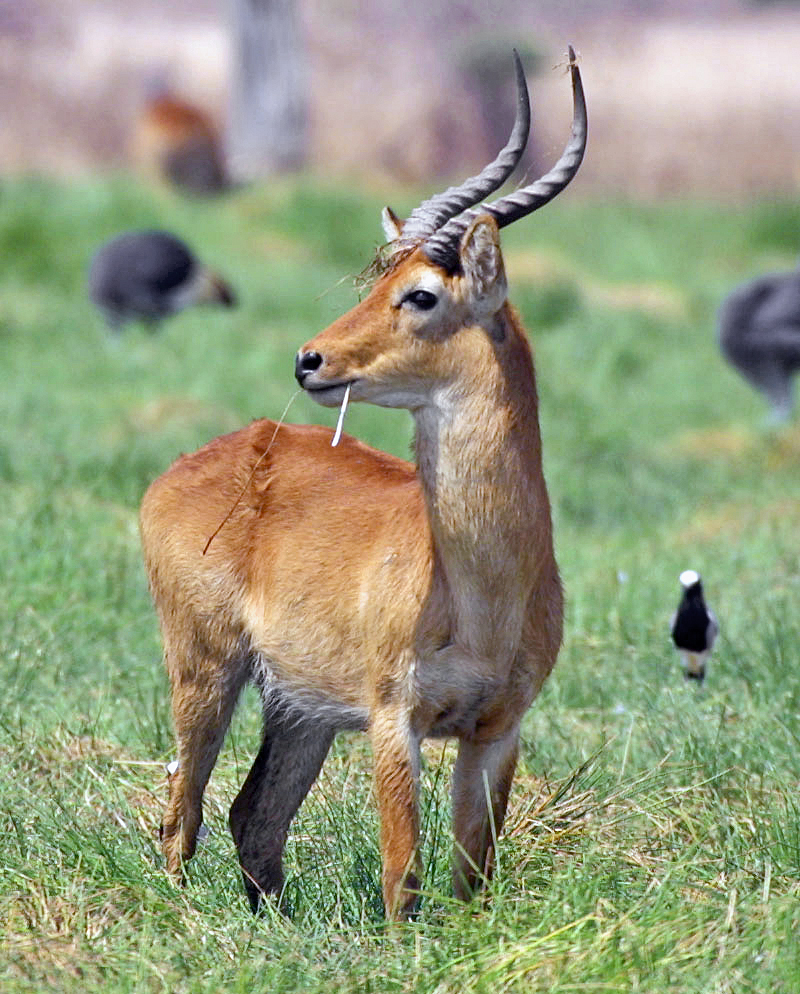
Puku is a mammal in the family Bovidae, order Artiodactyla and class Mammalia. Puku inhabit wet grasslands, marshy grasslands and dambos. Puku have a sandy-brown coat, and males possess lyre-shaped, ridged horns.
Written 26 November 2026 from the sources listed below. Each statement was checked against the passage it cites; statements that could not be supported were removed.
Appearance
The puku has a sandy-brown coat with a slightly lighter brown underbelly. Its fur is approximately 32 mm long and varies in colour, with most fur golden yellow, a browner forehead and white fur around the eyes, under the belly, neck and upper lip.[1][2][3]
The puku's coat is rougher than that of the southern reedbuck, lechwe, impala and oribi. Its tail has long hairs near the tip and is not bushy.[4][5]
Female puku lack horns, whereas males possess lyre-shaped horns. The horns are strongly ridged along two-thirds of their length and smooth near the tips.[6][7]
Puku possess small facial glands and inguinal pouches measuring 40 to 80 mm in depth.[8][9]
Habitat
Puku inhabit wet grasslands and occur almost exclusively in marshy grasslands and dambos. They also inhabit grasslands, savannas and river floodplains.[10][11][12]
During the dry season, puku remain near watercourses.[13]
Puku occur in southern Democratic Republic of Congo, Namibia, Tanzania, Zambia and Botswana. Populations have also been reported in Angola, Katanga and Malawi.[14][15]
Nearly two-thirds of the puku population in Tanzania live in the Kilombero Valley. The estimated puku population in Tanzania is 54,600 individuals, while the estimated population in Zambia is 21,000 individuals.[16][17][18]
Diet
Puku feed on grasses and consume different types depending on availability. They prefer plants with high crude protein content.[19][20][21]
Eragrostis rigidior is the primary grass consumed by puku because of its high crude protein content. During March, Brachiaria latifolia accounts for 92% of their diet.[22][23]
Puku consume more Digitaria setivalva than other antelopes.[24]
Behaviour
Puku are active during the early morning and late afternoon. They feed twice daily, in the early morning and late afternoon.[25][26]
Female puku typically form groups containing 6 to 20 individuals. During the rainy season, female herds can gather into groups of approximately 50 individuals.[27][28]
Territorial male puku generally live alone, while bachelor males form groups consisting exclusively of males. Territorial males maintain their territories throughout the year.[29][30][31]
Puku communicate warnings and other signals primarily through whistles. When threatened, they produce repeated whistles to warn other individuals.[32][33]
Reproduction and life cycle
Puku can breed throughout the year, although sexual activity increases after the first heavy rains of the wet season. Most mating occurs between May and September.[34][35]
Female puku generally produce one offspring per breeding season. Gestation lasts approximately eight months, and calves are generally born between January and April.[36][37][38][39]
Female puku leave their calves concealed in hidden places rather than accompanying them. Calves are weaned at approximately six months of age.[40][41]
Puku reach sexual maturity between 12 and 14 months of age.[42]
Conservation
Nearly one-third of the puku population is located in protected areas. The puku population in Botswana has fewer than 100 individuals and is declining.[43][44]
Habitat loss and unsustainable hunting threaten puku populations. Livestock and human settlements increasingly encroach on grasslands preferred by puku.[45][46]
Uses
Puku contribute to the structure of grassland communities through their grazing activity. They also contribute to supporting populations of large predators, including lions.[47][48]
Classification of the Puku
| Kingdom | Animalia |
|---|---|
| Phylum | Chordata |
| Subphylum | Vertebrata |
| Infraphylum | Gnathostomata |
| Parvphylum | Osteichthyes |
| Megaclass | Tetrapoda |
| Class | Mammalia (Mammal) |
| Subclass | Theria |
| Infraclass | Eutheria |
| Order | Artiodactyla (Artiodactyls) |
| Family | Bovidae (Goats) |
| Subfamily | Antilopinae |
| Tribe | Reduncini |
| Genus | Kobus (Kobs) |
| Species | Kobus vardonii (Livingstone, 1857) |
Where the Puku is found
Checklists and occurrence records place Kobus vardonii in 8 countries across Africa. GBIF holds 2,765 georeferenced records of it.
Countries
- Angola 69
- Botswana 129
- Democratic Republic of the Congo 48
- Malawi 29
- Namibia 12
- Tanzania 27
- Zambia 2,426
- Zimbabwe 25
Regions and cities with the most records
- Central Province, Zambia 1,967
- Muchinga, Zambia 225
- Chobe, Botswana 116
- Eastern Province, Zambia 78
- North-Western, Zambia 53
- Southern Province, Zambia 26
- Haut-Lomami, Democratic Republic of the Congo 24
- Lunda Sul, Angola 21
- Victoria Falls, Zimbabwe 19
- Livingstone, Zambia 18
- Lusaka Province, Zambia 18
- Zambezi Region, Namibia 15
- Chisankane, Zambia 12
- Chilanga Township, Zambia 10
- Haut-Katanga, Democratic Republic of the Congo 10
- Kaputa, Zambia 10
- Tanganyika, Democratic Republic of the Congo 10
- Lusaka, Zambia 9
- Copperbelt, Zambia 8
- Malanje, Angola 8
- Ntandabale, Zambia 8
- Kambove, Democratic Republic of the Congo 6
- Likasi, Democratic Republic of the Congo 6
- Itezhi-Tezhi, Zambia 4
- Matabeleland North, Zimbabwe 4
- Palabana, Zambia 4
- Rumphi, Malawi 4
- Kafue, Zambia 3
- Madido, Zambia 3
- Namalombwe, Zambia 3
Range as the checklists state it
Africa
A number beside a place is its count of GBIF occurrence records. A place without a number comes from a checklist alone. Records show where a species has been observed or collected, which can include escapes and vagrants.
Common names
English
- Puku
Names in 16 other languages
- Afrikaans
- Rooiwaterbok
- Arabic
- بوكو
- Chinese
- 瓦氏赤羚
- Czech
- voduška puku
- Dutch
- Poekoe
- German
- Gelbfuss-moorantilope, Grasantilope, Puku-Antilope
- Greek
- Αντιλόπη Πουκού
- Hungarian
- Puku mocsáriantilop
- Italian
- Antilope Rossa d'Acqua
- Japanese
- プークー
- Korean
- 푸쿠
- Polish
- kob lirorogi
- Russian
- Пуку
- Spanish
- Antilope Rojode Agua, Pucú
- Swahili
- Sheshe
- Tswana
- Phuku
Synonyms
4 other scientific names have been used for this species and are now treated as synonyms of Kobus vardonii.
- Antilope vardonii Livingstone, 1857
- Kobus vardoni (Livingstone, 1857)
- Kobus vardonii senganus (P. L. Sclater & Thomas, 1897)
- Kobus vardonii vardonii (Livingstone, 1857)
Related species
-
 WaterbuckKobus ellipsiprymnus
-
 LechweKobus leche
-
 KobKobus kob
-
 Nile LechweKobus megaceros
- Upemba LechweKobus anselli
-
 White-eared KobKobus leucotis
- Defassa WaterbuckKobus defassa
- Uganda KobKobus thomasi
Compare
Questions and answers
What is the scientific name of the Puku?
The scientific name of the Puku is Kobus vardonii. Written with its author, the full name is Kobus vardonii (Livingstone, 1857).
Which family does the Puku belong to?
Kobus vardonii belongs to the family Bovidae, in the order Artiodactyla and the class Mammalia.
Where is the Puku found?
Checklists and occurrence records place Kobus vardonii in 8 countries, including Zambia, Botswana, Angola, Democratic Republic of the Congo, Malawi and Tanzania.
What is the conservation status of the Puku?
The IUCN Red List category recorded for Kobus vardonii is Near Threatened (NT).
Can you describe the puku animal?
The puku has a sandy-brown coat with a slightly lighter brown underbelly. Its fur is approximately 32 mm long, and males have strongly ridged, lyre-shaped horns.[1][49][2][7]
Sources
Passages the profile rests on
- The puku has a sandy-brown coat with a slightly lighter brown underbelly. Source passage: “The puku is sandy brown in colour, with the underbelly a slightly lighter brown.” — English Wikipedia
- Puku fur is approximately 32 mm long and varies in colour. Source passage: “Their fur is approximately 32 mm in length, with varying colors.” — animaldiversity.org
- Most puku fur is golden yellow, with a browner forehead and white fur around the eyes, under the belly, neck and upper lip. Source passage: “The majority of their fur is golden yellow, the forehead is browner in color than elsewhere on the body and they have white fur near the eyes and under the belly, neck, and upper lip.” — animaldiversity.org
- The puku's coat is rougher than that of the southern reedbuck, lechwe, impala and oribi. Source passage: “The coat is rougher than that of the similar-sized southern reedbuck, lechwe or impala, or the smaller oribi.” — English Wikipedia
- Puku tails have long hairs near the tip and are not bushy. Source passage: “Their tails have long hairs towards the tip and lack of bushiness.” — animaldiversity.org
- Female puku lack horns, whereas males possess them. Source passage: “Males have horns and the females do not.” — animaldiversity.org
- Puku horns are lyre-shaped, strongly ridged along two-thirds of their length and smooth near the tips. Source passage: “The horns are lyre-shaped and strongly ridged for two-thirds of their length and smooth towards the tips.” — animaldiversity.org
- Puku possess small facial glands. Source passage: “Puku have small face glands.” — animaldiversity.org
- Puku have inguinal pouches measuring 40 to 80 mm in depth. Source passage: “Puku also have well-developed inguinal pouches that are 40 to 80mm deep.” — animaldiversity.org
- Puku inhabit wet grasslands. Source passage: “found in wet grasslands” — English Wikipedia
- Puku occur almost exclusively in marshy grasslands and dambos. Source passage: “Puku are found almost exclusively in marshy grassland and dambos” — English Wikipedia
- Puku inhabit grasslands, savannas and river floodplains. Source passage: “Puku are found in grasslands, savannas, and river floodplains.” — animaldiversity.org
- During the dry season, puku remain near watercourses. Source passage: “During dry seasons they remain near watercourses.” — animaldiversity.org
- Puku occur in southern Democratic Republic of Congo, Namibia, Tanzania, Zambia and Botswana. Source passage: “found in wet grasslands in southern Democratic Republic of Congo, Namibia, Tanzania, Zambia and more concentrated in the Okavango Delta in Botswana.” — English Wikipedia
- Puku populations have been reported in Angola, Botswana, Katanga, Malawi, Tanzania and Zambia. Source passage: “Recent research described puku as being found in Angola, Botswana, Katanga, Malawi, Tanzania, and Zambia.” — animaldiversity.org
- Nearly two-thirds of the puku population in Tanzania live in the Kilombero Valley. Source passage: “Nearly two-thirds live in the Kilombero Valley of Tanzania.” — animaldiversity.org
- The estimated puku population in Tanzania is 54,600 individuals. Source passage: “Populations were estimated at 54,600 Puku within Tanzania” — animaldiversity.org
- The estimated puku population in Zambia is 21,000 individuals. Source passage: “and 21,000 in Zambia.” — animaldiversity.org
- Puku feed on grasses. Source passage: “where they eat grasses.” — English Wikipedia
- Puku consume different types of grasses depending on availability. Source passage: “The puku diet is flexible in regards to type of grasses consumed.” — English Wikipedia
- Puku prefer plants with high crude protein content. Source passage: “Puku prefer plants containing high crude protein value.” — animaldiversity.org
- Eragrostis rigidior is the primary grass consumed by puku because of its high crude protein content. Source passage: “Eragrostis rigidior is the primary grass eaten because is has a high amount of crude protein.” — animaldiversity.org
- During March, Brachiaria latifolia accounts for 92% of the puku diet. Source passage: “During March, 92% of their diet is from Brachiaria latifolia” — animaldiversity.org
- Puku consume more Digitaria setivalva than other antelopes. Source passage: “Puku eat more Digitaria setivalva than other antelopes” — animaldiversity.org
- Puku are active during the early morning and late afternoon. Source passage: “This species is crepuscular, active in the early morning and late afternoon.” — English Wikipedia
- Puku feed twice daily, in the early morning and late afternoon. Source passage: “Puku feed early in the morning and again late in the afternoon” — animaldiversity.org
- Female puku form groups typically containing 6 to 20 individuals. Source passage: “Females tend to found in groups of 6 to 20.” — animaldiversity.org
- During the rainy season, female puku herds can gather into groups of approximately 50 individuals. Source passage: “During the rainy season, herds will come together for added safety, typically reaching around 50 females.” — English Wikipedia
- Territorial male puku generally live alone. Source passage: “Territorial males are found on their own.” — animaldiversity.org
- Bachelor male puku form groups consisting exclusively of males. Source passage: “Bachelor males are found in male-only herds.” — animaldiversity.org
- Territorial male puku maintain their territories throughout the year. Source passage: “Territorial males maintain their territories throughout the year.” — animaldiversity.org
- Puku communicate warnings and other signals primarily through whistles. Source passage: “Puku communicate primarily by whistling.” — animaldiversity.org
- When threatened, puku produce repeated whistles to warn other individuals. Source passage: “When scared, puku repeat a shrill whistle sound.” — English Wikipedia
- Puku can breed throughout the year, although sexual activity increases after the first heavy rains of the wet season. Source passage: “Puku breed year round but are more sexually active after the first heavy rains of the wet season.” — animaldiversity.org
- Most puku mating occurs between May and September. Source passage: “Most mating occurs between the months of May and September” — animaldiversity.org
- Female puku generally produce one offspring per breeding season. Source passage: “The typical number of offspring per female per breeding season is one.” — animaldiversity.org
- Puku gestation lasts approximately eight months. Source passage: “Puku gestation lasts 8 months” — animaldiversity.org
- Puku generally give birth to a single offspring. Source passage: “they generally give birth to a single offspring.” — animaldiversity.org
- Puku calves are generally born between January and April. Source passage: “most calves are born from January to April” — animaldiversity.org
- Puku calves are weaned at approximately six months of age. Source passage: “Calves wean at approximately 6 months.” — animaldiversity.org
- Female puku leave their calves concealed in hidden places rather than accompanying them. Source passage: “females leave them on their own in a hidden place rather than travel with them.” — animaldiversity.org
- Puku reach sexual maturity between 12 and 14 months of age. Source passage: “reach sexual maturity at 12 to 14 months.” — animaldiversity.org
- Nearly one-third of the puku population is located in protected areas. Source passage: “Nearly one-third of all puku are found in protected areas, zoos, and national parks due to their diminishing habitat.” — English Wikipedia
- The puku population in Botswana has fewer than 100 individuals and is declining. Source passage: “In Botswana there are less than 100 remaining, and their numbers are falling.” — animaldiversity.org
- Habitat loss and unsustainable hunting threaten puku populations. Source passage: “Humans cause unsustainable hunting and habitat loss.” — animaldiversity.org
- Livestock and human settlements increasingly encroach on grasslands preferred by puku. Source passage: “Grasslands that puku prefer are increasingly invaded by livestock and human settlement each year.” — animaldiversity.org
- Puku contribute to the structure of grassland communities through their grazing activity. Source passage: “Puku are part of a grazing fauna that is important in structuring grassland communities” — animaldiversity.org
- Puku contribute to supporting populations of large predators, including lions. Source passage: “supporting populations of large predators, such as lions” — animaldiversity.org
- Male puku have lyre-shaped horns with ridged structures. Source passage: “Males have horns which are ridge-structured, 50 cm (20 in) long, and lyre-shaped.” — English Wikipedia
Data
- Catalogue of Life, 2026-10-16 XR cc by
- Global Biodiversity Information Facility CC BY 4.0
- Wikidata CC0
- GeoNames CC BY 4.0
- Wikimedia Commons per image; credit shown with each image
- Within the Catalogue of Life, this name comes from The Integrated Taxonomic Information System cc0
References
- Missionary Travels and Researches in South Africa p.256 where the name was published
- Wilson, Don E., and DeeAnn M. Reeder, eds. (1993). Mammal Species of the World: A Taxonomic and Geographic Reference, 2nd Ed., 3rd Printing.
- Wilson, Don E., and F. Russell Cole. (2000). Common Names of Mammals of the World.
- Wilson, Don E., and DeeAnn M. Reeder, eds. (2005). Mammal Species of the World: A Taxonomic and Geographic Reference, 3rd Ed., Vols. 1 & 2.
- Wilson, D. E., and R. A. Mittermeier, eds. (2011). Handbook of the Mammals of the World, Vol. 2: Hoofed Mammals.
- Burgin, Connor J., Don E. Wilson, Russell A. Mittermeier, Anthony B. Rylands, et al. (2020). Illustrated Checklist of the Mammals of the World. Vol. 2. Eulipotyphla to Carnivora.
This species in other databases
Page built on 26 November 2026. See how the catalog is made and all sources and licences.
Cite this page
ScientificNames.org. (2026). Kobus vardonii (Puku). Retrieved November 26, 2026, from https://scientificnames.org/species/kobus-vardonii
“Kobus vardonii (Puku).” ScientificNames.org, 2026, scientificnames.org/species/kobus-vardonii. Accessed 26 Nov. 2026.
ScientificNames.org. “Kobus vardonii (Puku).” Accessed November 26, 2026. https://scientificnames.org/species/kobus-vardonii.
@misc{scientificnames_kobus_vardonii_puku,
  author = {{ScientificNames.org}},
  title = {Kobus vardonii (Puku)},
  year = {2026},
  url = {https://scientificnames.org/species/kobus-vardonii},
  note = {Accessed 2026-11-26}
}