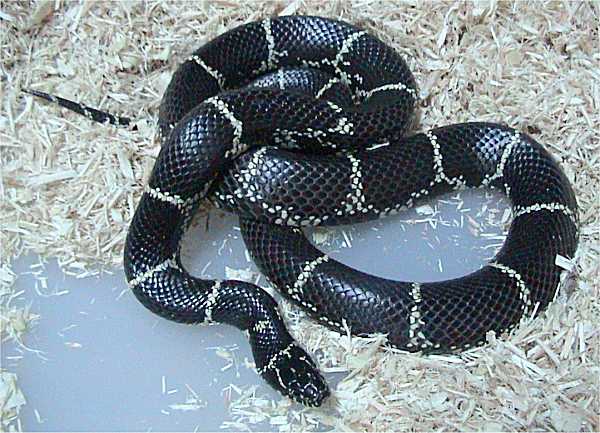
| Appearance | | No checked fact yet |
|---|
| Size | | |
|---|
| Habitat | - The species primarily inhabits prairies, pastures, and shrublands, uses forests less frequently, and generally avoids croplands. English Wikipedia
- It inhabits grasslands ranging from high-quality remnant prairie to degraded brushy fields. herpetology.inhs.illinois.edu
- It is less common in heavily farmed black-soil prairie. herpetology.inhs.illinois.edu
- The species occurs in crop-field edges, hayfields, fallow fields, open woodland edges, rocky wooded hillsides, and areas near farm buildings. mdc.mo.gov
- It commonly shelters underground in burrows or beneath objects that provide cover. mdc.mo.gov
- In northern Missouri, it commonly overwinters in crayfish burrows in dry upland prairies. mdc.mo.gov
| - Eastern kingsnakes most frequently inhabit sandy uplands in Georgia and South Carolina. srelherp.uga.edu
- Eastern kingsnakes also occupy pine flatwoods, mixed hardwood forests, river floodplains, and wetland-adjacent habitats. srelherp.uga.edu
- Common kingsnakes occupy forests, grasslands, deserts, and urban areas. animaldiversity.org
- Eastern kingsnakes can use thick leaf litter and dense shrubbery as microhabitats. English Wikipedia
- Eastern kingsnakes frequently use logs, stumps, and other objects for cover. srelherp.uga.edu
- Eastern kingsnakes in southern Florida used rodent burrows on canal banks as nocturnal retreats. pubs.usgs.gov
|
|---|
| Diet | | - Their diet includes amphibians, turtle eggs, and bird eggs, including those of northern bobwhites. English Wikipedia
- Eastern kingsnakes consume lizards, including five-lined skinks. English Wikipedia
- Eastern kingsnakes prey on small mammals such as white-footed mice. English Wikipedia
- At Rainey Slough, snakes were the only prey detected in the eastern kingsnake diet. pubs.usgs.gov
- Snakes, reptile eggs, and lizards account for 94.8% of the eastern kingsnake diet in Florida. pubs.usgs.gov
|
|---|
| Behaviour | - When threatened, it may vibrate its tail, producing a rattlesnake-like sound in dry leaf litter. English Wikipedia
- When handled, it may release a foul-smelling musk. English Wikipedia
- In central Illinois, individuals emerge from hibernation in late March and enter hibernation in mid-October. English Wikipedia
- Individuals are usually underground during daylight hours and are probably mostly nocturnal. English Wikipedia
- Males have home ranges averaging more than four times the size of female home ranges. English Wikipedia
- In Illinois, males and females move with similar frequency and travel equivalent distances per movement. English Wikipedia
- The species is active during the day in spring and autumn but becomes nocturnal during hot summer months. herpetology.inhs.illinois.edu
- It may become active on warm days in November and December. herpetology.inhs.illinois.edu
- It is generally active from April to early November, although adults may appear aboveground during warm winter days. mdc.mo.gov
- It typically begins moving toward overwintering sites in mid-September. mdc.mo.gov
| - Eastern kingsnakes may vibrate their tails, release foul-smelling musk, or bite when cornered. srelherp.uga.edu
- When possible, eastern kingsnakes respond defensively by seeking refuge. srelherp.uga.edu
- Eastern kingsnakes use constriction as their primary feeding strategy. srelherp.uga.edu
- Eastern kingsnakes are resistant to the venom of venomous pit vipers. srelherp.uga.edu
- At the Rainey Slough study site, eastern kingsnakes were susceptible to capture mostly during winter and spring. pubs.usgs.gov
- Adult male eastern kingsnakes lost an average of 39.3% of their body mass during the spring reproductive season. pubs.usgs.gov
|
|---|
| Reproduction | | |
|---|
| Distribution | - The species occurs across 13 states in the midwestern and southern United States. English Wikipedia
- The species is considered relatively common in prairie remnants of the Southern Till Plain counties of Illinois. herpetology.inhs.illinois.edu
- The species is presumed to occur throughout Missouri but is less common in the southeastern corner. mdc.mo.gov
| - Eastern kingsnakes occur from southern New Jersey south through peninsular Florida and westward into Alabama. srelherp.uga.edu
|
|---|
| Conservation | - The species is considered relatively common and nonvenomous. mdc.mo.gov
- Vehicle traffic kills prairie kingsnakes on Missouri roads. mdc.mo.gov
- The species is often killed because people mistakenly identify it as a copperhead. mdc.mo.gov
| - Some eastern kingsnake populations in the southeastern United States have declined substantially in recent decades. pubs.usgs.gov
- Eastern kingsnake populations at the protected Savannah River Site in South Carolina declined in abundance and body condition over three decades. srelherp.uga.edu
- Road mortality, human persecution, feral cats, and habitat degradation and fragmentation are major causes of declines at unprotected sites. srelherp.uga.edu
- Eastern kingsnakes are legally protected in Georgia and South Carolina. srelherp.uga.edu
- No eastern kingsnakes were detected at Rainey Slough during follow-up surveys conducted between 2006 and 2010. pubs.usgs.gov
- Road reconstruction, paving, and subsequent roadkill were identified as the likely primary cause of the Rainey Slough population's disappearance. pubs.usgs.gov
|
|---|
| Uses | - The species provides natural rodent control by consuming rodents considered destructive. mdc.mo.gov
| No checked fact yet |
|---|
| Similar species | - The species can be mistaken for colubrid snakes belonging to the genus Pantherophis because of similar markings. English Wikipedia
- The Illinois species identification guide lists the milksnake, gray ratsnake, Great Plains ratsnake, and foxsnake as similar species. herpetology.inhs.illinois.edu
- Newly hatched prairie kingsnakes may be confused with venomous copperheads. mdc.mo.gov
- The closest relatives of the prairie kingsnake in Missouri are the eastern black kingsnake, eastern milksnake, and speckled kingsnake. mdc.mo.gov
| No checked fact yet |
|---|
| Name origin | - The common name prairie kingsnake reflects a name associated with its size and ability to defeat seemingly larger opponents. mdc.mo.gov
| No checked fact yet |
|---|
| Other | No checked fact yet | |
|---|