Species · Reptiles
Prairie Kingsnake Lampropeltis calligaster
The scientific name of the Prairie Kingsnake is Lampropeltis calligaster. It is a species of reptile in the family Colubridae (colubrid), order Squamata. The name dates from 1827.
- Scientific name
- Lampropeltis calligaster (Harlan, 1827)
- Common name
- Prairie Kingsnake
- Genus
- Lampropeltis
- Family
- Colubridae (Colubrid)
- Order
- Squamata
- Class
- Reptilia
- Red List category
- LC Least Concern
- Recorded in
- 1 country
- Name status
- accepted in the Catalogue of Life

Overview
Lampropeltis calligaster inhabits prairies, pastures, shrublands, and grasslands, and also occurs in field edges, open woodland edges, and rocky wooded hillsides. It has a light brown, grey-brown, or other-colored back with dark-bordered brown or reddish-brown blotches, and a pale or yellowish belly.
Written 26 November 2026 from the sources listed below. Each statement was checked against the passage it cites; statements that could not be supported were removed.
Appearance
The Prairie kingsnake has a light brown or grey-brown back with dark reddish-brown blotches along its dorsal surface. Its back may also be reddish-brown, olive, or dark gray, and its underside is pale or yellowish.[1][2][3]
The belly may be cream or yellowish gray with faint dark markings, or yellow with rectangular brown markings. Some individuals have uniform olive-brown coloration or horizontal stripes that are generally wider than they are long.[4][5][6][7]
Young individuals have more distinct blotches and more clearly defined black belly markings than adults. Newly hatched individuals are lighter and more colorful, while dorsal markings may become less distinct with age.[8][9][10]
Habitat
The Prairie kingsnake primarily inhabits prairies, pastures, shrublands, and grasslands ranging from high-quality remnant prairie to degraded brushy fields. It uses forests less frequently, generally avoids croplands, and is less common in heavily farmed black-soil prairie.[11][12][13]
It occurs along crop-field edges, in hayfields, fallow fields, open woodland edges, rocky wooded hillsides, and areas near farm buildings. It commonly shelters underground in burrows or beneath objects that provide cover.[14][15]
In northern Missouri, it commonly overwinters in crayfish burrows in dry upland prairies.[16]
Diet
The Prairie kingsnake eats small mammals, including mice, voles, and shrews. Prairie voles are the most commonly consumed prey reported in one dietary study.[17][18][19]
Behaviour
When threatened, it may vibrate its tail, producing a rattlesnake-like sound in dry leaf litter. When handled, it may release a foul-smelling musk.[20][21]
Individuals are usually underground during daylight hours and are probably mostly nocturnal. They are active during the day in spring and autumn but become nocturnal during hot summer months.[22][23]
The species is generally active from April to early November, although adults may appear aboveground during warm winter days. It may also become active on warm days in November and December.[24][25]
In central Illinois, individuals emerge from hibernation in late March and enter hibernation in mid-October. They typically begin moving toward overwintering sites in mid-September.[26][27]
Males have home ranges averaging more than four times the size of female home ranges. In Illinois, males and females move with similar frequency and travel equivalent distances per movement.[28][29]
Reproduction and life cycle
Mating occurs soon after emergence from hibernation, generally in April or May. It can begin in late March through early April and continue into early June.[30][31]
Females usually produce one clutch annually but may skip reproduction in a given year. Clutches contain between 7 and 20 eggs, with reported clutch sizes averaging 10 eggs.[32][33][34][35]
Eggs generally hatch in late August or September. Individuals reach sexual maturity after approximately two to three years, and males reach maturity earlier than females.[36][37][38]
Conservation
The Prairie kingsnake is considered relatively common and nonvenomous. It is relatively common in prairie remnants of the Southern Till Plain counties of Illinois.[39][40]
Vehicle traffic kills Prairie kingsnakes on Missouri roads. They are also often killed because people mistakenly identify them as copperheads.[41][42]
Uses
The Prairie kingsnake provides natural rodent control by consuming rodents considered destructive.[43]
Similar species
The Prairie kingsnake can be mistaken for colubrid snakes belonging to the genus Pantherophis because of similar markings. The Illinois species identification guide lists the milksnake, gray ratsnake, Great Plains ratsnake, and foxsnake as similar species.[44][45]
Newly hatched Prairie kingsnakes may be confused with venomous copperheads. Its closest relatives in Missouri are the eastern black kingsnake, eastern milksnake, and speckled kingsnake.[46][47]
Classification of the Prairie Kingsnake
| Kingdom | Animalia |
|---|---|
| Phylum | Chordata |
| Subphylum | Vertebrata |
| Infraphylum | Gnathostomata |
| Parvphylum | Osteichthyes |
| Megaclass | Tetrapoda |
| Class | Reptilia (Reptile) |
| Order | Squamata (Snakes) |
| Suborder | Serpentes (Snakes) |
| Infraorder | Alethinophidia |
| Family | Colubridae (Colubrid) |
| Subfamily | Colubrinae |
| Genus | Lampropeltis (Kingsnakes) |
| Species | Lampropeltis calligaster (Harlan, 1827) |
Where the Prairie Kingsnake is found
Checklists and occurrence records place Lampropeltis calligaster in 1 country across North America. GBIF holds 5,137 georeferenced records of it.
Countries
Regions and cities with the most records
- Texas, United States 798
- Kansas, United States 625
- Oklahoma, United States 474
- Missouri, United States 368
- Arkansas, United States 337
- Illinois, United States 303
- North Carolina, United States 291
- Tennessee, United States 91
- Louisiana, United States 90
- Virginia, United States 81
- Fayetteville, United States 78
- Springdale, United States 76
- Lawrence, United States 70
- Columbia, United States 62
- Kentucky, United States 53
- Norman, United States 49
- Durham, United States 46
- Moore, United States 43
- Olathe, United States 42
- Chapel Hill, United States 41
- Gardner, United States 38
- Raleigh, United States 38
- Carrboro, United States 37
- Pinehurst, United States 37
- Wichita Falls, United States 37
- Siloam Springs, United States 35
- Tulsa, United States 34
- South Carolina, United States 33
- Morrisville, United States 32
- Cary, United States 30
- Lenexa, United States 30
- Owasso, United States 30
- Edmond, United States 29
- Iowa, United States 29
- Nebraska, United States 29
- Pittsburg, United States 29
Range as the checklists state it
USA (E Texas, Oklahoma, Missouri, Illinois, Indiana, Iowa, Kentucky, Western Tennessee, Arkansas, Louisiana, Alabama)
A number beside a place is its count of GBIF occurrence records. A place without a number comes from a checklist alone. Records show where a species has been observed or collected, which can include escapes and vagrants.
Common names
English
- Prairie Kingsnake
- Yellow-bellied Kingsnake
Names in 6 other languages
- Czech
- korálovka prérijní
- German
- Prärie-Königsnatter
- Polish
- lancetogłów preriowy
- Russian
- Красивая королевская змея
- Spanish
- Culebra real de la pradera, Falsa coralillo real de las praderas estadounidenses
- mus
- hvyakpo-cetto
Synonyms
2 other scientific names have been used for this species and are now treated as synonyms of Lampropeltis calligaster.
- Coluber calligaster Harlan, 1827
- Ophibolus evansii Kennicott, 1859 ambiguous synonym
Subspecies and varieties
- Lampropeltis calligaster calligaster (Prairie Kingsnake) subspecies
Related species
-
 Milk SnakeLampropeltis triangulum
-
 California KingsnakeLampropeltis californiae
-
 Scarlet KingsnakeLampropeltis elapsoides
-
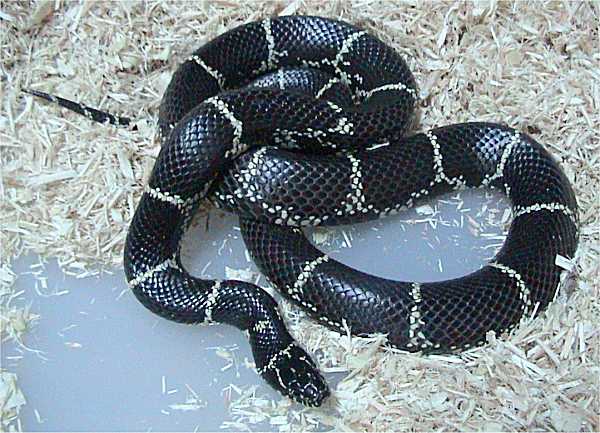 Common KingsnakeLampropeltis getula
-
 Speckled KingsnakeLampropeltis holbrooki
-
 California Mountain KingsnakeLampropeltis zonata
-
 Black KingsnakeLampropeltis nigra
-
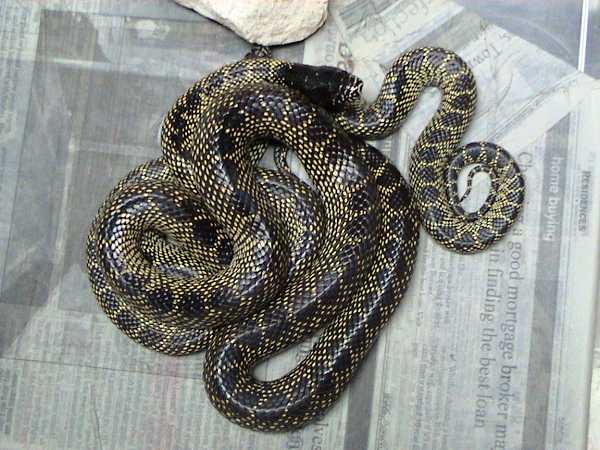 Desert KingsnakeLampropeltis splendida
Compare
Questions and answers
What is the scientific name of the Prairie Kingsnake?
The scientific name of the Prairie Kingsnake is Lampropeltis calligaster. Written with its author, the full name is Lampropeltis calligaster (Harlan, 1827).
Which family does the Prairie Kingsnake belong to?
Lampropeltis calligaster belongs to the family Colubridae, in the order Squamata and the class Reptilia.
Where is the Prairie Kingsnake found?
Checklists and occurrence records place Lampropeltis calligaster in 1 country: United States.
What is the conservation status of the Prairie Kingsnake?
The IUCN Red List category recorded for Lampropeltis calligaster is Least Concern (LC).
What other names does the Prairie Kingsnake have?
Lampropeltis calligaster is also known in English as Yellow-bellied Kingsnake.
Are prairie kingsnakes rare?
The Prairie kingsnake is considered relatively common. It is relatively common in prairie remnants of the Southern Till Plain counties of Illinois.[39][40]
Are prairie kingsnakes venomous?
No. The Prairie kingsnake is nonvenomous.[40]
How big do prairie kingsnakes get?
The species typically reaches a length of 76–110 cm. Individuals can reach a total length of 130 cm, and recorded total lengths range from 76.0 to 142.7 cm.[48][49][50]
Why are king snakes called kingsnakes?
The common name prairie kingsnake reflects a name associated with its size and ability to defeat seemingly larger opponents.[51]
What is the diet of a king snake?
The Prairie kingsnake's diet includes small mammals, birds, amphibians, reptiles, and insects. Its principal prey include mice, voles, and shrews.[18][19]
What kind of habitat do king snakes need?
The Prairie kingsnake primarily inhabits prairies, pastures, shrublands, and grasslands. It also occurs in field edges, open woodland edges, rocky wooded hillsides, and areas near farm buildings, and commonly shelters underground in burrows or beneath objects that provide cover.[11][12][14][15]
Sources
Passages the profile rests on
- The snake has a light brown or grey-brown back with dark reddish-brown blotches along its dorsal surface. Source passage: “Prairie kingsnakes are light brown or grey-brown in color, with dark reddish-brown blotching down the dorsal length of their bodies.” — English Wikipedia
- Its underside is pale or yellowish. Source passage: “Their ventral side is pale or yellowish.” — English Wikipedia
- The back may be light gray, light brown, reddish-brown, olive, or dark gray. Source passage: “Back color: light gray, light brown, reddish-brown, olive, and/or dark gray” — herpneb.unl.edu
- Its belly is cream or yellowish gray with faint dark markings. Source passage: “Belly cream or yellowish gray with dim dark markings.” — herpetology.inhs.illinois.edu
- Some individuals have a uniform olive-brown coloration, while a few have stripes. Source passage: “Some individuals uniform olive brown, a few striped.” — herpetology.inhs.illinois.edu
- Some individuals have horizontal stripes that are generally wider than they are long. Source passage: “May or may not have stripes that are usually wider then they are long that are horizontal to the back” — herpneb.unl.edu
- The belly is yellow with rectangular brown markings. Source passage: “The belly is yellow with rectangular brown markings.” — mdc.mo.gov
- Its dorsal markings may become less distinct as it ages. Source passage: “Dorsal marking may fade with age.” — English Wikipedia
- Young individuals have more distinct blotches and more clearly defined black belly markings than adults. Source passage: “Young are more distinctly blotched and their bellies more clearly marked with black.” — herpetology.inhs.illinois.edu
- Newly hatched individuals are lighter and more colorful than adults. Source passage: “Newly hatched young are lighter and more colorful than adults.” — mdc.mo.gov
- The species primarily inhabits prairies, pastures, and shrublands, uses forests less frequently, and generally avoids croplands. Source passage: “Prairie kingsnakes primarily use prairie, pasture, and shrublands, less often use forests, and appear to never use croplands” — English Wikipedia
- It inhabits grasslands ranging from high-quality remnant prairie to degraded brushy fields. Source passage: “Grasslands from high-quality remnant prairie to degraded brushy fields.” — herpetology.inhs.illinois.edu
- It is less common in heavily farmed black-soil prairie. Source passage: “Less common in heavily farmed black-soil prairie.” — herpetology.inhs.illinois.edu
- The species occurs in crop-field edges, hayfields, fallow fields, open woodland edges, rocky wooded hillsides, and areas near farm buildings. Source passage: “lives not only in native prairie habitats but also along the edge of crop fields, hayfields, fallow fields, or the edge of open woods, on rocky, wooded hillsides, near farm buildings” — mdc.mo.gov
- It commonly shelters underground in burrows or beneath objects that provide cover. Source passage: “They are secretive and spend most of their time underground in burrows or beneath sheltering objects.” — mdc.mo.gov
- In northern Missouri, it commonly overwinters in crayfish burrows in dry upland prairies. Source passage: “In northern Missouri, prairie kingsnakes commonly use crayfish burrows in dry upland prairies.” — mdc.mo.gov
- Prairie voles are the most commonly consumed prey reported in one dietary study. Source passage: “Fitch (1978) found that prairie voles were most commonly consumed” — English Wikipedia
- Its recorded diet includes small mammals, birds, amphibians, reptiles, and insects. Source passage: “Diet includes small mammals, birds, amphibians, reptiles, and insects.” — herpetology.inhs.illinois.edu
- Its principal prey include mice, voles, and shrews. Source passage: “The prairie kingsnake's chief prey are small mammals such as mice, voles, and shrews.” — mdc.mo.gov
- When threatened, it may vibrate its tail, producing a rattlesnake-like sound in dry leaf litter. Source passage: “Like most colubrids, if harassed they will shake their tail, which, if in dry leaf litter, can sound like a rattlesnake.” — English Wikipedia
- When handled, it may release a foul-smelling musk. Source passage: “may excrete a foul-smelling musk if handled.” — English Wikipedia
- Individuals are usually underground during daylight hours and are probably mostly nocturnal. Source passage: “they were usually underground during the day, so they are probably mostly nocturnal.” — English Wikipedia
- The species is active during the day in spring and autumn but becomes nocturnal during hot summer months. Source passage: “Active by day during spring and autumn, but becomes nocturnal during hot summer months.” — herpetology.inhs.illinois.edu
- It may become active on warm days in November and December. Source passage: “May become active on warm days even in November and December.” — herpetology.inhs.illinois.edu
- It is generally active from April to early November, although adults may appear aboveground during warm winter days. Source passage: “The active season of this species is normally April to early November.” — mdc.mo.gov
- In central Illinois, individuals emerge from hibernation in late March and enter hibernation in mid-October. Source passage: “In central Illinois, they emerge from hibernation in late March and enter hibernation mid-October.” — English Wikipedia
- It typically begins moving toward overwintering sites in mid-September. Source passage: “Most move to their overwintering sites starting in mid-September.” — mdc.mo.gov
- Males have home ranges averaging more than four times the size of female home ranges. Source passage: “home ranges of male prairie kingsnakes averaged over four times larger than those of females” — English Wikipedia
- In Illinois, males and females move with similar frequency and travel equivalent distances per movement. Source passage: “Males and females move with the same frequency and travel equivalent distances per move.” — English Wikipedia
- Mating occurs soon after emergence from hibernation, generally in April or May. Source passage: “Mates soon after emerging from hibernation in April or May.” — herpetology.inhs.illinois.edu
- Mating begins in late March through early April and can continue into early June. Source passage: “Mating occurs in early spring, in late March through early April, soon after emerging from winter dormancy, and extends into early June.” — mdc.mo.gov
- Females may skip reproduction in a given year. Source passage: “Many adult females do not breed within a given year.” — English Wikipedia
- Egg laying has been reported from June through July, with an average clutch size of 10 eggs. Source passage: “Egg laying has been reported in June through July, with clutch sizes averaging 10 eggs” — English Wikipedia
- Clutches contain between 7 and 20 eggs and are laid in midsummer. Source passage: “Clutches of 7-20 eggs laid in midsummer hatch in August and September.” — herpetology.inhs.illinois.edu
- Females usually produce one clutch annually. Source passage: “Usually, only one clutch is produced annually” — mdc.mo.gov
- Eggs generally hatch in late August or September. Source passage: “that hatch in late August or September.” — English Wikipedia
- Individuals reach sexual maturity after approximately two to three years. Source passage: “reach sexual maturity after two to three years.” — English Wikipedia
- Males reach maturity earlier than females. Source passage: “with males maturing earlier than females.” — mdc.mo.gov
- The species is considered relatively common in prairie remnants of the Southern Till Plain counties of Illinois. Source passage: “Locally common in prairie remnants of the Southern Till Plain counties.” — herpetology.inhs.illinois.edu
- The species is considered relatively common and nonvenomous. Source passage: “A relatively common, nonvenomous, harmless snake.” — mdc.mo.gov
- Vehicle traffic kills prairie kingsnakes on Missouri roads. Source passage: “Unfortunately, many prairie kingsnakes are killed by vehicle traffic on Missouri roads.” — mdc.mo.gov
- The species is often killed because people mistakenly identify it as a copperhead. Source passage: “They are often misidentified as copperheads and killed out of unwarranted fear.” — mdc.mo.gov
- The species provides natural rodent control by consuming rodents considered destructive. Source passage: “Because the prairie kingsnake consumes many destructive rodents, it provides a valuable nontoxic rodent-control service.” — mdc.mo.gov
- The species can be mistaken for colubrid snakes belonging to the genus Pantherophis because of similar markings. Source passage: “They are easily mistaken for some species of colubrid snakes of the genus Pantherophis, which can have similar markings.” — English Wikipedia
- The Illinois species identification guide lists the milksnake, gray ratsnake, Great Plains ratsnake, and foxsnake as similar species. Source passage: “Similar Species: Milksnake, Gray Ratsnake, Great Plains Ratsnake, Foxsnake.” — herpetology.inhs.illinois.edu
- Newly hatched prairie kingsnakes may be confused with venomous copperheads. Source passage: “Young or newly hatched prairie kingsnakes often are confused with the venomous copperhead.” — mdc.mo.gov
- The closest relatives of the prairie kingsnake in Missouri are the eastern black kingsnake, eastern milksnake, and speckled kingsnake. Source passage: “The prairie kingsnake's closest relatives in Missouri are the eastern black kingsnake, eastern milksnake, and speckled kingsnake.” — mdc.mo.gov
- The species typically reaches a length of 76–110 cm. Source passage: “They are capable of growing to lengths of 76–110 cm (30–43 in)” — English Wikipedia
- Individuals can reach a total length of 130 cm. Source passage: “Long (up to 130 cm TL)” — herpetology.inhs.illinois.edu
- Recorded total lengths range from 76.0 to 142.7 cm. Source passage: “Total length: 76.0-142.7 cm (29.9-56.2 in)” — herpneb.unl.edu
- The common name prairie kingsnake reflects a name associated with its size and ability to defeat seemingly larger opponents. Source passage: “The name "king," applied to this snake for its size and ability to fight and win against seemingly overwhelming opponents” — mdc.mo.gov
- The species occurs across 13 states in the midwestern and southern United States. Source passage: “Prairie kingsnakes are found across 13 states in the midwestern and southern United States.” — English Wikipedia
- The species is presumed to occur throughout Missouri but is less common in the southeastern corner. Source passage: “Presumed to occur statewide; less common in the southeastern corner of the state.” — mdc.mo.gov
Data
- Catalogue of Life, 2026-10-16 XR cc by
- Global Biodiversity Information Facility CC BY 4.0
- Wikidata CC0
- GeoNames CC BY 4.0
- Wikimedia Commons per image; credit shown with each image
- Within the Catalogue of Life, this name comes from The Reptile Database cc by
References
- Harlan, R. (1827). Genera of North American Reptilia, and synopsis of the species. J. Acad. Nat. Sci. Philadelphia 5: 317-372.
- Holbrook, John E. (1840). North American Herpetology, Vol. 4 (1st ed.). J. Dobson, Philadelphia, 126 Pp.
- Holbrook, John E. (1842). North American Herpetology; or, A description of the reptiles inhabiting the United States. Vol I (2nd ed.). J. Dobson, Philadelphia, 152 Pp.
- Baird, S. F. and C. Girard. (1853). Catalogue of North American Reptiles in the Museum of the Smithsonian Institution. Part 1.-Serpents. Smithsonian Inst., Washington, Xvi + 172 Pp.
- Cope, E. D. (1860). Catalogue of the Colubridae in the Museum of the Academy of Natural Sciences of Philadelphia, with notes and descriptions of new species. Part II. Proc. Acad. Nat. Sci. Philadelphia 12: 241-266.
- Jan, G. (1866). Iconographie générale des ophidiens. 17. Livraison. J.B. Bailière et Fils, Paris.
- Garman, & Samuel. (1884). The reptiles and batrachians of North America. Mem. Mus. Comp. Zool, Cambridge (Massachusetts), 8 (3): Xxxiv + 185 Pp. [1883] [CNAH Reprint 10].
- Stejneger, L. (1891). Notes on some North American snakes. Proc. US Natl. Mus. 14 (876): 501-505.
- Cope, E. D. (1900). The crocodilians, lizards and snakes of North America. Ann. Rep. U.S. Natl. Mus. 1898: 153-1270.
- Miller, Gerrit S., Jr. (1902). A fully adult specimen of Ophibolus rhombomaculatus. Proc. Biol. Soc. Washington 15: 36.
- Hay, W. P. (1902). The color of the fully adult Ophibolus rhombomaculatus Holbrook. Proc. Biol. Soc. Washington 15: 90.
- Blanchard, Frank N. (1920). A synopsis of the king snakes: Genus Lampropeltis Fitzinger. Occasional Papers of the Museum of Zoology, University of Michigan (87): 1-7.
- Blanchard, Frank N. (1921). A revision of the king snakes: genus Lampropeltis. Bull. US Natl. Mus. (114): 1-260.
- Brimley, C. S. (1927). Some records of amphibians and reptiles from North Carolina. Copeia 1927 (162): 10-12.
- Force, Edith R. (1928). A Preliminary Checklist of Amphibians and Reptiles of Tulsa County. Proceedings of the Oklahoma Academy of Science 8:
- Allen, Morrow J. (1932). A survey of the Amphibians and reptiles of Harrison County, Mississippi. American Museum Novitates (542): 1-20.
- Smith, Hobart M.;Leonard, Arthur B. (1934). Distributional records of reptiles and amphibians in Oklahoma. American Midland Naturalist 15: 190-196.
- Burt, Charles E. (1935). Further records of the ecology and distribution of amphibians and reptiles in the middle west. American Midland Naturalist 16 (3): 311-336.
- Bailey, Reeve M. (1939). Carphophis amoena vermis and Lampropeltis calligaster in Iowa. Copeia 1939 (4): 218-220.
- Cook, Fannye A. (1945). Intergradation of Lampropeltis calligaster and L. rhombomaculata in Mississippi. Copeia 1945 (1): 47-48.
- Sinclair, R. M. (1951). Lampropeltis calligaster in Tennessee. Herpetologica 7 (4): 174.
- Schmidt, Karl P. (1954). Omissions from the Sixth Edition of the Check List of North American Amphibians and Reptiles. Copeia 1954: 304-306.
- Shoop, & Robert, C. (1957). Eggs and young of the prairie king snake, Lampropeltis c. calligaster. Copeia 1957 (1): 48-49.
- Liner, Ernest A. (1966). Lampropeltis calligaster rhombomaculata (Holbrook) in Louisiana. Journal of the Ohio Herpetological Society 5 (3): 105.
- Nemuras, K. (1966). Additional records of Lampropeltis getulus getulus and Lampropeltis calligaster rhombomaculata in Anne Arundel County, Maryland. Bull. Maryland Herp. Soc. 2 (3): 5.
This species in other databases
Page built on 26 November 2026. See how the catalog is made and all sources and licences.
Cite this page
ScientificNames.org. (2026). Lampropeltis calligaster (Prairie Kingsnake). Retrieved November 26, 2026, from https://scientificnames.org/species/lampropeltis-calligaster
“Lampropeltis calligaster (Prairie Kingsnake).” ScientificNames.org, 2026, scientificnames.org/species/lampropeltis-calligaster. Accessed 26 Nov. 2026.
ScientificNames.org. “Lampropeltis calligaster (Prairie Kingsnake).” Accessed November 26, 2026. https://scientificnames.org/species/lampropeltis-calligaster.
@misc{scientificnames_lampropeltis_calligaster_prairie_kingsnake,
  author = {{ScientificNames.org}},
  title = {Lampropeltis calligaster (Prairie Kingsnake)},
  year = {2026},
  url = {https://scientificnames.org/species/lampropeltis-calligaster},
  note = {Accessed 2026-11-26}
}