Comparison

Lesser Grey Shrike vs Northern Shrike

Lesser Grey Shrike (Lanius minor) and Northern Shrike (Lanius borealis) both belong to the genus Lanius (shrikes) and part ways below it. Both are recorded in 7 countries.
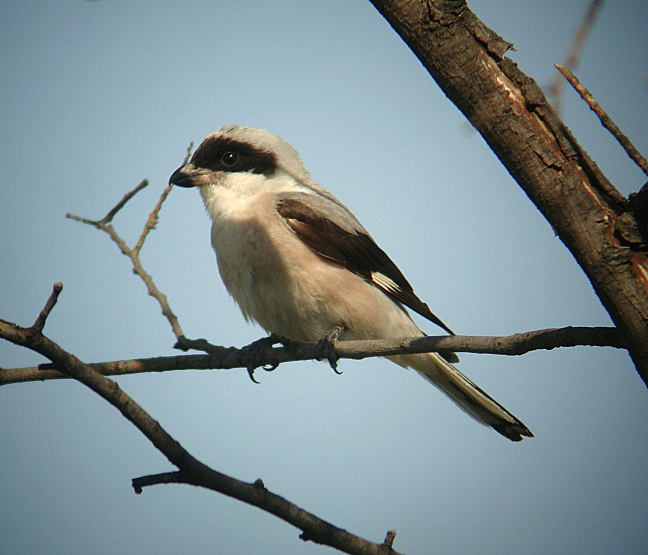
Lesser Grey Shrike

Lesser Grey Shrike

Lanius minor

Daniel Bastaja, http://www.birdingfaqs.com/, CC BY 3.0, via Wikimedia Commons

Northern Shrike

Northern Shrike

Lanius borealis

Paul Hurtado, CC BY-SA 2.0, via Wikimedia Commons

Side by side

Lesser Grey ShrikeNorthern Shrike
Scientific nameLanius minor J. F. Gmelin, 1788Lanius borealis Vieillot, 1808
English nameLesser Grey ShrikeNorthern Shrike
GroupBirdsBirds
ClassAves BirdAves Bird
OrderPasseriformes PasserinePasseriformes Passerine
FamilyLaniidae ShrikeLaniidae Shrike
GenusLanius ShrikesLanius Shrikes
Named in17881808
Red List categoryLeast ConcernLeast Concern
EnvironmentterrestrialNot recorded
Countries on record93 countries13 countries
GBIF occurrence records103,944 records329,808 records

Rows where the two agree are shown in grey.

Where each is found

Both recorded in 7 countries

Only Lesser Grey Shrike (86)

Only Northern Shrike (6)

From Catalogue of Life checklists and GBIF occurrence records. A country missing from a list means no record is held, which is not proof of absence.

Checked facts

Lesser Grey ShrikeNorthern Shrike
AppearanceNo checked fact yet
Size
Habitat
  • During summer, the species inhabits open countryside and the margins of cultivated areas. English Wikipedia
  • Summer habitats include heathland containing scattered bushes and trees. English Wikipedia
  • The species also occupies gardens, coppices, woodland and roadside trees during summer. English Wikipedia
  • In its wintering range, the species is generally found in scrubland and among thorn trees. English Wikipedia
  • The northern shrike breeds in taiga and tundra habitats. English Wikipedia
  • The northern shrike breeds in forest-edge habitats containing suitable trees or shrubs. English Wikipedia
  • Northern shrikes have nested in white spruce, black spruce, felt-leaf willow, mountain alders, and poplars. English Wikipedia
  • The northern limit of the northern shrike's breeding range is determined by the presence of shrubby willows approximately 1–2 meters tall. English Wikipedia
  • Wintering northern shrikes prefer open country, including forest edges, prairies, agricultural land, savannas, and coastal marshes. English Wikipedia
Diet
  • The species primarily eats insects, including beetles, moths, butterflies, large flies, grasshoppers, crickets and millipedes. English Wikipedia
  • It occasionally consumes cherries and figs in small quantities. English Wikipedia
  • The species captures insects both in flight and on the ground. English Wikipedia
  • Northern shrikes prey on arthropods including spiders, beetles, bugs, and grasshoppers. English Wikipedia
  • Northern shrikes also consume small vertebrates. English Wikipedia
  • Recorded bird prey of northern shrikes include horned larks, black-capped chickadees, common starlings, Brewer's sparrows, white-crowned sparrows, dark-eyed juncos, pine siskins, and house sparrows. English Wikipedia
  • Recorded mammalian prey of northern shrikes include vagrant shrews, western harvest mice, deer mice, long-tailed voles, meadow voles, and house mice. English Wikipedia
  • Northern shrikes have been recorded preying on spiny lizards. English Wikipedia
Behaviour
  • The species hunts from elevated perches such as wires and branches. English Wikipedia
  • Individuals frequently hover while hunting on their breeding grounds. English Wikipedia
  • Individuals do not hover while moulting on their non-breeding grounds. English Wikipedia
  • The species occasionally impales freshly caught prey on thorns for later consumption. English Wikipedia
  • Individuals create food stores primarily when they are satiated. English Wikipedia
  • Experimental exposure to abundant food increases the rate at which individuals impale freshly caught prey. English Wikipedia
  • The male has been observed feeding the female before beginning to store food. English Wikipedia
  • Its flight is low and somewhat undulating, and it occasionally glides with extended wings. English Wikipedia
  • The species hops when moving on the ground and generally remains there only long enough to collect food. English Wikipedia
  • When excited, individuals fan their tails and move them up and down or sideways. English Wikipedia
  • The species vigorously defends its nest and drives away larger birds. English Wikipedia
  • Northern shrikes exhibit irruptive movements outside the breeding season. English Wikipedia
  • Some northern shrikes remain in their breeding range throughout the year. English Wikipedia
  • Most northern shrikes move south according to winter severity, food availability, and competition from other shrikes. English Wikipedia
  • Northern shrikes frequently perch on tall poles and branches while searching for food. English Wikipedia
  • Northern shrikes have been observed hunting finches and house sparrows at bird feeders. English Wikipedia
  • Northern shrikes can attract small birds by imitating their calls. English Wikipedia
  • Northern shrikes impale prey on thorns or spikes. English Wikipedia
ReproductionNo checked fact yet
Distribution
  • The species breeds in South and Central Europe and western Asia. English Wikipedia
  • Its European breeding range includes southern France, Switzerland, Austria, Hungary, Slovakia, the Czech Republic, Italy, Albania, Greece, Romania, Bulgaria, Ukraine and southern Russia. English Wikipedia
  • Its Asian breeding range extends through the Middle East to eastern Turkey and Iran. English Wikipedia
  • The species migrates to tropical southern Africa for winter. English Wikipedia
  • The northern shrike is native to North America and Siberia. English Wikipedia
  • The northern shrike breeds from Labrador west through Alaska to western Siberia. English Wikipedia
  • The northern shrike's breeding range extends south to extreme northwestern China, northern Mongolia, and James Bay. English Wikipedia
  • Northern shrikes occur irregularly as far south as New Mexico, Kansas, Illinois, Ohio, Pennsylvania, and New Jersey during winter. English Wikipedia
Conservation
  • The species is classified as Least Concern on the IUCN Red List. English Wikipedia
  • The estimated global population is between 2.5 million and 9 million individuals. English Wikipedia
  • The European breeding population is estimated at approximately 3,000–5,000 pairs. English Wikipedia
  • Declining insect availability following a series of wet summers is suggested as a possible cause of population decline. English Wikipedia
  • Changes from small agricultural enclosures and woodland patches to large fields are identified as another possible cause of declining numbers. English Wikipedia
  • The species is listed as threatened under Annex I of the European Commission Birds Directive. English Wikipedia
  • The Montana Field Guide reports that no threats are known for the northern shrike. fieldguide.mt.gov
Similar species
  • The lesser grey shrike resembles the great grey shrike and the Iberian grey shrike. English Wikipedia
  • The northern shrike is larger than the loggerhead shrike. English Wikipedia
  • The loggerhead shrike has a shorter bill with a less prominent hook than the northern shrike. English Wikipedia
Name origin
  • The northern shrike and the related loggerhead shrike are commonly called butcherbirds in North America because they impale prey on thorns or spikes. English Wikipedia
  • The northern shrike has the folk name winter butcherbird in Michigan. English Wikipedia
Other
  • A molecular phylogenetic study published in 2019 identified the woodchat shrike as its sister species. English Wikipedia
  • The lesser grey shrike and woodchat shrike diverged approximately 3.9–5.0 million years ago. English Wikipedia
  • The Vuntut Gwitchin First Nation people of Old Crow, Yukon, call the northern shrike Tzi kwut go katshi lyi. English Wikipedia

In brief

Lesser Grey Shrike

Lanius minor breeds in South and Central Europe and western Asia and migrates to tropical southern Africa for winter. Full profile

Northern Shrike

Lanius borealis is native to North America and Siberia, where it breeds in taiga and tundra habitats. It has a hooked beak characteristic of a raptor but lacks talons. Full profile

Compare something else

Page built on 29 November 2026 from the data on the two species pages, where every source is listed.

Cite this page

ScientificNames.org. (2026). Lesser Grey Shrike vs Northern Shrike. Retrieved November 29, 2026, from https://scientificnames.org/compare/lesser-grey-shrike-vs-northern-shrike