Species · Birds
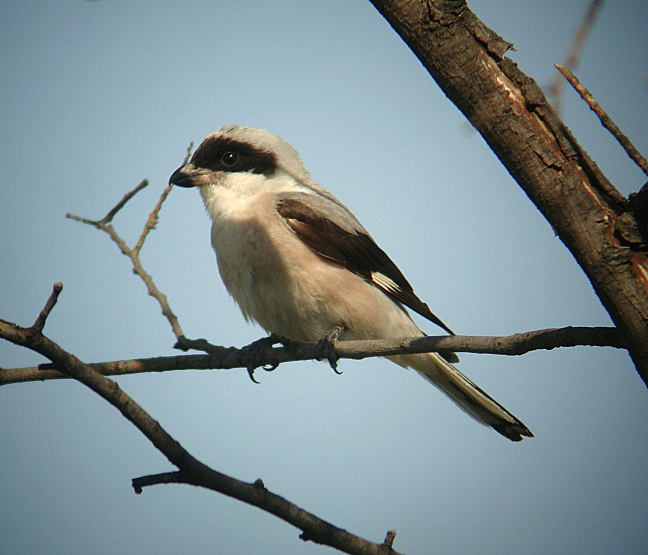
Lesser Grey Shrike Lanius minor
The scientific name of the Lesser Grey Shrike is Lanius minor. It is a species of bird in the family Laniidae (shrike), order Passeriformes. The name dates from 1788.
- Scientific name
- Lanius minor J. F. Gmelin, 1788
- Common name
- Lesser Grey Shrike
- Genus
- Lanius
- Family
- Laniidae (Shrike)
- Order
- Passeriformes
- Class
- Aves
- Red List category
- LC Least Concern
- Environment
- terrestrial
- Recorded in
- 93 countries
- Name status
- accepted in the Catalogue of Life
Overview
Lanius minor breeds in South and Central Europe and western Asia and migrates to tropical southern Africa for winter.
Written 26 November 2026 from the sources listed below. Each statement was checked against the passage it cites; statements that could not be supported were removed.
Conservation
The Lesser Grey Shrike is classified as Least Concern on the IUCN Red List. Its estimated global population is between 2.5 million and 9 million individuals, while the European breeding population is estimated at approximately 3,000–5,000 pairs.[1][2][3]
Declining insect availability following a series of wet summers is suggested as a possible cause of population decline. Changes from small agricultural enclosures and woodland patches to large fields are identified as another possible cause of declining numbers.[4][5]
The species is listed as threatened under Annex I of the European Commission Birds Directive.[6]
Similar species
The Lesser Grey Shrike resembles the great grey shrike and the Iberian grey shrike. A molecular phylogenetic study published in 2019 identified the woodchat shrike as its sister species. The two species diverged approximately 3.9–5.0 million years ago.[7][8][9]
Appearance
Adults measure approximately 20 centimetres in length. The wing length is approximately 13 centimetres, and the tarsus measures approximately 2.5 centimetres.[10][11][12]
Habitat
During summer, the Lesser Grey Shrike inhabits open countryside and the margins of cultivated areas. Its summer habitats include heathland containing scattered bushes and trees, as well as gardens, coppices, woodland and roadside trees.[13][14][15]
In its wintering range, the species is generally found in scrubland and among thorn trees.[16]
Diet
The Lesser Grey Shrike primarily eats insects, including beetles, moths, butterflies, large flies, grasshoppers, crickets and millipedes. It occasionally consumes cherries and figs in small quantities.[17][18]
The species captures insects both in flight and on the ground.[19]
Behaviour
The Lesser Grey Shrike hunts from elevated perches such as wires and branches. Individuals frequently hover while hunting on their breeding grounds but do not hover while moulting on their non-breeding grounds.[20][21][22]
The species occasionally impales freshly caught prey on thorns for later consumption. Individuals create food stores primarily when they are satiated, and experimental exposure to abundant food increases the rate at which they impale freshly caught prey.[23][24][25]
The male has been observed feeding the female before beginning to store food.[26]
Its flight is low and somewhat undulating, and it occasionally glides with extended wings. It hops when moving on the ground and generally remains there only long enough to collect food.[27][28]
When excited, individuals fan their tails and move them up and down or sideways. The species vigorously defends its nest and drives away larger birds.[29][30]
Reproduction and life cycle
The Lesser Grey Shrike often builds its nest in roadside trees approximately 4–10 metres above the ground. Both parents construct the nest using stems of flowering plants, including cudweed, Filago and thyme.[31][32][33]
The nest lining consists of wool, hairs, roots and feathers. A typical clutch contains five to seven eggs, usually bluish green with greenish-brown blotches, averaging 26.1 by 18.2 millimetres.[34][35][36][37]
Incubation lasts approximately 15 days and is performed mainly by the female, with both parents participating. Both parents feed the chicks, and young birds leave the nest after approximately 14 days.[38][39][40]
The species usually produces one brood per breeding season.[41]
Classification of the Lesser Grey Shrike
| Kingdom | Animalia |
|---|---|
| Phylum | Chordata |
| Subphylum | Vertebrata |
| Infraphylum | Gnathostomata |
| Parvphylum | Osteichthyes |
| Megaclass | Tetrapoda |
| Class | Aves (Bird) |
| Order | Passeriformes (Passerine) |
| Family | Laniidae (Shrike) |
| Genus | Lanius (Shrikes) |
| Species | Lanius minor J. F. Gmelin, 1788 |
Where the Lesser Grey Shrike is found
Checklists and occurrence records place Lanius minor in 93 countries. GBIF holds 103,944 georeferenced records of it.
Countries
- Afghanistan 46
- Aland Islands 3
- Albania 119
- Angola 47
- Armenia 2,104
- Austria 80
- Azerbaijan 643
- Bahrain 50
- Belarus 42
- Belgium 78
- Bosnia and Herzegovina 121
- Botswana 2,076
- Bulgaria 4,338
- Burundi 10
- Chad 23
- China 169
- Croatia 504
- Cyprus 1,287
- Czechia 16
- Democratic Republic of the Congo 310
- Denmark 359
- Djibouti 17
- Egypt 179
- Eritrea 3
- Estonia 94
- Eswatini 92
- Ethiopia 93
- Finland 248
- France 1,954
- Gabon 3
- Georgia 3,966
- Germany 161
- Greece 5,354
- Hungary 3,073
- India 28
- Iran 761
- Iraq 120
- Ireland 6
- Israel 4,221
- Italy 453
- Jordan 72
- Kazakhstan 1,201
- Kenya 1,296
- Kosovo 33
- Kuwait 796
- Kyrgyzstan 505
- Lebanon 55
- Libya 4
- Malawi 34
- Moldova 122
- Mongolia 18
- Montenegro 188
- Mozambique 61
- Namibia 6,138
- Nepal 7
- North Macedonia 265
- Norway 572
- Oman 25
- Pakistan 7
- Palestinian Territory 195
- Poland 129
- Portugal 19
- Qatar 145
- Republic of the Congo 5
- Romania 2,599
- Russia 2,427
- Rwanda 39
- San Marino 4
- Saudi Arabia 672
- Serbia 395
- Slovakia 168
- Slovenia 84
- Somalia 22
- South Africa 28,063
- Spain 247
- Sudan 46
- Sweden 5,602
- Switzerland 54
- Syria 28
- Tajikistan 41
- Tanzania 676
- The Netherlands 2,991
- Tunisia 4
- Turkey 6,546
- Turkmenistan 16
- Uganda 391
- Ukraine 4,092
- United Arab Emirates 1,076
- United Kingdom 768
- Uzbekistan 218
- Yemen 8
- Zambia 667
- Zimbabwe 857
Regions and cities with the most records
- Limpopo, South Africa 7,524
- North West, South Africa 6,247
- Mpumalanga, South Africa 6,141
- Northern Cape, South Africa 3,677
- Gauteng, South Africa 1,718
- Kalmar, Sweden 1,482
- Southern District, Israel 1,459
- Free State, South Africa 1,387
- Kakheti, Georgia 1,348
- Khomas Region, Namibia 1,293
- Occitanie, France 1,220
- Constanța County, Romania 1,217
- Otjozondjupa Region, Namibia 1,211
- Oshikoto Region, Namibia 1,154
- Dobrich, Bulgaria 1,042
- Batumi, Georgia 960
- Crimea, Ukraine 958
- Ararat, Armenia 916
- Northern District, Israel 912
- Hajdú-Bihar, Hungary 902
- Ararat, Armenia 857
- Uppsala, Sweden 835
- Qalqīlyah, Palestinian Territory 798
- Kvemo Kartli, Georgia 782
- Eṭ Ṭīra, Israel 775
- Tulcea County, Romania 759
- Almaty Region, Kazakhstan 743
- Istanbul, Turkey 743
- Hod HaSharon, Israel 742
- Giv'at Shmuel, Israel 741
- Petaẖ Tiqva, Israel 741
- Kafr Qāsim, Israel 740
- Even Yehuda, Israel 739
- Rosh Ha‘Ayin, Israel 738
- Bnei Brak, Israel 737
- Kfar Saba, Israel 736
Range as the checklists state it
Europe & Northern Asia (excluding China)
A number beside a place is its count of GBIF occurrence records. A place without a number comes from a checklist alone. Records show where a species has been observed or collected, which can include escapes and vagrants.
Common names
English
- Lesser Grey Shrike
- LGSH
- Lesser Gray Shrike
Names in 54 other languages
- Afrikaans
- Gryslaksman
- Arabic
- صرد رمادي صغير
- Armenian
- Սևաճակատ շամփրուկ
- Asturian
- picanzu nanu
- Belarusian
- Чарналобы грычун
- Breton
- Pig-spern tal du
- Bulgarian
- Черночела сврачка
- Catalan
- trenca
- Chinese
- 黑額伯勞, 黑额伯劳
- Czech
- ťuhýk menší
- Danish
- Rosenbrystet Tornskade
- Dutch
- Kleine Klapekster
- Esperanto
- nigrafrunta lanio
- Estonian
- mustlauk-õgija
- Faroese
- Ennissvartur tyrningur
- Finnish
- mustaotsalepinkäinen
- French
- Pie-grièche d'Italie, Pie-grièche à poitrine rose
- Galician
- Picanzo pequeno
- German
- Schwarzstirnwürger
- Greek
- Σταχτοκεφαλάς
- Hebrew
- חנקן שחור מצח, חנקן שחור-מצח
- Hungarian
- kis őrgébics
- Icelandic
- Geigsvarri
- Irish
- Mionscréachán liath
- Italian
- Averla cenerina, Averla minore
- Japanese
- ヒメオオモズ
- Kazakh
- Кіші тағанақ
- Latvian
- melnpieres čakste
- Lithuanian
- juodakaktė medšarkė
- Luxembourgish
- Klenge groen Neimäerder
- Macedonian
- Мало свраче, мало страче
- Northern Sami
- Čáhppesgálloskirri
- Norwegian
- rosenvarsler
- Norwegian Nynorsk
- rosenvarslar
- Persian
- سنگ چشم خاکستری کوچک
- Polish
- dzierzba czarnoczelna
- Portuguese
- picanço-de-mascarilha, picanço-pequeno
- Romanian
- Sfrâncioc cu frunte neagră
- Russian
- Чернолобый сорокопут
- Scottish Gaelic
- Buidseir glas beag
- Serbian
- Sivi svračak, Сиви сврачак
- Slovak
- strakoš kolesár
- Slovenian
- črnočeli srakoper
- Spanish
- Alcaudón chico
- Swedish
- svartpannad törnskata
- Turkish
- Kara Alınlı Örümcekkuşu
- Ukrainian
- сорокопуд чорнолобий
- Welsh
- Cigydd Glas, Cigyddion Glas
- arg
- Picapuerco chicot
- chm
- Шим лепкӓн шапренгӹ
- chv
- Пӗчӗк шӑлан кайӑк
- glv
- Pieannad ghlass veg
- pcd
- Agache-écreuhèle à pouétrinne rose
- rue
- Чігач
Synonyms
8 other scientific names have been used for this species and are now treated as synonyms of Lanius minor.
- Lanioides minor
- Lanius italicus Latham, J, 1790
- Lanius lubberti Reichenow, A, 1902
- Lanius luebberti Reichenow, A, 1902
- Lanius minor minor J. F. Gmelin, 1788
- Lanius minor turanicus Fedyushin, 1927
- Lanius roseogularis de Sélys Longchamps, ME, 1831
- Lanius yemenensis Ogilvie-Grant, WR, 1914
Related species
-
 Loggerhead ShrikeLanius ludovicianus
-
 Great Grey ShrikeLanius excubitor
-
 Red-backed ShrikeLanius collurio
-
 Northern ShrikeLanius borealis
-
 Brown ShrikeLanius cristatus
-
 Long-tailed ShrikeLanius schach
-
 Isabelline ShrikeLanius isabellinus
-
 Southern FiscalLanius collaris
Compare
Questions and answers
What is the scientific name of the Lesser Grey Shrike?
The scientific name of the Lesser Grey Shrike is Lanius minor. Written with its author, the full name is Lanius minor J. F. Gmelin, 1788.
Which family does the Lesser Grey Shrike belong to?
Lanius minor belongs to the family Laniidae, in the order Passeriformes and the class Aves.
Where is the Lesser Grey Shrike found?
Checklists and occurrence records place Lanius minor in 93 countries, including South Africa, Turkey, Namibia, Sweden, Greece and Bulgaria.
What is the conservation status of the Lesser Grey Shrike?
The IUCN Red List category recorded for Lanius minor is Least Concern (LC).
What other names does the Lesser Grey Shrike have?
Lanius minor is also known in English as LGSH and Lesser Gray Shrike.
Why is shrike called butcher bird?
The genus name Lanius derives from the Latin word for butcher. The Lesser Grey Shrike occasionally impales freshly caught prey on thorns for later consumption.[23][42]
What do shrikes eat?
The Lesser Grey Shrike primarily eats insects, including beetles, moths, butterflies, large flies, grasshoppers, crickets and millipedes. It occasionally consumes cherries and figs in small quantities.[17][18]
Do shrikes impale their food?
The Lesser Grey Shrike occasionally impales freshly caught prey on thorns for later consumption. Individuals create food stores primarily when satiated.[23][24]
Where does the bird shrike live?
The Lesser Grey Shrike breeds in South and Central Europe and western Asia, including southern France, Switzerland, Austria, Hungary, Slovakia, the Czech Republic, Italy, Albania, Greece, Romania, Bulgaria, Ukraine and southern Russia. Its Asian breeding range extends through the Middle East to eastern Turkey and Iran. It migrates to tropical southern Africa for winter.[43][44][45][46]
Sources
Passages the profile rests on
- The species is classified as Least Concern on the IUCN Red List. Source passage: “lists the bird as being of "Least Concern".” — English Wikipedia
- The estimated global population is between 2.5 million and 9 million individuals. Source passage: “The lesser grey shrike has a world population estimated as being between two and a half and nine million individuals.” — English Wikipedia
- The European breeding population is estimated at approximately 3,000–5,000 pairs. Source passage: “there are now thought to be three to five thousand breeding pairs.” — English Wikipedia
- Declining insect availability following a series of wet summers is suggested as a possible cause of population decline. Source passage: “The diminution in numbers may be due to a series of wet summers leading to a dearth of insects.” — English Wikipedia
- Changes from small agricultural enclosures and woodland patches to large fields are identified as another possible cause of declining numbers. Source passage: “Another factor may be changes in agricultural practices with small enclosures with varying crops and patches of woodland being replaced by large fields.” — English Wikipedia
- The species is listed as threatened under Annex I of the European Commission Birds Directive. Source passage: “this bird has been listed as a threatened species in Annex I of the European Commission Birds Directive.” — English Wikipedia
- The lesser grey shrike resembles the great grey shrike and the Iberian grey shrike. Source passage: “It is similar in appearance to the great grey shrike (Lanius excubitor) and the Iberian grey shrike (Lanius meridionalis)” — English Wikipedia
- A molecular phylogenetic study published in 2019 identified the woodchat shrike as its sister species. Source passage: “A molecular phylogenetic study published in 2019 found that within the genus Lanius the lesser grey shrike was sister to the woodchat shrike (Lanius senator)” — English Wikipedia
- The lesser grey shrike and woodchat shrike diverged approximately 3.9–5.0 million years ago. Source passage: “The two species diverged from each other around 3.9–5.0 million years ago.” — English Wikipedia
- Adults measure approximately 20 centimetres in length. Source passage: “Adult length is around 20 cm (7.9 in)” — English Wikipedia
- The wing length is approximately 13 centimetres. Source passage: “with a wing length of 13 cm (5.1 in)” — English Wikipedia
- The tarsus measures approximately 2.5 centimetres. Source passage: “a tarsus length of 2.5 cm (1 in).” — English Wikipedia
- During summer, the species inhabits open countryside and the margins of cultivated areas. Source passage: “During the summer the lesser grey shrike inhabits open countryside, the edges of cultivated areas,” — English Wikipedia
- Summer habitats include heathland containing scattered bushes and trees. Source passage: “heathland with scattered bushes and trees” — English Wikipedia
- The species also occupies gardens, coppices, woodland and roadside trees during summer. Source passage: “gardens, coppices, woodland and roadside trees.” — English Wikipedia
- In its wintering range, the species is generally found in scrubland and among thorn trees. Source passage: “In its winter quarters it is usually found in scrubland and among thorn trees.” — English Wikipedia
- The species primarily eats insects, including beetles, moths, butterflies, large flies, grasshoppers, crickets and millipedes. Source passage: “The diet includes beetles, moths and butterflies, large flies, grasshoppers, crickets and millipedes.” — English Wikipedia
- It occasionally consumes cherries and figs in small quantities. Source passage: “Some fruits such as cherries and figs are eaten to a limited extent.” — English Wikipedia
- The species captures insects both in flight and on the ground. Source passage: “primarily feeds on insects which it catches in the air or on the ground.” — English Wikipedia
- The species hunts from elevated perches such as wires and branches. Source passage: “The lesser grey shrike hunts from a strategic post, wire or branch” — English Wikipedia
- Individuals frequently hover while hunting on their breeding grounds. Source passage: “Lesser grey shrikes frequently hover when hunting on their breeding grounds” — English Wikipedia
- Individuals do not hover while moulting on their non-breeding grounds. Source passage: “but do not do so while moulting on non-breeding grounds.” — English Wikipedia
- The species occasionally impales freshly caught prey on thorns for later consumption. Source passage: “The bird occasionally impales freshly caught prey on thorns for use later” — English Wikipedia
- Individuals create food stores primarily when they are satiated. Source passage: “this species only creates a larder when it is satiated” — English Wikipedia
- Experimental exposure to abundant food increases the rate at which individuals impale freshly caught prey. Source passage: “Repeated experimental exposure of birds to a food surplus significantly increases the rate at which they impale freshly caught prey.” — English Wikipedia
- The male has been observed feeding the female before beginning to store food. Source passage: “The male has been observed to feed the female before starting to create a food store.” — English Wikipedia
- Its flight is low and somewhat undulating, and it occasionally glides with extended wings. Source passage: “The flight of the lesser grey shrike is low and somewhat undulating and it occasionally glides with extended wings.” — English Wikipedia
- The species hops when moving on the ground and generally remains there only long enough to collect food. Source passage: “When on the ground it hops, but it normally only stays there for long enough to pick up an item of food.” — English Wikipedia
- When excited, individuals fan their tails and move them up and down or sideways. Source passage: “Like other shrikes, when excited it fans its tail and moves it up and down or from sided to side.” — English Wikipedia
- The species vigorously defends its nest and drives away larger birds. Source passage: “It is pugnacious and will defend its nest with vigour and drive away larger birds.” — English Wikipedia
- The species often builds its nest in roadside trees approximately 4–10 metres above the ground. Source passage: “The nest is often built in a roadside tree with good all-round visibility some 4 to 10 metres (13 to 33 ft) off the ground.” — English Wikipedia
- Both parents construct the nest using stems of flowering plants. Source passage: “It is built by both birds out of the stems of various flowering plants” — English Wikipedia
- Nest materials include cudweed, Filago and thyme. Source passage: “such as cudweed (Gnaphalium) and (Filago), and thyme (Thymus)” — English Wikipedia
- The nest lining consists of wool, hairs, roots and feathers. Source passage: “and lined with whisps of wool, hairs, roots and feathers.” — English Wikipedia
- A typical clutch contains five to seven eggs. Source passage: “There are five to seven eggs in the clutch” — English Wikipedia
- The eggs are usually bluish green with greenish-brown blotches. Source passage: “usually bluish green blotched with greenish-brown.” — English Wikipedia
- The eggs average 26.1 by 18.2 millimetres. Source passage: “Their average size is 26.1 by 18.2 millimetres (1.03 in × 0.72 in).” — English Wikipedia
- Incubation lasts approximately 15 days and is performed mainly by the female, with both parents participating. Source passage: “Incubation lasts about fifteen days and is chiefly done by the female though both parents take part.” — English Wikipedia
- Both parents feed the chicks. Source passage: “They both feed the young” — English Wikipedia
- Young birds leave the nest after approximately 14 days. Source passage: “which are ready to leave the nest after about fourteen days.” — English Wikipedia
- The species usually produces one brood per breeding season. Source passage: “There is usually a single brood.” — English Wikipedia
- The genus name Lanius derives from the Latin word for butcher. Source passage: “The genus name, Lanius, is derived from the Latin word for "butcher"” — English Wikipedia
- The species breeds in South and Central Europe and western Asia. Source passage: “It breeds in South and Central Europe and western Asia” — English Wikipedia
- Its European breeding range includes southern France, Switzerland, Austria, Hungary, Slovakia, the Czech Republic, Italy, Albania, Greece, Romania, Bulgaria, Ukraine and southern Russia. Source passage: “It breeds in southern France, Switzerland, Austria, Hungary, Slovakia, Czech Republic, Italy, the former Yugoslavia, Albania, Greece, Romania, Bulgaria, Ukraine and southern Russia.” — English Wikipedia
- Its Asian breeding range extends through the Middle East to eastern Turkey and Iran. Source passage: “In Asia it breeds in the Middle East, its range extending as far as eastern Turkey and Iran.” — English Wikipedia
- The species migrates to tropical southern Africa for winter. Source passage: “it is a migratory species and winters in a broad belt across tropical southern Africa.” — English Wikipedia
Data
- Catalogue of Life, 2026-10-16 XR cc by
- Global Biodiversity Information Facility CC BY 4.0
- Wikidata CC0
- GeoNames CC BY 4.0
- Wikimedia Commons per image; credit shown with each image
- Within the Catalogue of Life, this name comes from The Integrated Taxonomic Information System cc0
References
- Gmelin, J. F. (1788). Systema Naturae, per Regna Tria Naturae: Secundum Classes, Ordines, Genera, Species, Cum Characteribus, Differentiis, Synonymis, Locis, Vol. 1, Part 1. where the name was published
- Gill, Frank, & and Minturn Wright. (2006). Birds of the World: Recommended English Names.
This species in other databases
- Catalogue of Life 3S7BY
- Wikidata Q239393
- iNaturalist 12054
- WoRMS urn:lsid:marinespecies.org:taxname:1562669
- Avibase legshr2
Page built on 27 November 2026. See how the catalog is made and all sources and licences.
Cite this page
ScientificNames.org. (2026). Lanius minor (Lesser Grey Shrike). Retrieved November 27, 2026, from https://scientificnames.org/species/lanius-minor
“Lanius minor (Lesser Grey Shrike).” ScientificNames.org, 2026, scientificnames.org/species/lanius-minor. Accessed 27 Nov. 2026.
ScientificNames.org. “Lanius minor (Lesser Grey Shrike).” Accessed November 27, 2026. https://scientificnames.org/species/lanius-minor.
@misc{scientificnames_lanius_minor_lesser_grey_shrike,
  author = {{ScientificNames.org}},
  title = {Lanius minor (Lesser Grey Shrike)},
  year = {2026},
  url = {https://scientificnames.org/species/lanius-minor},
  note = {Accessed 2026-11-27}
}