Comparison
Lesser Grey Shrike vs Red-backed Shrike
Lesser Grey Shrike (Lanius minor) and Red-backed Shrike (Lanius collurio) both belong to the genus Lanius (shrikes) and part ways below it. Both are recorded in 89 countries.
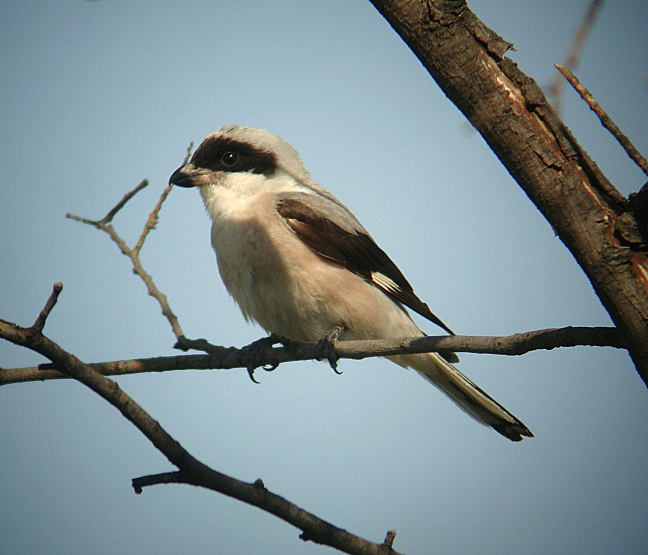
Lesser Grey Shrike
Lanius minor
Daniel Bastaja, http://www.birdingfaqs.com/, CC BY 3.0, via Wikimedia Commons


Side by side
| Lesser Grey Shrike | Red-backed Shrike | |
|---|---|---|
| Scientific name | Lanius minor J. F. Gmelin, 1788 | Lanius collurio Linnaeus, 1758 |
| English name | Lesser Grey Shrike | Red-backed Shrike |
| Group | Birds | Birds |
| Class | Aves Bird | Aves Bird |
| Order | Passeriformes Passerine | Passeriformes Passerine |
| Family | Laniidae Shrike | Laniidae Shrike |
| Genus | Lanius Shrikes | Lanius Shrikes |
| Named in | 1788 | 1758 |
| Red List category | Least Concern | Least Concern |
| Environment | terrestrial | terrestrial |
| Countries on record | 93 countries | 107 countries |
| GBIF occurrence records | 103,944 records | 1,463,133 records |
Rows where the two agree are shown in grey.
Where each is found
Both recorded in 89 countries
- Afghanistan
- Aland Islands
- Albania
- Angola
- Armenia
- Austria
- Azerbaijan
- Bahrain
- Belarus
- Belgium
- Bosnia and Herzegovina
- Botswana
- Bulgaria
- Burundi
- Chad
- China
- Croatia
- Cyprus
- Czechia
- Democratic Republic of the Congo
- Denmark
- Djibouti
- Egypt
- Eritrea
- Estonia
- Eswatini
- Ethiopia
- Finland
- France
- Georgia
- Germany
- Greece
- Hungary
- India
- Iran
- Iraq
- Ireland
- Israel
- Italy
- Jordan
- Kazakhstan
- Kenya
- Kosovo
- Kuwait
- Kyrgyzstan
- Lebanon
- Libya
- Malawi
- Moldova
- Mongolia
- Montenegro
- Mozambique
- Namibia
- North Macedonia
- Norway
- Oman
- Pakistan
- Palestinian Territory
- Poland
- Portugal
- Qatar
- Romania
- Russia
- Rwanda
- Saudi Arabia
- Serbia
- Slovakia
- Slovenia
- Somalia
- South Africa
- Spain
- Sudan
- Sweden
- Switzerland
- Syria
- Tajikistan
- Tanzania
- The Netherlands
- Tunisia
- Turkey
- Turkmenistan
- Uganda
- Ukraine
- United Arab Emirates
- United Kingdom
- Uzbekistan
- Yemen
- Zambia
- Zimbabwe
Only Lesser Grey Shrike (4)
Only Red-backed Shrike (18)
- Algeria
- Andorra
- Faroe Islands
- Hong Kong
- Iceland
- Isle of Man
- Japan
- Latvia
- Lesotho
- Liechtenstein
- Lithuania
- Luxembourg
- Malta
- Morocco
- South Korea
- South Sudan
- Taiwan
- Thailand
From Catalogue of Life checklists and GBIF occurrence records. A country missing from a list means no record is held, which is not proof of absence.
Checked facts
| Lesser Grey Shrike | Red-backed Shrike | |
|---|---|---|
| Appearance | No checked fact yet |
|
| Size |
| No checked fact yet |
| Habitat |
|
|
| Diet |
|
|
| Behaviour |
|
|
| Reproduction |
|
|
| Distribution |
|
|
| Conservation |
|
|
| Similar species |
| No checked fact yet |
| Name origin |
| No checked fact yet |
| Other |
|
|
In brief
Lesser Grey Shrike
Lanius minor breeds in South and Central Europe and western Asia and migrates to tropical southern Africa for winter. Full profile
Red-backed Shrike
The Red-backed Shrike is a migratory bird. It breeds across most of Europe and western Asia and winters in eastern tropical Africa and southern Africa. It stores prey by impaling dead animals on thorns or barbed wire. Full profile
Compare something else
Page built on 28 November 2026 from the data on the two species pages, where every source is listed.
Cite this page
ScientificNames.org. (2026). Lesser Grey Shrike vs Red-backed Shrike. Retrieved November 28, 2026, from https://scientificnames.org/compare/lesser-grey-shrike-vs-red-backed-shrike
“Lesser Grey Shrike vs Red-backed Shrike.” ScientificNames.org, 2026, scientificnames.org/compare/lesser-grey-shrike-vs-red-backed-shrike. Accessed 28 Nov. 2026.
ScientificNames.org. “Lesser Grey Shrike vs Red-backed Shrike.” Accessed November 28, 2026. https://scientificnames.org/compare/lesser-grey-shrike-vs-red-backed-shrike.
@misc{scientificnames_lesser_grey_shrike_vs_red_backed_shrike,
  author = {{ScientificNames.org}},
  title = {Lesser Grey Shrike vs Red-backed Shrike},
  year = {2026},
  url = {https://scientificnames.org/compare/lesser-grey-shrike-vs-red-backed-shrike},
  note = {Accessed 2026-11-28}
}