Comparison

Little Mountain Palm vs Açaí Palm

Little Mountain Palm (Lepidorrhachis mooreana) and Açaí Palm (Euterpe oleracea) both belong to the family Arecaceae (palm) and part ways below it.
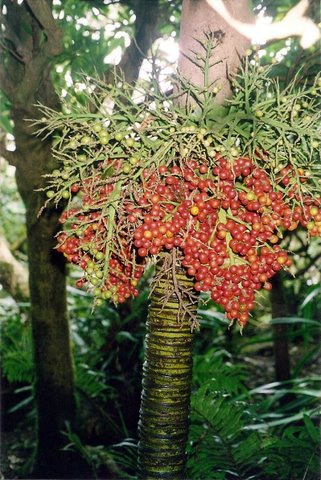
Little Mountain Palm

Little Mountain Palm

Lepidorrhachis mooreana

Poyt448 Peter Woodard, CC0, via Wikimedia Commons

Açaí Palm

Açaí Palm

Euterpe oleracea

Vihelik, Public domain, via Wikimedia Commons

Side by side

Little Mountain PalmAçaí Palm
Scientific nameLepidorrhachis mooreana (F.Muell.) O.F.CookEuterpe oleracea Mart.
English nameLittle Mountain PalmAçaí Palm
GroupFlowering plantsFlowering plants
ClassLiliopsidaLiliopsida
OrderArecalesArecales
FamilyArecaceae PalmArecaceae Palm
GenusLepidorrhachisEuterpe Palm
Countries on record1 country11 countries
GBIF occurrence records63 records8,337 records

Rows where the two agree are shown in grey.

Where each is found

Only Little Mountain Palm (1)

Only Açaí Palm (11)

From Catalogue of Life checklists and GBIF occurrence records. A country missing from a list means no record is held, which is not proof of absence.

Checked facts

Little Mountain PalmAçaí Palm
Appearance
  • The species has solitary trunks that are prominently marked by leaf scars. English Wikipedia
  • The trunks are green near their bases and generally grey near their crowns. English Wikipedia
  • The leaves are pinnate, arching and ascending, with lance-shaped leaflets ranging from medium to dark green. English Wikipedia
  • The leaves, petioles and rachises are covered with scales of varying density. English Wikipedia
  • The inflorescences are short, thick and highly branched. English Wikipedia
  • The fruit is spherical or nearly spherical and becomes red when mature. English Wikipedia
Size
Habitat
  • The species grows in cloud forest vegetation at elevations above approximately 740 metres. environment.nsw.gov.au
  • Its habitat is restricted to cloud forests on the summits of Mount Gower and Mount Lidgbird. environment.nsw.gov.au
  • On Mount Gower, the species is more abundant on small ridge tops and slopes than on lower slopes and in small gullies. environment.nsw.gov.au
  • The species grows in a cool, windy and extremely moist climate. English Wikipedia
  • The species can grow in any soil type but cannot tolerate frost. English Wikipedia
  • The species is native to the Amazon region, particularly swamps and floodplains. English Wikipedia
  • The species is typically found along the Amazon River. britannica.com
DietNo checked fact yet
  • The fruit has been consumed as a dietary staple in the Amazon River delta region for centuries. English Wikipedia
BehaviourNo checked fact yet
  • The species is light-loving, and shading substantially reduces fruit yield and quality. English Wikipedia
Reproduction
  • The fruits are produced in branched panicles containing approximately 500–900 fruits. English Wikipedia
  • The palm produces fruit throughout the year. English Wikipedia
  • The fruit cannot be harvested during the rainy season. English Wikipedia
  • Planted seeds can require several months to develop into seedlings under suitable growing conditions. English Wikipedia
Distribution
  • The species is indigenous to tropical South and Central America. britannica.com
  • Brazil produces approximately 99% of global açaí berries. English Wikipedia
Conservation
  • The species is classified as critically endangered under the NSW threatened species listing. environment.nsw.gov.au
  • The species is also recorded as critically endangered under the EPBC status listing. dcceew.gov.au
  • The introduced Black Rat is a major threat to the species. environment.nsw.gov.au
  • Black Rats can destroy the entire annual seed crop of the species. environment.nsw.gov.au
  • More than 90 percent of the species' habitat is currently affected by Black Rats. environment.nsw.gov.au
  • Black Rats may consume the leaves of seedlings, juvenile plants and mature palms. environment.nsw.gov.au
  • Black Rat predation prevents the establishment of juvenile palms and reduces long-term recruitment. environment.nsw.gov.au
  • Changes in the timing, magnitude and duration of summer cloud cover could adversely affect the species. environment.nsw.gov.au
  • A rat baiting programme has enabled successful fruit maturation and seedling recruitment in treated areas. environment.nsw.gov.au
  • Approximately seven percent of Mount Gower's summit has been baited to reduce rat impacts. environment.nsw.gov.au
  • Ongoing rat control or eradication has been recommended for the long-term conservation of the species. environment.nsw.gov.au
No checked fact yet
UsesNo checked fact yet
  • The palm is cultivated for its fruit, hearts of palm, leaves and trunk wood. English Wikipedia
  • The fruit is processed into pulp, frozen pulp and juice for food products. English Wikipedia
  • The fruit is commonly eaten in Brazil as açaí na tigela. English Wikipedia
  • The fruit is used as an ingredient in beverages, foods, cosmetics and supplements. English Wikipedia
  • Açaí oil is used for cooking and salad dressings, as well as in cosmetic products. English Wikipedia
  • The leaves can be made into hats, mats, baskets, brooms and roofing thatch. English Wikipedia
  • The trunk wood is used in building construction and is described as resistant to pests. English Wikipedia
  • The seeds can be ground for livestock feed or used as a component of organic soil. English Wikipedia
Name origin
  • The genus name combines two Greek words meaning scale and rachis. English Wikipedia
  • The specific epithet honours Charles Moore, the first director of the Sydney Botanical Gardens. English Wikipedia
  • The specific epithet oleracea means vegetable in Latin and refers to the fruit's edibility. English Wikipedia
Other

In brief

Little Mountain Palm

Lepidorrhachis mooreana grows in cloud forests on the summits of Mount Gower and Mount Lidgbird on Lord Howe Island. It is distinguished by solitary trunks marked by prominent leaf scars and pinnate leaves with scaled surfaces. Full profile

Açaí Palm

Euterpe oleracea is native to the Amazon region, particularly swamps and floodplains, and is typically found along the Amazon River. It produces small, round, black-purple fruits in branched panicles containing approximately 500–900 fruits. Full profile

Compare something else

Page built on 28 November 2026 from the data on the two species pages, where every source is listed.

Cite this page

ScientificNames.org. (2026). Little Mountain Palm vs Açaí Palm. Retrieved November 28, 2026, from https://scientificnames.org/compare/little-mountain-palm-vs-acai-palm