Species · Flowering plants
Little Mountain Palm Lepidorrhachis mooreana
The scientific name of the Little Mountain Palm is Lepidorrhachis mooreana. It is a species of flowering plant in the family Arecaceae (palm), order Arecales.
- Scientific name
- Lepidorrhachis mooreana (F.Muell.) O.F.Cook
- Common name
- Little Mountain Palm
- Genus
- Lepidorrhachis
- Family
- Arecaceae (Palm)
- Order
- Arecales
- Class
- Liliopsida
- Recorded in
- 1 country
- Name status
- accepted in the Catalogue of Life
Overview
Lepidorrhachis mooreana grows in cloud forests on the summits of Mount Gower and Mount Lidgbird on Lord Howe Island. It is distinguished by solitary trunks marked by prominent leaf scars and pinnate leaves with scaled surfaces.
Written 27 November 2026 from the sources listed below. Each statement was checked against the passage it cites; statements that could not be supported were removed.
Appearance
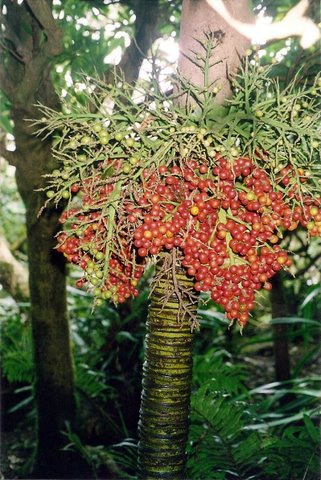
The Little Mountain Palm has solitary trunks that are prominently marked by leaf scars. The trunks can reach 3.5 metres in height and 15 centimetres in diameter, and are green near their bases and generally grey near their crowns.[1][2][3]
The leaves are pinnate, arching and ascending, with lance-shaped leaflets ranging from medium to dark green. The leaves can reach 1.5 metres in length, and the leaflets can reach 60 centimetres in length.[4][5][6]
The leaves, petioles and rachises are covered with scales of varying density. The inflorescences are short, thick and highly branched.[7][8]
The fruit is spherical or nearly spherical and becomes red when mature. It measures approximately one centimetre in diameter.[9][10]
Reproduction and life cycle
The Little Mountain Palm is monoecious, with male and female flowers occurring on the same plant but in separate inflorescences. Flowering generally occurs between August and December.[11][12][13]
The fruits mature in years following flowering. Individual plants can simultaneously carry mature fruits, developing fruits and flowers.[14][15]
The species is considered likely to be insect-pollinated, although its pollinators have not been identified.[16]
Habitat
The Little Mountain Palm grows in cloud forest vegetation at elevations above approximately 740 metres. Its habitat is restricted to cloud forests on the summits of Mount Gower and Mount Lidgbird.[17][18]
On Mount Gower, the species is more abundant on small ridge tops and slopes than on lower slopes and in small gullies. It grows in a cool, windy and extremely moist climate.[19][20]
The species can grow in any soil type but cannot tolerate frost.[21]
Conservation
The species is classified as critically endangered under the NSW threatened species listing and is also recorded as critically endangered under the EPBC status listing.[22][23]
The introduced Black Rat is a major threat to the species and can destroy its entire annual seed crop. More than 90 percent of the species' habitat is currently affected by Black Rats.[24][25][26]
Black Rats may consume the leaves of seedlings, juvenile plants and mature palms. Their predation prevents the establishment of juvenile palms and reduces long-term recruitment.[27][28]
Changes in the timing, magnitude and duration of summer cloud cover could adversely affect the species.[29]
A rat baiting programme has enabled successful fruit maturation and seedling recruitment in treated areas. Approximately seven percent of Mount Gower's summit has been baited to reduce rat impacts.[30][31]
Ongoing rat control or eradication has been recommended for the long-term conservation of the species.[32]
Classification of the Little Mountain Palm
| Kingdom | Plantae |
|---|---|
| Subkingdom | Pteridobiotina |
| Phylum | Tracheophyta |
| Class | Liliopsida |
| Order | Arecales |
| Family | Arecaceae (Palm) |
| Genus | Lepidorrhachis |
| Species | Lepidorrhachis mooreana (F.Muell.) O.F.Cook |
Where the Little Mountain Palm is found
Checklists and occurrence records place Lepidorrhachis mooreana in 1 country. GBIF holds 63 georeferenced records of it.
Countries
Regions and cities with the most records
A number beside a place is its count of GBIF occurrence records. A place without a number comes from a checklist alone. Records show where a species has been observed or collected, which can include escapes and vagrants.
Common names
English
- Little Mountain Palm
Names in 2 other languages
- Chinese
- 小山槟榔
- Slovak
- vrchárka ostrovná
Synonyms
3 other scientific names have been used for this species and are now treated as synonyms of Lepidorrhachis mooreana.
- Clinostigma mooreanum (F.Muell.) H.Wendl. & Drude
- Kentia mooreana F.Muell.
- Kentia moorei W.Bull
Related species
-
 Date PalmPhoenix dactylifera
- CoconutCocos nucifera
-
 Açaí PalmEuterpe oleracea
-
 Walking PalmSocratea exorrhiza
-
 SalakSalacca zalacca
-
 Cabbage PalmSabal palmetto
-
 Black PalmAstrocaryum standleyanum
-
 Areca PalmAreca catechu
Compare
Questions and answers
What is the scientific name of the Little Mountain Palm?
The scientific name of the Little Mountain Palm is Lepidorrhachis mooreana. Written with its author, the full name is Lepidorrhachis mooreana (F.Muell.) O.F.Cook.
Which family does the Little Mountain Palm belong to?
Lepidorrhachis mooreana belongs to the family Arecaceae, in the order Arecales and the class Liliopsida.
Where is the Little Mountain Palm found?
Checklists and occurrence records place Lepidorrhachis mooreana in 1 country: Australia.
Where is the Little Mountain Palm found?
It occurs exclusively on Lord Howe Island, in cloud forests on the summits of Mount Gower and Mount Lidgbird.[18][33]
How large does the Little Mountain Palm grow?
Its trunks can reach 3.5 metres in height and 15 centimetres in diameter. Its leaves can reach 1.5 metres in length, with leaflets reaching 60 centimetres.[2][4][6]
When does the Little Mountain Palm flower?
Flowering generally occurs between August and December. The fruits mature in years following flowering.[13][14]
How is the Little Mountain Palm pollinated?
It is considered likely to be insect-pollinated, although its pollinators have not been identified.[16]
What are the main threats to the Little Mountain Palm?
The introduced Black Rat is a major threat. Rat predation can destroy the annual seed crop, consume palm leaves and prevent juvenile palms from becoming established. Changes in summer cloud cover could also adversely affect the species.[24][25][27][28][29]
What is the conservation status of the Little Mountain Palm?
It is classified as critically endangered under both the NSW threatened species listing and the EPBC status listing.[22][23]
What conservation measures are being used for the Little Mountain Palm?
A rat baiting programme has enabled successful fruit maturation and seedling recruitment in treated areas. Approximately seven percent of Mount Gower's summit has been baited, and ongoing rat control or eradication has been recommended.[30][31][32]
Is the Little Mountain Palm the only species in its genus?
Yes. Lepidorrhachis mooreana is the sole species in its genus.[34]
Sources
Passages the profile rests on
- The species has solitary trunks that are prominently marked by leaf scars. Source passage: “These small palms are solitary-trunked, reaching heights of 3.5 m at a 15 cm diameter; prominently ringed by leaf scars” — English Wikipedia
- The trunks can reach 3.5 metres in height and 15 centimetres in diameter. Source passage: “reaching heights of 3.5 m at a 15 cm diameter” — English Wikipedia
- The trunks are green near their bases and generally grey near their crowns. Source passage: “the trunks are green at the base and usually grey nearing the crown.” — English Wikipedia
- The leaves can reach 1.5 metres in length. Source passage: “The 1.5 m leaf is pinnate” — English Wikipedia
- The leaves are pinnate, arching and ascending, with lance-shaped leaflets ranging from medium to dark green. Source passage: “The 1.5 m leaf is pinnate, arching and ascending, with 60 cm lanceolate leaflets from medium to dark green” — English Wikipedia
- The leaflets can reach 60 centimetres in length. Source passage: “with 60 cm lanceolate leaflets” — English Wikipedia
- The leaves, petioles and rachises are covered with scales of varying density. Source passage: “The leaves, petioles, and rachises are lightly or densely covered in scales.” — English Wikipedia
- The inflorescences are short, thick and highly branched. Source passage: “The inflorescence is short, thick, and much branched” — English Wikipedia
- The fruit is spherical or nearly spherical and becomes red when mature. Source passage: “The fruit, known to attract rats, is spherical or nearly so, colored red at maturity, with one seed.” — English Wikipedia
- The fruit measures approximately one centimetre in diameter. Source passage: “Fruit c. 1 cm diam., red.” — environment.nsw.gov.au
- The species is monoecious, with male and female flowers occurring on the same plant. Source passage: “As is typical for Arecoideae, individuals are monoecious” — environment.nsw.gov.au
- Male and female flowers occur in separate inflorescences on the same plant. Source passage: “inflorescences contain flowers of one sex only, rather than both sexes, with both male and female inflorescences occurring on a single plant” — environment.nsw.gov.au
- Flowering generally occurs between August and December. Source passage: “Flowering is generally from August to December (Baker and Hutton 2006)” — environment.nsw.gov.au
- The fruits mature in years following flowering. Source passage: “with fruits maturing in subsequent years.” — environment.nsw.gov.au
- Individual plants can simultaneously carry mature fruits, developing fruits and flowers. Source passage: “A plant may have mature fruits, developing fruits and flowers present at the one time.” — environment.nsw.gov.au
- The species is considered likely to be insect-pollinated, although its pollinators have not been identified. Source passage: “It is likely to be insect pollinated, but pollinators are unknown.” — environment.nsw.gov.au
- The species grows in cloud forest vegetation at elevations above approximately 740 metres. Source passage: “where it occurs above an elevation of approximately 740 m (Baker and Hutton 2006).” — environment.nsw.gov.au
- Its habitat is restricted to cloud forests on the summits of Mount Gower and Mount Lidgbird. Source passage: “restricted to the cloud forest vegetation at the summits of Mt Gower and Mt Lidgbird” — environment.nsw.gov.au
- On Mount Gower, the species is more abundant on small ridge tops and slopes than on lower slopes and in small gullies. Source passage: “L. mooreana is most abundant on small ridge tops and slopes rather than lower slopes and small gullies” — environment.nsw.gov.au
- The species grows in a cool, windy and extremely moist climate. Source passage: “Constantly cloaked in a cool, windy, extremely moist climate” — English Wikipedia
- The species can grow in any soil type but cannot tolerate frost. Source passage: “they grow in any soil type but will not withstand frost.” — English Wikipedia
- The species is classified as critically endangered under the NSW threatened species listing. Source passage: “as a CRITICALLY ENDANGERED SPECIES in Part 1 of Schedule 1A of the Act.” — environment.nsw.gov.au
- The species is also recorded as critically endangered under the EPBC status listing. Source passage: “EPBC status. Critically endangered” — dcceew.gov.au
- The introduced Black Rat is a major threat to the species. Source passage: “The major threats to Lepidorrhachis mooreana are impacts by the introduced Black Rat ( Rattus rattus) and a changing climate.” — environment.nsw.gov.au
- Black Rats can destroy the entire annual seed crop of the species. Source passage: “Black Rats can destroy all the annual seed crop of L. mooreana” — environment.nsw.gov.au
- More than 90 percent of the species' habitat is currently affected by Black Rats. Source passage: “Because over 90% of the habitat of the species is currently impacted by Black Rats” — environment.nsw.gov.au
- Black Rats may consume the leaves of seedlings, juvenile plants and mature palms. Source passage: “and may also consume leaves of seedlings, juveniles and adult palms.” — environment.nsw.gov.au
- Black Rat predation prevents the establishment of juvenile palms and reduces long-term recruitment. Source passage: “The loss of fruits to Black Rats prevents the establishment of the juvenile bank of palms and hence, leads to a lack of long-term recruitment in L. mooreana” — environment.nsw.gov.au
- Changes in the timing, magnitude and duration of summer cloud cover could adversely affect the species. Source passage: “any changes to the onset, magnitude and duration of cloud cover in summer under a changing climate could adversely affect the species.” — environment.nsw.gov.au
- A rat baiting programme has enabled successful fruit maturation and seedling recruitment in treated areas. Source passage: “This baiting has been effective in allowing successful maturation of Lepidorrhachis mooreana fruits and recruitment of seedling plants in the baited areas.” — environment.nsw.gov.au
- Approximately seven percent of Mount Gower's summit has been baited to reduce rat impacts. Source passage: “On Mt Gower, some 7% of the summit has been baited to reduce the impacts of rats” — environment.nsw.gov.au
- Ongoing rat control or eradication has been recommended for the long-term conservation of the species. Source passage: “Ongoing control or eradication of rats has been recommended by Auld et al. (2010) for the long-term conservation of both these mountain palms.” — environment.nsw.gov.au
- The species is endemic to New South Wales and occurs exclusively on Lord Howe Island. Source passage: “It is only found on Lord Howe Island, where it is known as the Little Mountain Palm.” — environment.nsw.gov.au
- Lepidorrhachis mooreana is the sole species in its genus. Source passage: “Lepidorrhachis is a monotypic genus of flowering plant in the palm family restricted to Lord Howe Island.” — English Wikipedia
- The genus name combines two Greek words meaning scale and rachis. Source passage: “comes from two Greek word meaning "scale" and "rachis"” — English Wikipedia
- The specific epithet honours Charles Moore, the first director of the Sydney Botanical Gardens. Source passage: “the epithet honors Charles Moore, first director of the Sydney Botanical Gardens.” — English Wikipedia
Data
- Catalogue of Life, 2026-10-16 XR cc by
- Global Biodiversity Information Facility CC BY 4.0
- Wikidata CC0
- GeoNames CC BY 4.0
- Wikimedia Commons per image; credit shown with each image
- Within the Catalogue of Life, this name comes from The World Checklist of Vascular Plants (WCVP) cc by
References
- J. Heredity 18: 408 (1927) where the name was published
This species in other databases
Page built on 28 November 2026. See how the catalog is made and all sources and licences.
Cite this page
ScientificNames.org. (2026). Lepidorrhachis mooreana (Little Mountain Palm). Retrieved November 28, 2026, from https://scientificnames.org/species/lepidorrhachis-mooreana
“Lepidorrhachis mooreana (Little Mountain Palm).” ScientificNames.org, 2026, scientificnames.org/species/lepidorrhachis-mooreana. Accessed 28 Nov. 2026.
ScientificNames.org. “Lepidorrhachis mooreana (Little Mountain Palm).” Accessed November 28, 2026. https://scientificnames.org/species/lepidorrhachis-mooreana.
@misc{scientificnames_lepidorrhachis_mooreana_little_mountain_palm,
  author = {{ScientificNames.org}},
  title = {Lepidorrhachis mooreana (Little Mountain Palm)},
  year = {2026},
  url = {https://scientificnames.org/species/lepidorrhachis-mooreana},
  note = {Accessed 2026-11-28}
}