Comparison
Uribe's False Cat-eyed Snake vs Banded Cat-eyed Snake
Uribe's False Cat-eyed Snake (Leptodeira uribei) and Banded Cat-eyed Snake (Leptodeira annulata) both belong to the genus Leptodeira (cat-eyed snakes) and part ways below it. Both are recorded in 1 country.
Uribe's False Cat-eyed Snake
Leptodeira uribei
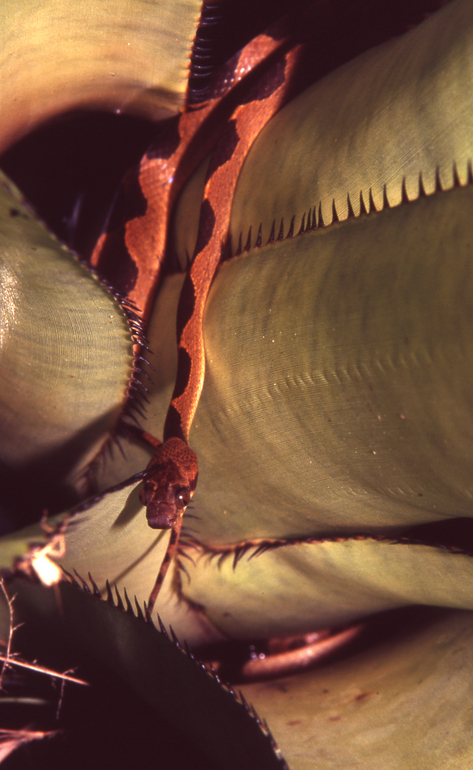

Side by side
| Uribe's False Cat-eyed Snake | Banded Cat-eyed Snake | |
|---|---|---|
| Scientific name | Leptodeira uribei (Bautista & Smith, 1992) | Leptodeira annulata (Linnaeus, 1758) |
| English name | Uribe's False Cat-eyed Snake | Banded Cat-eyed Snake |
| Group | Reptiles | Reptiles |
| Class | Reptilia Reptile | Reptilia Reptile |
| Order | Squamata Snakes | Squamata Snakes |
| Family | Colubridae Colubrid | Colubridae Colubrid |
| Genus | Leptodeira Cat-eyed Snakes | Leptodeira Cat-eyed Snakes |
| Named in | 1992 | 1758 |
| Red List category | Least Concern | Least Concern |
| Countries on record | 1 country | 23 countries |
| GBIF occurrence records | 65 records | 6,931 records |
Rows where the two agree are shown in grey.
Where each is found
Both recorded in 1 country
Only Banded Cat-eyed Snake (22)
- Argentina
- Belize
- Bolivia
- Brazil
- Canada
- Colombia
- Costa Rica
- Dominican Republic
- Ecuador
- El Salvador
- French Guiana
- Guatemala
- Guyana
- Honduras
- Nicaragua
- Panama
- Paraguay
- Peru
- Suriname
- Trinidad and Tobago
- United States
- Venezuela
From Catalogue of Life checklists and GBIF occurrence records. A country missing from a list means no record is held, which is not proof of absence.
Checked facts
| Uribe's False Cat-eyed Snake | Banded Cat-eyed Snake | |
|---|---|---|
| Appearance | No checked fact yet |
|
| Habitat | No checked fact yet |
|
| Diet | No checked fact yet |
|
| Behaviour | No checked fact yet |
|
| Reproduction | No checked fact yet |
|
| Distribution |
| No checked fact yet |
| Conservation |
| No checked fact yet |
| Other |
| No checked fact yet |
In brief
Uribe's False Cat-eyed Snake
Uribe's False Cat-eyed Snake is a snake in the family Colubridae. The species is native to Mexico. It is also known as Uribe's Cat-eyed Snake. Full profile
Banded Cat-eyed Snake
Leptodeira annulata inhabits moist and dry forests, forest edges, vegetated urban areas adjacent to forests, and riparian environments. It has a very slender body, large eyes with vertically elliptical pupils, and dark spots that may form a wavy or zigzag stripe. Full profile
Compare something else
Page built on 28 November 2026 from the data on the two species pages, where every source is listed.
Cite this page
ScientificNames.org. (2026). Uribe's False Cat-eyed Snake vs Banded Cat-eyed Snake. Retrieved November 28, 2026, from https://scientificnames.org/compare/uribes-false-cat-eyed-snake-vs-banded-cat-eyed-snake
“Uribe's False Cat-eyed Snake vs Banded Cat-eyed Snake.” ScientificNames.org, 2026, scientificnames.org/compare/uribes-false-cat-eyed-snake-vs-banded-cat-eyed-snake. Accessed 28 Nov. 2026.
ScientificNames.org. “Uribe's False Cat-eyed Snake vs Banded Cat-eyed Snake.” Accessed November 28, 2026. https://scientificnames.org/compare/uribes-false-cat-eyed-snake-vs-banded-cat-eyed-snake.
@misc{scientificnames_uribes_false_cat_eyed_snake_vs_banded_cat_eyed_snake,
  author = {{ScientificNames.org}},
  title = {Uribe's False Cat-eyed Snake vs Banded Cat-eyed Snake},
  year = {2026},
  url = {https://scientificnames.org/compare/uribes-false-cat-eyed-snake-vs-banded-cat-eyed-snake},
  note = {Accessed 2026-11-28}
}