Comparison

Southern Long-nosed Bat vs Honduran White Bat

Southern Long-nosed Bat (Leptonycteris curasoae) and Honduran White Bat (Ectophylla alba) both belong to the family Phyllostomidae (new world leaf-nosed bats) and part ways below it.
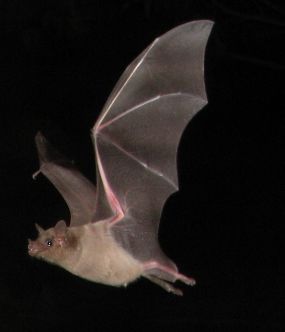
Southern Long-nosed Bat

Southern Long-nosed Bat

Leptonycteris curasoae

NPS, Public domain, via Wikimedia Commons

Honduran White Bat

Honduran White Bat

Ectophylla alba

Leyo, CC BY-SA 2.5 ch, via Wikimedia Commons

Side by side

Southern Long-nosed BatHonduran White Bat
Scientific nameLeptonycteris curasoae Miller, 1900Ectophylla alba H. Allen, 1892
English nameSouthern Long-nosed BatHonduran White Bat
GroupMammalsMammals
ClassMammalia MammalMammalia Mammal
OrderChiroptera BatChiroptera Bat
FamilyPhyllostomidae New World Leaf-nosed BatsPhyllostomidae New World Leaf-nosed Bats
GenusLeptonycteris Saussure's Long-nosed BatEctophylla Honduran White Bat.
Named in19001892
Red List categoryVulnerableNear Threatened
Countries on record8 countries4 countries
GBIF occurrence records1,265 records710 records

Rows where the two agree are shown in grey.

Where each is found

Only Southern Long-nosed Bat (8)

Only Honduran White Bat (4)

From Catalogue of Life checklists and GBIF occurrence records. A country missing from a list means no record is held, which is not proof of absence.

Checked facts

Southern Long-nosed BatHonduran White Bat
Appearance
  • The species has a long tongue with hook-like papillae at its tip that assist in nectar feeding. English Wikipedia
  • Males develop chemically complex, strongly scented dorsal patches during the breeding period. animaldiversity.org
  • The species has long and thin molars. animaldiversity.org
  • Its yellow-orange pigmentation results from concentrations of carotenoids, particularly xanthophyll. English Wikipedia
  • The species has an erect nose-leaf, no tail, and large rounded ears. English Wikipedia
  • It has eight to ten small warts beneath its mouth. English Wikipedia
  • Its tragus has a convex inner margin and a coarsely serrated outer margin with four or five small lobes. English Wikipedia
  • Its nose-leaf has a serrated margin. English Wikipedia
  • Its skull has unusually deep basioccipital pits compared with other species in its subfamily. English Wikipedia
  • The species resembles a small white Platyrrhinus. English Wikipedia
  • Its yellow pigmentation varies with age, with adults having greater yellow chroma in their ears than juveniles. English Wikipedia
  • Adult males have brighter yellow nose-leaves than adult females. English Wikipedia
Size
Habitat
  • The species inhabits semi-arid and arid environments, including dry forests. animaldiversity.org
  • Its habitats include thorn forests, scrubland, and areas containing Pachycereus cacti. English Wikipedia
  • It prefers wet evergreen forests and secondary forests. English Wikipedia
  • It commonly constructs roosting tents from leaves of Heliconia plants. English Wikipedia
  • It occasionally uses Calathea and Ischnosiphon inflatus plants as roosts. English Wikipedia
  • It prefers roosting leaves measuring 0.8–1.2 m long and less than 30 days old. English Wikipedia
  • It prefers roosting leaves located less than 2 m above the forest floor. English Wikipedia
  • Its tents typically maintain a temperature of approximately 23.3 °C. English Wikipedia
  • A modified Heliconia leaf survives approximately 7.5 weeks after being converted into a tent. English Wikipedia
  • It occupies small colonies containing between one and fifteen individuals. English Wikipedia
  • It uses a network of tents scattered throughout the forest rather than consistently occupying a single tent. English Wikipedia
Diet
  • It prefers Ficus colubrinae trees that produce many fruits simultaneously. English Wikipedia
  • It selects fig trees that are closest to its daytime roosts. English Wikipedia
  • Ficus colubrinae provides food throughout the year because its fruits are produced asynchronously. English Wikipedia
Behaviour
  • The species forms highly social colonies that can contain thousands of individuals. English Wikipedia
  • Colonies are generally separated by sex and combine for breeding in specialized caves. animaldiversity.org
  • Females select mates by assessing the odor and chemical composition of male dorsal patches. animaldiversity.org
  • Males create their dorsal patches by transferring body fluids onto their interscapular region. animaldiversity.org
Reproduction
  • The species generally breeds between November and December. English Wikipedia
  • Females typically produce one offspring per birth and reproduce once annually. animaldiversity.org
  • The gestation period typically lasts six months. animaldiversity.org
  • Females primarily lactate in June in populations from Venezuela and Curaçao. animaldiversity.org
  • Mothers leave their offspring in caves while foraging and return several times nightly to nurse them. animaldiversity.org
  • Females do not cooperatively nurse or raise the offspring of other individuals. animaldiversity.org
Distribution
  • The species occurs in northern Colombia, Venezuela, Aruba, Bonaire, and Curaçao. English Wikipedia
Conservation
  • The species is identified as an important pollinator of local cacti. English Wikipedia
  • The species is classified as Near Threatened by the IUCN. English Wikipedia
  • Its population is experiencing a significant decline. English Wikipedia
  • Habitat conversion to farmland and human population expansion are identified as causes of its population decline. English Wikipedia
  • Its specialization on a single fig species makes it particularly susceptible to habitat loss. English Wikipedia
  • It can persist in small numbers in agroforestry habitats. animaldiversity.org
  • No large-scale conservation efforts are reported for this species. animaldiversity.org
UsesNo checked fact yet
  • The species has potential research applications for understanding and treating macular degeneration in humans. English Wikipedia
Similar speciesNo checked fact yet
  • MacConnell's bat is the closest relative of the Honduran white bat. English Wikipedia

In brief

Southern Long-nosed Bat

The species occurs in northern Colombia, Venezuela, Aruba, Bonaire, and Curaçao. The species is identified as an important pollinator of local cacti. Full profile

Honduran White Bat

Ectophylla alba occurs in Honduras, Nicaragua, Costa Rica, and Panama, from sea level to 700 m above sea level. Full profile

Compare something else

Page built on 29 November 2026 from the data on the two species pages, where every source is listed.

Cite this page

ScientificNames.org. (2026). Southern Long-nosed Bat vs Honduran White Bat. Retrieved November 29, 2026, from https://scientificnames.org/compare/southern-long-nosed-bat-vs-honduran-white-bat