Species · Mammals
Southern Long-nosed Bat Leptonycteris curasoae
The scientific name of the Southern Long-nosed Bat is Leptonycteris curasoae. It is a species of mammal in the family Phyllostomidae (new world leaf-nosed bats), order Chiroptera. The name dates from 1900.
- Scientific name
- Leptonycteris curasoae Miller, 1900
- Common name
- Southern Long-nosed Bat
- Genus
- Leptonycteris
- Family
- Phyllostomidae (New World Leaf-nosed Bats)
- Order
- Chiroptera
- Class
- Mammalia
- Red List category
- VU Vulnerable
- Recorded in
- 8 countries
- Name status
- accepted in the Catalogue of Life
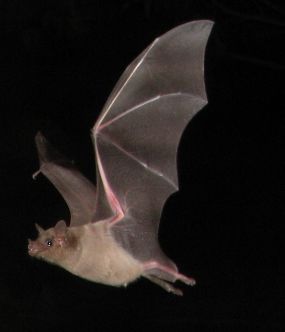
Overview
The species occurs in northern Colombia, Venezuela, Aruba, Bonaire, and Curaçao. The species is identified as an important pollinator of local cacti.
Written 26 November 2026 from the sources listed below. Each statement was checked against the passage it cites; statements that could not be supported were removed.
Appearance
The species has a long tongue with hook-like papillae at its tip that assist in nectar feeding. Its molars are long and thin.[1][2]
Males develop chemically complex, strongly scented dorsal patches during the breeding period.[3]
The species can fly at approximately 8.2 m/s.[4]
Habitat
The Southern Long-nosed Bat inhabits semi-arid and arid environments, including dry forests. Its habitats include thorn forests, scrubland, and areas containing Pachycereus cacti.[5][6]
Diet
The Southern Long-nosed Bat feeds on nectar, pollen, and fruit. Cacti provide approximately 90% of its diet during most of the year.[7][8]
The species also feeds on Agave and Ceiba when these plants flower. Individuals migrate toward blooming cactus and agave plants to locate food.[9][10]
Behaviour
The Southern Long-nosed Bat forms highly social colonies that can contain thousands of individuals. Colonies are generally separated by sex and combine for breeding in specialized caves.[11][12]
Females select mates by assessing the odor and chemical composition of male dorsal patches. Males create these patches by transferring body fluids onto their interscapular region.[13][14]
Reproduction and life cycle
The Southern Long-nosed Bat generally breeds between November and December. Females typically produce one offspring per birth and reproduce once annually, with a gestation period that typically lasts six months.[15][16][17]
Females primarily lactate in June in populations from Venezuela and Curaçao. Mothers leave their offspring in caves while foraging and return several times nightly to nurse them.[18][19]
Females do not cooperatively nurse or raise the offspring of other individuals.[20]
Conservation
The Southern Long-nosed Bat is identified as an important pollinator of local cacti.[21]
Classification of the Southern Long-nosed Bat
| Kingdom | Animalia |
|---|---|
| Phylum | Chordata |
| Subphylum | Vertebrata |
| Infraphylum | Gnathostomata |
| Parvphylum | Osteichthyes |
| Megaclass | Tetrapoda |
| Class | Mammalia (Mammal) |
| Subclass | Theria |
| Infraclass | Eutheria |
| Order | Chiroptera (Bat) |
| Suborder | Yangochiroptera |
| Superfamily | Noctilionoidea |
| Family | Phyllostomidae (New World Leaf-nosed Bats) |
| Subfamily | Glossophaginae |
| Tribe | Glossophagini (Long-tongued Bats) |
| Genus | Leptonycteris (Saussure's Long-nosed Bat) |
| Species | Leptonycteris curasoae Miller, 1900 |
Where the Southern Long-nosed Bat is found
Checklists and occurrence records place Leptonycteris curasoae in 8 countries across North America and South America. GBIF holds 1,265 georeferenced records of it.
Countries
- Aruba 35
- Bonaire, Saint Eustatius and Saba 5
- Colombia 132
- Curacao 13
- Guatemala 7
- Mexico 434
- United States 62
- Venezuela 577
Regions and cities with the most records
- Lara, Venezuela 369
- El Tocuyo, Venezuela 367
- Quíbor, Venezuela 367
- Sanare, Venezuela 367
- Colima, Mexico 106
- Sonora, Mexico 82
- Nueva Esparta, Venezuela 80
- Falcón, Venezuela 77
- La Guajira Department, Colombia 77
- Hatonuevo, Colombia 66
- Barrancas, Colombia 62
- Fonseca, Colombia 61
- Pueblo Nuevo, Venezuela 59
- Colima, Mexico 40
- Ciudad de Villa de Álvarez, Mexico 32
- New Mexico, United States 31
- Arizona, United States 27
- Judibana, Venezuela 15
- Punto Fijo, Venezuela 15
- Santa Cruz de los Taques, Venezuela 15
- Zulia, Venezuela 13
- Cartagena, Colombia 12
- Turbaco, Colombia 12
- Bolívar, Colombia 11
- Juan Griego, Venezuela 11
- La Asunción, Venezuela 11
- La Guardia, Venezuela 11
- Pampatar, Venezuela 11
- Porlamar, Venezuela 11
- San Juan Bautista, Venezuela 11
- Santa Ana, Venezuela 11
- Tecomán, Mexico 11
- Jalisco, Mexico 9
- Nayarit, Mexico 9
- Santander Department, Colombia 9
- Cihuatlán, Mexico 8
Range as the checklists state it
South America
Caribbean
A number beside a place is its count of GBIF occurrence records. A place without a number comes from a checklist alone. Records show where a species has been observed or collected, which can include escapes and vagrants.
Common names
English
- Southern Long-nosed Bat
- Curaçao Long-nosed Bat
- Curaçaoan Long-nosed Bat
- Curaçaoan Long-nosed Bat.
- Long-nosed Bat
Names in 8 other languages
- Czech
- glosofága lesní
- Dutch
- Curaçao-bladneusvleermuis, Curaçaose bladneus-vleermuis, Langneusvleermuis
- Finnish
- kolumbiankuonoleikko
- German
- Curaçao-Blütenfledermaus, Kleine Langnasen-Blumenfledermaus, Südliche Langnasen-Blütenfledermaus
- Japanese
- ソーシュルハナナガコウモリ
- Papiamento
- Ratón di anochi
- Polish
- Smukłonosek kaktusowy
- Spanish
- Murciélago hocicudo de Curazao, Murciélago trompudo cardonero, Murciélago-hocicudo de Curazao
Synonyms
2 other scientific names have been used for this species and are now treated as synonyms of Leptonycteris curasoae.
- Leptonyctenis curasoae G. S. Miller, 1900
- Leptonycteris nivalis curasoae Miller, 1900
Related species
-
 Lesser Long-nosed BatLeptonycteris yerbabuenae
-
 Greater Long-nosed BatLeptonycteris nivalis
-
 Common Vampire BatDesmodus rotundus
-
 Honduran White BatEctophylla alba
-
 Spectral BatVampyrum spectrum
-
 Hairy-legged Vampire BatDiphylla ecaudata
-
 Big-eared Woolly BatChrotopterus auritus
-
 Seba's Short-tailed BatCarollia perspicillata
Compare
Questions and answers
What is the scientific name of the Southern Long-nosed Bat?
The scientific name of the Southern Long-nosed Bat is Leptonycteris curasoae. Written with its author, the full name is Leptonycteris curasoae Miller, 1900.
Which family does the Southern Long-nosed Bat belong to?
Leptonycteris curasoae belongs to the family Phyllostomidae, in the order Chiroptera and the class Mammalia.
Where is the Southern Long-nosed Bat found?
Checklists and occurrence records place Leptonycteris curasoae in 8 countries, including Venezuela, Mexico, Colombia, United States, Aruba and Curacao.
What is the conservation status of the Southern Long-nosed Bat?
The IUCN Red List category recorded for Leptonycteris curasoae is Vulnerable (VU).
What other names does the Southern Long-nosed Bat have?
Leptonycteris curasoae is also known in English as Curaçao Long-nosed Bat, Curaçaoan Long-nosed Bat, Curaçaoan Long-nosed Bat. and Long-nosed Bat.
Sources
Passages the profile rests on
- The species has a long tongue with hook-like papillae at its tip that assist in nectar feeding. Source passage: “The tongue is long and easily extended to lap up nectar, a task made easier by the presence of hook-like papillae on the tip.” — English Wikipedia
- The species has long and thin molars. Source passage: “Their molars are long and thin” — animaldiversity.org
- Males develop chemically complex, strongly scented dorsal patches during the breeding period. Source passage: “Male L. curasoae have developed dorsal patches for breeding that have a strong odor and are chemically complex to show females that they are a good mate.” — animaldiversity.org
- The species can fly at approximately 8.2 m/s. Source passage: “They can fly approximately 8.2 m/s” — animaldiversity.org
- The species inhabits semi-arid and arid environments, including dry forests. Source passage: “Leptonycteris curasoae lives in a semiarid or arid environment potentially including dry forests” — animaldiversity.org
- Its habitats include thorn forests, scrubland, and areas containing Pachycereus cacti. Source passage: “including thorn forest, scrubland, and patches of Pachycereus cactus.” — English Wikipedia
- The species feeds on nectar, pollen, and fruit. Source passage: “They are agile fliers, feeding on nectar, pollen, and fruit.” — English Wikipedia
- Cacti provide approximately 90% of the species' diet during most of the year. Source passage: “For most of the year, around 90% of their diet is derived from various species of cactus” — English Wikipedia
- The species also feeds on Agave and Ceiba when these plants flower. Source passage: “although they also feed on Agave and Ceiba when those plants are in bloom.” — English Wikipedia
- Individuals migrate toward blooming cactus and agave plants to locate food. Source passage: “They migrate to find better food resources, following blooming plants such as cactus and agave” — animaldiversity.org
- The species forms highly social colonies that can contain thousands of individuals. Source passage: “They are highly gregarious, with colonies numbering in the thousands of individuals.” — English Wikipedia
- Colonies are generally separated by sex and combine for breeding in specialized caves. Source passage: “Leptonycteris curasoae colonies are usually separated by sex, and are combined only for breeding in special caves used for mating” — animaldiversity.org
- Females select mates by assessing the odor and chemical composition of male dorsal patches. Source passage: “Female L. curasoae use the dorsal patch to choose a mate by analyzing the complex odor and chemical composition of the dorsal patch” — animaldiversity.org
- Males create their dorsal patches by transferring body fluids onto their interscapular region. Source passage: “They spread body fluids collected from the head, mouth, penis and anus onto the interscapular region of their body with their hands” — animaldiversity.org
- The species generally breeds between November and December. Source passage: “Breeding takes place between November and December” — English Wikipedia
- Females typically produce one offspring per birth and reproduce once annually. Source passage: “there is only one offspring per birth, which happens once a year for the mature female bats” — animaldiversity.org
- The gestation period typically lasts six months. Source passage: “Their period of gestation typically lasts 6 months.” — animaldiversity.org
- Females primarily lactate in June in populations from Venezuela and Curaçao. Source passage: “Populations in Venezuela lactate mainly in June; populations in Curaçao lactate mainly in June” — animaldiversity.org
- Mothers leave their offspring in caves while foraging and return several times nightly to nurse them. Source passage: “L. curasoae will leave their babies in the cave while they go out to forage, and then return a few times a night to nurse” — animaldiversity.org
- Females do not cooperatively nurse or raise the offspring of other individuals. Source passage: “mothers will not care for or nurse offspring of other bats” — animaldiversity.org
- The species is identified as an important pollinator of local cacti. Source passage: “They have been identified as important pollinators of local cacti.” — English Wikipedia
Data
- Catalogue of Life, 2026-10-16 XR cc by
- Global Biodiversity Information Facility CC BY 4.0
- Wikidata CC0
- GeoNames CC BY 4.0
- Wikimedia Commons per image; credit shown with each image
- Within the Catalogue of Life, this name comes from The Integrated Taxonomic Information System cc0
References
- Proc. Biol. Soc. Wash. vol.13 p.126 where the name was published
- Wilson, Don E., and DeeAnn M. Reeder, eds. (1993). Mammal Species of the World: A Taxonomic and Geographic Reference, 2nd Ed., 3rd Printing.
- Wilson, Don E., and F. Russell Cole. (2000). Common Names of Mammals of the World.
- Simmons, Nancy B. / Wilson, Don E., and DeeAnn M. Reeder, eds. (2005). Order Chiroptera. Mammal Species of the World: A Taxonomic and Geographic Reference, 3rd Ed., Vols. 1 & 2.
- Gardner, Alfred L., ed. (2008). Mammals of South America, Vol. 1: Marsupials, Xenarthrans, Shrews, and Bats.
- Wilson, D. E., and R. A. Mittermeier, eds. (2019). Handbook of the Mammals of the World. Vol. 9: Bats.
This species in other databases
Page built on 29 November 2026. See how the catalog is made and all sources and licences.
Cite this page
ScientificNames.org. (2026). Leptonycteris curasoae (Southern Long-nosed Bat). Retrieved November 29, 2026, from https://scientificnames.org/species/leptonycteris-curasoae
“Leptonycteris curasoae (Southern Long-nosed Bat).” ScientificNames.org, 2026, scientificnames.org/species/leptonycteris-curasoae. Accessed 29 Nov. 2026.
ScientificNames.org. “Leptonycteris curasoae (Southern Long-nosed Bat).” Accessed November 29, 2026. https://scientificnames.org/species/leptonycteris-curasoae.
@misc{scientificnames_leptonycteris_curasoae_southern_long_nosed_bat,
  author = {{ScientificNames.org}},
  title = {Leptonycteris curasoae (Southern Long-nosed Bat)},
  year = {2026},
  url = {https://scientificnames.org/species/leptonycteris-curasoae},
  note = {Accessed 2026-11-29}
}