Comparison

Lesser Egyptian Jerboa vs Long-eared Jerboa

Lesser Egyptian Jerboa (Jaculus jaculus) and Long-eared Jerboa (Euchoreutes naso) both belong to the family Dipodidae (jerboa) and part ways below it.

Lesser Egyptian Jerboa

Lesser Egyptian Jerboa

Jaculus jaculus

Elias Neideck, CC BY-SA 3.0, via Wikimedia Commons

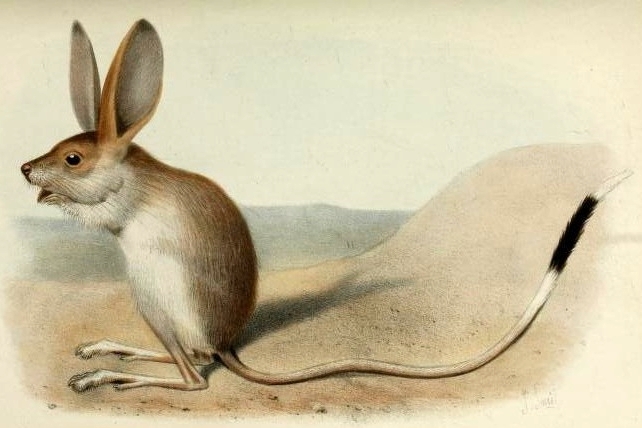
Long-eared Jerboa

Long-eared Jerboa

Euchoreutes naso

Joseph Smit (1836–1929), Public domain, via Wikimedia Commons

Side by side

Lesser Egyptian JerboaLong-eared Jerboa
Scientific nameJaculus jaculus (Linnaeus, 1758)Euchoreutes naso Sclater, 1891
English nameLesser Egyptian JerboaLong-eared Jerboa
GroupMammalsMammals
ClassMammalia MammalMammalia Mammal
OrderRodentia RodentRodentia Rodent
FamilyDipodidae JerboaDipodidae Jerboa
GenusJaculus Desert JerboasEuchoreutes
Named in17581891
Red List categoryLeast ConcernLeast Concern
Countries on record14 countries2 countries
GBIF occurrence records3,405 records111 records

Rows where the two agree are shown in grey.

Where each is found

Only Lesser Egyptian Jerboa (14)

Only Long-eared Jerboa (2)

From Catalogue of Life checklists and GBIF occurrence records. A country missing from a list means no record is held, which is not proof of absence.

Checked facts

Lesser Egyptian JerboaLong-eared Jerboa
Appearance
  • The lesser Egyptian jerboa has three toes on each hind foot. English Wikipedia
  • The species has a very long tail that helps it maintain balance when jumping. English Wikipedia
  • The species has large eyes, large ears, and a relatively short snout. English Wikipedia
  • Its coat ranges from pale to dark sandy in colour and has a lighter underside. English Wikipedia
  • The long-eared jerboa has reddish-yellow to light russet upperparts and a white belly. animaldiversity.org
  • The long-eared jerboa has ears approximately one-third longer than its head. animaldiversity.org
  • The long-eared jerboa has a tail with short hairs and a terminal tuft of black and white hairs. animaldiversity.org
  • The long-eared jerboa has five digits on each hind foot, with shorter lateral digits than central digits. animaldiversity.org
  • The central metatarsals of the long-eared jerboa are fused over a short distance. animaldiversity.org
  • The long-eared jerboa has tufts of bristly hairs covering its feet. animaldiversity.org
  • The long-eared jerboa has thin, white incisors. animaldiversity.org
  • The long-eared jerboa has a small premolar on each side of its upper jaw. animaldiversity.org
  • Female long-eared jerboas have eight mammary glands. animaldiversity.org
SizeNo checked fact yet
Habitat
  • The species inhabits desert environments that may be sandy or rocky. English Wikipedia
  • The lesser Egyptian jerboa lives in desert and semi-desert areas with sandy or stony substrates. animaldiversity.org
  • Long-eared jerboas have been collected in sandy valleys covered with low-growing bushes. animaldiversity.org
  • The long-eared jerboa inhabits arid desert and semi-desert environments in the Mengxin and Aerjin Mountain regions. animaldiversity.org
  • The long-eared jerboa also inhabits cold, high-elevation desert environments in the Qing-Zang Plateau region. animaldiversity.org
  • Haloxylon ammodendron has been documented at some long-eared jerboa capture sites. animaldiversity.org
Diet
Behaviour
  • The lesser Egyptian jerboa is strictly nocturnal. English Wikipedia
  • The lesser Egyptian jerboa uses its acute sense of smell to detect food. English Wikipedia
  • The species can survive without drinking water by obtaining its water requirements from food. English Wikipedia
  • The species can travel up to ten kilometres in a day while searching for food. English Wikipedia
  • The lesser Egyptian jerboa can leap up to three metres in a single jump. English Wikipedia
  • The species lives in burrows that it excavates using its forelimbs and teeth. English Wikipedia
  • Its permanent burrows can contain storage chambers, hibernation chambers, and a nesting chamber. English Wikipedia
  • The species seals its burrows with sand plugs during late spring and summer. English Wikipedia
  • The species uses its burrows to rest, avoid predators, and escape daytime heat. English Wikipedia
  • The lesser Egyptian jerboa has also been observed sheltering beneath desert truffles. English Wikipedia
  • The species may enter aestivation in its burrow during particularly hot or dry periods. English Wikipedia
  • Winter hibernation has been suggested for the species but has only been reported in a few individuals. English Wikipedia
  • The lesser Egyptian jerboa is generally silent but may grunt or shriek when disturbed or handled. English Wikipedia
  • Long-eared jerboas are presumed to be mainly nocturnal. animaldiversity.org
  • The long-eared jerboa locates flying insects using sound and captures them by leaping rapidly into the air. animaldiversity.org
  • The long-eared jerboa belongs to a species whose mating system has not been established. animaldiversity.org
  • The long-eared jerboa is gonochoric, with separate male and female sexes. animaldiversity.org
Reproduction
  • Breeding has been recorded at least twice annually, during June–July and October–December. English Wikipedia
  • Males attract females through a ritual display performed while standing on their hind legs. English Wikipedia
  • During courtship, males slap approaching females at regular intervals using their short forelimbs. English Wikipedia
  • A successful mating usually results in a litter of four to five offspring. English Wikipedia
  • Young become independent at approximately eight to ten weeks of age. English Wikipedia
  • The species reaches sexual maturity at approximately eight to twelve months of age. English Wikipedia
  • Female long-eared jerboas nurse and care for their offspring at least until weaning. animaldiversity.org
Distribution
  • The species occurs throughout the Sahara Desert, in scattered parts of the Sahel, and in the Middle East. English Wikipedia
  • The long-eared jerboa occurs from southernmost Mongolia into northwestern China. animaldiversity.org
ConservationNo checked fact yet
  • The long-eared jerboa was identified as one of the ten focal species of the EDGE project in 2007. English Wikipedia
  • Ongoing human disturbance is identified as a major threat to the long-eared jerboa. animaldiversity.org
  • The long-eared jerboa's population has experienced an observed or probable reduction of at least 80 percent over ten years. animaldiversity.org
OtherNo checked fact yet
  • The long-eared jerboa is the only recognized member of its genus, Euchoreutes. English Wikipedia
  • The long-eared jerboa is also the only recognized member of its subfamily, Euchoreutinae. English Wikipedia

In brief

Lesser Egyptian Jerboa

Jaculus jaculus lives in desert and semi-desert environments with sandy or stony substrates. It has three toes on each hind foot and a very long tail that helps it maintain balance when jumping. Full profile

Long-eared Jerboa

Euchoreutes naso occurs from southernmost Mongolia into northwestern China and inhabits arid desert, semi-desert, and cold, high-elevation desert environments. It is distinguished by ears approximately one-third longer than its head and a tail ending in a tuft of black and white hairs. Full profile

Compare something else

Page built on 26 November 2026 from the data on the two species pages, where every source is listed.

Cite this page

ScientificNames.org. (2026). Lesser Egyptian Jerboa vs Long-eared Jerboa. Retrieved November 26, 2026, from https://scientificnames.org/compare/lesser-egyptian-jerboa-vs-long-eared-jerboa