| Appearance | - Males in breeding plumage have black heads, necks and lower parts, contrasting with a white throat. English Wikipedia
- Breeding males have elongated ribbon-like feathers behind each ear-covering that curve backwards and end in spatulate tips. English Wikipedia
- The back and scapular feathers of breeding males have white mottling with V-shaped markings. English Wikipedia
- Females are slightly larger than males. English Wikipedia
- Females and males outside breeding plumage are buff-coloured with black streaks and darker markings on the head and neck. English Wikipedia
- The legs and irises are pale yellow and yellow, respectively. English Wikipedia
- Young birds have a U-shaped marking on the neck near the throat. English Wikipedia
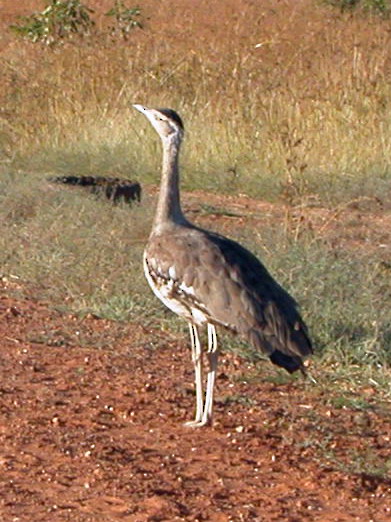
| - The Australian bustard has a black crown and nape, a pale grey front to its long neck, and brown plumage on its wings and upper body. English Wikipedia
- The species has a white abdomen separated from its grey neck by a black feather band. English Wikipedia
- Its wing coverts have irregular black-and-white markings visible both at rest and in flight. English Wikipedia
- The Australian bustard has a white iris and a bill ranging from whitish to brown. English Wikipedia
- Its long legs are yellow to cream in colour. English Wikipedia
- Females resemble males in coloration but are smaller in stature, wingspan and weight. English Wikipedia
- The Australian bustard is a large terrestrial bird with a form resembling an American turkey. English Wikipedia
|
|---|
| Size | - The lesser florican is described as the smallest member of the bustard family. English Wikipedia
| - Male Australian bustards can reach 1.2 metres in height and have wingspans of up to 2.3 metres. English Wikipedia
- Male body mass averages 6.3 kilograms, with a recorded range of 4.3 to 12.76 kilograms. English Wikipedia
- Females reach approximately 80 centimetres in height and have wingspans of about 1.8 metres. English Wikipedia
- Female body mass averages 3.2 kilograms, with a recorded range of 2.4 to 6.35 kilograms. English Wikipedia
- The largest recorded male Australian bustard weighed 14.5 kilograms and was obtained in Victoria. English Wikipedia
- The Australian bustard is the largest extant flying land bird in Australia. English Wikipedia
|
|---|
| Habitat | - The species primarily inhabits tall grasslands. English Wikipedia
- The species prefers grasslands but also occurs in cotton and lentil fields. English Wikipedia
- Breeding areas include Rajasthan, Gujarat, Madhya Pradesh, parts of southern Nepal and parts of Andhra Pradesh. English Wikipedia
- Breeding nests are generally located in dense grass. English Wikipedia
| - The species inhabits open grasslands, including areas with scattered trees. English Wikipedia
- Spinifex plains and low shrublands are favoured habitats of the Australian bustard. English Wikipedia
- Australian bustards enter denser vegetation following fires. English Wikipedia
- The species also uses artificial clearings such as golf courses and farmland. English Wikipedia
- The species avoids forests and densely vegetated areas. English Wikipedia
- The species occurs in savanna, shrubland, grassland, inland wetlands and artificial terrestrial habitats. iucnredlist.org
|
|---|
| Diet | | - The Australian bustard is omnivorous and primarily consumes plant fruits and seeds. English Wikipedia
- Its plant diet includes shoots, roots, leaves, flowerheads, seeds and fruits. English Wikipedia
- Grasshoppers, beetles and caterpillars are among the insects eaten by the species. English Wikipedia
- The Australian bustard eats lizards, young birds and small rodents. English Wikipedia
- The species is strongly attracted to the fruits of Capparis nummularia, known as myandee or moonflower in northwestern Australia. English Wikipedia
|
|---|
| Behaviour | - Lesser floricans occur singly or in pairs in thick grassland and occasionally in crop fields. English Wikipedia
- The species moves in response to rainfall, and its occurrence at particular locations can be irregular. English Wikipedia
- Lesser floricans generally feed in the early morning or evening. English Wikipedia
- Newly migrated individuals feed throughout the day. English Wikipedia
- Lesser floricans fly faster than other bustards. English Wikipedia
- Breeding males perform repeated leaps from the grass while fluttering their wings and producing croaking or knocking calls. English Wikipedia
- Male courtship displays are generally repeated at intervals of approximately three minutes or longer. English Wikipedia
- Male courtship displays occur mainly in the early morning and late evening. English Wikipedia
- Each male in the dispersed lek breeding system holds a territory of approximately one to two hectares. English Wikipedia
- Males display at preferred sites characterized by flat ground, low vegetation and good visibility. English Wikipedia
- Females perform defensive displays at nests by spreading their wings, tails and neck feathers. English Wikipedia
- Males behave aggressively towards other males in their vicinity. English Wikipedia
| - Australian bustards are predominantly terrestrial and usually walk slowly alone or in pairs. English Wikipedia
- When disturbed, Australian bustards may hold their necks erect and point their bills skywards as camouflage. English Wikipedia
- When alarmed, the species may walk away gradually or run, generally taking flight only as a last resort. English Wikipedia
- Australian bustards can travel long distances despite the apparent effort required for flight. English Wikipedia
- The species is nomadic and moves to locations where food becomes plentiful. English Wikipedia
- Australian bustards roost at elevated locations on open plains or in trees when available. English Wikipedia
- Male Australian bustards perform conspicuous breeding displays accompanied by loud booming calls. English Wikipedia
- Displaying males expand a neck sac and spread their feathers into a swaying skirt while holding their wings downward and arching their tails over their backs. English Wikipedia
- Courting males produce a call transliterated as 'who-o-o-o'. English Wikipedia
|
|---|
| Reproduction | | - The Australian bustard does not construct a nest. English Wikipedia
- Females usually lay one egg per clutch, although clutches of two eggs sometimes occur. English Wikipedia
- Eggs are laid on bare ground near a small shrub or bush. English Wikipedia
- Australian bustard eggs measure approximately 75 by 55 millimetres. English Wikipedia
- Female Australian bustards are responsible for incubating the eggs. English Wikipedia
- Newly hatched chicks leave the hatching site to reduce their risk of predation. English Wikipedia
|
|---|
| Distribution | | - The Australian bustard occurs across a wide area of the Australian continent. English Wikipedia
- Its distribution occasionally extends into southern Papua New Guinea and Indonesia. English Wikipedia
- The species remains relatively common and widespread across most of northern Australia. English Wikipedia
- The species' range has contracted in southeastern Australia. English Wikipedia
- Local populations in wetter regions are more permanent and geographically restricted than populations in more arid regions. English Wikipedia
|
|---|
| Conservation | - The lesser florican is listed as Critically Endangered in its 2021 IUCN assessment. iucnredlist.org
- The species is threatened by hunting and habitat degradation. English Wikipedia
- The species has been extirpated from some parts of its historical range, including Pakistan. English Wikipedia
- Shooting males at their display sites has contributed to sharp population declines. English Wikipedia
| - The IUCN assessed the Australian bustard as Least Concern in 2024. English Wikipedia
- The IUCN assessment recorded a declining population trajectory for the species in 2024. English Wikipedia
- The global population of Australian bustards is estimated to exceed 10,000 individuals but not to exceed 100,000. English Wikipedia
- The species is classified as near threatened in Western Australia and the Northern Territory. English Wikipedia
- The Australian bustard is classified as endangered in South Australia and New South Wales. English Wikipedia
- The species is classified as critically endangered on Victoria's 2007 advisory list of threatened vertebrate fauna, with the same advice retained in 2016. English Wikipedia
- The Australian bustard is classified as Least Concern in Queensland. English Wikipedia
- The species is not listed as threatened under Australia's Environment Protection and Biodiversity Conservation Act 1999. English Wikipedia
- The IUCN assessment identifies invasive non-native species and diseases among the threats relevant to the species. iucnredlist.org
- The IUCN assessment records continuing decline in the extent or quality of the species' habitat. iucnredlist.org
|
|---|
| Uses | - The species was considered suitable for eating, although its meat was regarded as inferior to that of the Bengal florican. English Wikipedia
| - Aboriginal people in Central Australia use the Australian bustard as an important food source. English Wikipedia
- The species' white feathers are used for ceremonial purposes. English Wikipedia
- Australian bustards have historically been hunted and shot for food. australian.museum
|
|---|
| Similar species | - The Bengal florican is the only similar species identified and is larger than the lesser florican. English Wikipedia
| No checked fact yet |
|---|
| Other | No checked fact yet | - The Australian bustard is also known as the plains turkey and bush turkey. English Wikipedia
|
|---|