Species · Birds
Australian Bustard Ardeotis australis
The scientific name of the Australian Bustard is Ardeotis australis. It is a species of bird in the family Otididae (bustard), order Otidiformes. The name dates from 1829.
- Scientific name
- Ardeotis australis (J. E. Gray, 1829)
- Common name
- Australian Bustard
- Genus
- Ardeotis
- Family
- Otididae (Bustard)
- Order
- Otidiformes
- Class
- Aves
- Red List category
- LC Least Concern
- Recorded in
- 2 countries
- Name status
- accepted in the Catalogue of Life
Overview
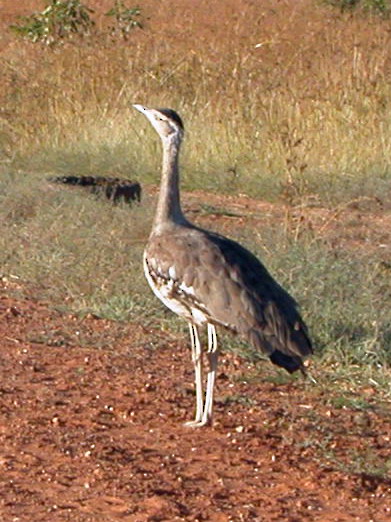
The Australian Bustard (Ardeotis australis) is a large terrestrial bird in the family Otididae and order Otidiformes. It occurs across a wide area of the Australian continent, primarily inhabiting open grasslands, spinifex plains and low shrublands. It is distinguished by a black crown and nape, a long grey neck, brown upper plumage, a white abdomen and long yellow to cream legs.
Written 26 November 2026 from the sources listed below. Each statement was checked against the passage it cites; statements that could not be supported were removed.
Appearance
The Australian Bustard has a black crown and nape, a pale grey front to its long neck, and brown plumage on its wings and upper body. Its white abdomen is separated from its grey neck by a black feather band.[1][2]
The wing coverts have irregular black-and-white markings visible both at rest and in flight. The species has a white iris, a bill ranging from whitish to brown, and long yellow to cream legs.[3][4][5]
The Australian Bustard is a large terrestrial bird with a form resembling an American turkey. Females resemble males in coloration but are smaller in stature, wingspan and weight.[6][7]
Males can reach 1.2 metres in height and have wingspans of up to 2.3 metres. Their body mass averages 6.3 kilograms, with a recorded range of 4.3 to 12.76 kilograms.[8][9]
Females reach approximately 80 centimetres in height and have wingspans of about 1.8 metres. Their body mass averages 3.2 kilograms, with a recorded range of 2.4 to 6.35 kilograms.[10][11]
The largest recorded male weighed 14.5 kilograms and was obtained in Victoria. The Australian Bustard is the largest extant flying land bird in Australia.[12][13]
Habitat
The Australian Bustard inhabits open grasslands, including areas with scattered trees. Spinifex plains and low shrublands are favoured habitats.[14][15]
The species also occurs in savanna, shrubland, grassland, inland wetlands and artificial terrestrial habitats. It uses artificial clearings such as golf courses and farmland.[16][17]
The Australian Bustard avoids forests and densely vegetated areas. Following fires, it enters denser vegetation.[18][19]
Diet
The Australian Bustard is omnivorous and primarily consumes plant fruits and seeds. Its plant diet includes shoots, roots, leaves, flowerheads, seeds and fruits.[20][21]
The species eats grasshoppers, beetles and caterpillars, as well as lizards, young birds and small rodents.[22][23]
The Australian Bustard is strongly attracted to the fruits of Capparis nummularia, known as myandee or moonflower in northwestern Australia.[24]
Behaviour
Australian Bustards are predominantly terrestrial and usually walk slowly alone or in pairs. They roost at elevated locations on open plains or in trees when available.[25][26]
When disturbed, they may hold their necks erect and point their bills skywards as camouflage. When alarmed, they may walk away gradually or run, generally taking flight only as a last resort.[27][28]
Australian Bustards can travel long distances despite the apparent effort required for flight. They are nomadic and move to locations where food becomes plentiful.[29][30]
Male Australian Bustards perform conspicuous breeding displays accompanied by loud booming calls. Displaying males expand a neck sac and spread their feathers into a swaying skirt while holding their wings downward and arching their tails over their backs.[31][32]
Courting males produce a call transliterated as 'who-o-o-o'.[33]
Reproduction and life cycle
The Australian Bustard does not construct a nest. Females usually lay one egg per clutch, although clutches of two eggs sometimes occur.[34][35]
Eggs are laid on bare ground near a small shrub or bush and measure approximately 75 by 55 millimetres. Females are responsible for incubating the eggs.[36][37][38]
Newly hatched chicks leave the hatching site to reduce their risk of predation.[39]
Conservation
The IUCN assessed the Australian Bustard as Least Concern in 2024 and recorded a declining population trajectory. The global population is estimated to exceed 10,000 individuals but not to exceed 100,000.[40][41][42]
The species remains relatively common and widespread across most of northern Australia, while its range has contracted in southeastern Australia. Populations in wetter regions are more permanent and geographically restricted than those in more arid regions.[43][44][45]
The Australian Bustard is classified as near threatened in Western Australia and the Northern Territory, endangered in South Australia and New South Wales, and Least Concern in Queensland.[46][47][48]
The species is classified as critically endangered on Victoria's 2007 advisory list of threatened vertebrate fauna, with the same advice retained in 2016. It is not listed as threatened under Australia's Environment Protection and Biodiversity Conservation Act 1999.[49][50]
Threats identified in the IUCN assessment include invasive non-native species and diseases. The assessment also records continuing decline in the extent or quality of the species' habitat.[51][52]
Uses
Aboriginal people in Central Australia use the Australian Bustard as an important food source. The species has historically been hunted and shot for food.[53][54]
The species' white feathers are used for ceremonial purposes.[55]
Similar species
The Australian Bustard is also known as the plains turkey and bush turkey.[56]
Classification of the Australian Bustard
| Kingdom | Animalia |
|---|---|
| Phylum | Chordata |
| Subphylum | Vertebrata |
| Infraphylum | Gnathostomata |
| Parvphylum | Osteichthyes |
| Megaclass | Tetrapoda |
| Class | Aves (Bird) |
| Order | Otidiformes (Bustards) |
| Family | Otididae (Bustard) |
| Genus | Ardeotis (Large Bustards) |
| Species | Ardeotis australis (J. E. Gray, 1829) |
Where the Australian Bustard is found
Checklists and occurrence records place Ardeotis australis in 2 countries across Oceania. GBIF holds 41,206 georeferenced records of it.
Countries
Regions and cities with the most records
- Queensland, Australia 20,653
- Western Australia, Australia 9,152
- Northern Territory, Australia 7,403
- Townsville, Australia 2,184
- South Australia, Australia 1,500
- New South Wales, Australia 1,246
- Victoria, Australia 560
- Mount Isa, Australia 125
- Rockhampton, Australia 72
- Alice Springs, Australia 62
- Mackay, Australia 33
- Warrnambool, Australia 32
- Port Hedland, Australia 28
- Gladstone, Australia 27
- Darwin, Australia 25
- Cairns, Australia 24
- Palmerston, Australia 23
- Karratha, Australia 17
- Coffs Harbour, Australia 15
- Western Province, Papua New Guinea 12
- Whyalla, Australia 11
- Geelong, Australia 10
- Toowoomba, Australia 9
- Bathurst, Australia 6
- Gawler, Australia 6
- Mildura, Australia 6
- Australian Capital Territory, Australia 4
- Ballarat, Australia 4
- Bundaberg, Australia 4
- Maryborough, Australia 4
- Bacchus Marsh, Australia 3
- Broken Hill, Australia 3
- Goulburn, Australia 3
- Gympie, Australia 3
- Mandurah, Australia 3
- Muswellbrook, Australia 3
1 more country has a few records outside this range
These countries hold a few records of Ardeotis australis but lie outside the range the checklists give for it. Such records are often zoo or garden specimens, museum material or vagrants, so the species is not counted as occurring there.
Range as the checklists state it
Australia
A number beside a place is its count of GBIF occurrence records. A place without a number comes from a checklist alone. Records show where a species has been observed or collected, which can include escapes and vagrants.
Common names
English
- Australian Bustard
Names in 28 other languages
- Arabic
- حبارى أسترالية
- Bulgarian
- Австралийска дропла
- Catalan
- pioc salvatge australià
- Chinese
- 澳洲鴇, 澳洲鷺鴇, 澳洲鹭鸨
- Croatian
- australska droplja
- Czech
- drop australský
- Danish
- Australsk Trappe
- Dutch
- Australische Trap
- Esperanto
- aŭstralia otido
- Estonian
- austraalia trapp
- Finnish
- australiantrappi
- French
- Outarde d'Australie, Outarde d’Australie
- German
- Wammentrappe
- Indonesian
- Kalkun-padang australia
- Italian
- Otarda australiana
- Japanese
- オーストラリアオオノガン
- Lithuanian
- australinis didysis einis
- Norwegian
- australtrappe
- Polish
- drop australijski
- Portuguese
- abetarda-australiana
- Russian
- Австралийская большая дрофа, Австралийская дрофа
- Serbian
- Australijska droplja
- Slovak
- drop zásternatý
- Spanish
- Avutarda australiana
- Swedish
- australisk trapp
- Turkish
- Avustralya Toyu
- Ukrainian
- дрохва австралійська
- nrl
- Garlirnangga
Synonyms
6 other scientific names have been used for this species and are now treated as synonyms of Ardeotis australis.
- Austrotis australis Gray, JE, 1829
- Austrotis australis melvillensis Mathews, GM, 1915
- Choriotis australis Gray, JE, 1829
- Choriotis australis derbyi Mathews, GM, 1912
- Otis australis J. E. Gray, 1829
- Otis novaehollandiae Leichhardt, L, 1847
Related species
-
 Great Indian BustardArdeotis nigriceps
-
 Kori BustardArdeotis kori
-
 Arabian BustardArdeotis arabs
-
 Great BustardOtis tarda
-
 Little BustardTetrax tetrax
-
 African HoubaraChlamydotis undulata
-
 Bengal FloricanHoubaropsis bengalensis
-
 Lesser FloricanSypheotides indicus
Compare
Questions and answers
What is the scientific name of the Australian Bustard?
The scientific name of the Australian Bustard is Ardeotis australis. Written with its author, the full name is Ardeotis australis (J. E. Gray, 1829).
Which family does the Australian Bustard belong to?
Ardeotis australis belongs to the family Otididae, in the order Otidiformes and the class Aves.
Where is the Australian Bustard found?
Checklists and occurrence records place Ardeotis australis in 2 countries: Australia and Papua New Guinea.
What is the conservation status of the Australian Bustard?
The IUCN Red List category recorded for Ardeotis australis is Least Concern (LC).
How rare are Australian bustards?
The global population is estimated to exceed 10,000 individuals but not to exceed 100,000. The IUCN assessed the species as Least Concern in 2024, with a declining population trajectory.[40][41][42]
Can you eat Australian Bustard?
Aboriginal people in Central Australia use the Australian Bustard as an important food source. The species has also historically been hunted and shot for food.[53][54]
What do bustards eat?
Australian Bustards are omnivorous and primarily consume plant fruits and seeds. Their diet also includes shoots, roots, leaves, flowerheads, insects, lizards, young birds and small rodents.[20][21][22][23]
Where do Australian bustards live?
Australian Bustards occur across a wide area of the Australian continent, with occasional extensions into southern Papua New Guinea and Indonesia. They inhabit open grasslands, spinifex plains, low shrublands, savanna, inland wetlands and artificial clearings.[14][15][16][17][57][58]
Sources
Passages the profile rests on
- The Australian bustard has a black crown and nape, a pale grey front to its long neck, and brown plumage on its wings and upper body. Source passage: “The general coloration of A. australis is black at the crown and nape, the long neck is pale grey at the front, and brown plumage cover the wings and upper body.” — English Wikipedia
- The species has a white abdomen separated from its grey neck by a black feather band. Source passage: “The abdomen is white and separated from the light grey of the neck by a black band of feathers.” — English Wikipedia
- Its wing coverts have irregular black-and-white markings visible both at rest and in flight. Source passage: “The wing coverts are patchily coloured with black and white patterning, which is visible while at rest or especially in flight.” — English Wikipedia
- The Australian bustard has a white iris and a bill ranging from whitish to brown. Source passage: “The iris is white, and their beak is variously whitish to brown in colour.” — English Wikipedia
- Its long legs are yellow to cream in colour. Source passage: “The legs are long and yellow to cream coloured.” — English Wikipedia
- Females resemble males in coloration but are smaller in stature, wingspan and weight. Source passage: “The sexes are similar in appearance, females are smaller in stature, wingspan and weight than the males.” — English Wikipedia
- The Australian bustard is a large terrestrial bird with a form resembling an American turkey. Source passage: “this bustard is a large terrestrial bird that resembles an American turkey in its form and behaviour.” — English Wikipedia
- Male Australian bustards can reach 1.2 metres in height and have wingspans of up to 2.3 metres. Source passage: “Males are up to 1.2 m (47 in) tall with a 2.3 m (7.5 ft) wingspan.” — English Wikipedia
- Male body mass averages 6.3 kilograms, with a recorded range of 4.3 to 12.76 kilograms. Source passage: “The average weight for males is 6.3 kg (14 lb), with a range of 4.3 to 12.76 kg (9.5 to 28.1 lb).” — English Wikipedia
- Females reach approximately 80 centimetres in height and have wingspans of about 1.8 metres. Source passage: “The female is quite a bit smaller at 80 cm (31 in) tall, with a 1.8 m (5.9 ft) wingspan” — English Wikipedia
- Female body mass averages 3.2 kilograms, with a recorded range of 2.4 to 6.35 kilograms. Source passage: “an average body mass of 3.2 kg (7.1 lb) in a range of 2.4 to 6.35 kg (5.3 to 14.0 lb)” — English Wikipedia
- The largest recorded male Australian bustard weighed 14.5 kilograms and was obtained in Victoria. Source passage: “The largest male recorded was 14.5 kg (32 lb), a specimen obtained in Victoria.” — English Wikipedia
- The Australian bustard is the largest extant flying land bird in Australia. Source passage: “Although it is the largest extant flying land bird in Australia” — English Wikipedia
- The species inhabits open grasslands, including areas with scattered trees. Source passage: “The habitat favoured by the species is open grasslands, perhaps with some trees” — English Wikipedia
- Spinifex plains and low shrublands are favoured habitats of the Australian bustard. Source passage: “spinifex plains and low shrublands.” — English Wikipedia
- The species also uses artificial clearings such as golf courses and farmland. Source passage: “is observed on artificial cleared areas such as golf courses and farmland.” — English Wikipedia
- The species occurs in savanna, shrubland, grassland, inland wetlands and artificial terrestrial habitats. Source passage: “Savanna, Shrubland, Grassland, Wetlands (inland), Artificial/Terrestrial” — iucnredlist.org
- Australian bustards enter denser vegetation following fires. Source passage: “This bustard will enter denser areas of vegetation after fire” — English Wikipedia
- The species avoids forests and densely vegetated areas. Source passage: “although the species avoided forest and densely vegetated areas.” — English Wikipedia
- The Australian bustard is omnivorous and primarily consumes plant fruits and seeds. Source passage: “The bustard is omnivorous, mostly consuming the fruit or seed of plants” — English Wikipedia
- Its plant diet includes shoots, roots, leaves, flowerheads, seeds and fruits. Source passage: “The omnivorous diet includes shoots, roots, leaves, flowerheads, seeds and fruit of plants” — English Wikipedia
- Grasshoppers, beetles and caterpillars are among the insects eaten by the species. Source passage: “a variety of insects, especially grasshoppers, beetles and caterpillars” — English Wikipedia
- The Australian bustard eats lizards, young birds and small rodents. Source passage: “lizards, young birds and small rodents.” — English Wikipedia
- The species is strongly attracted to the fruits of Capparis nummularia, known as myandee or moonflower in northwestern Australia. Source passage: “The species is strongly attracted to capers, fruit of the plant Capparis nummularia known as myandee or moonflower in the Australian northwest” — English Wikipedia
- Australian bustards are predominantly terrestrial and usually walk slowly alone or in pairs. Source passage: “The species is mostly terrestrial and usually seen walking slowly alone or in pairs.” — English Wikipedia
- Australian bustards roost at elevated locations on open plains or in trees when available. Source passage: “The roost is at a high point on an open plain or in trees when they are available.” — English Wikipedia
- When disturbed, Australian bustards may hold their necks erect and point their bills skywards as camouflage. Source passage: “When disturbed, Australian bustards often adopt a cryptic pose with neck erect and bill pointed skywards.” — English Wikipedia
- When alarmed, the species may walk away gradually or run, generally taking flight only as a last resort. Source passage: “They may stalk gradually away or run if alarmed, taking flight as a last resort.” — English Wikipedia
- Australian bustards can travel long distances despite the apparent effort required for flight. Source passage: “Despite the apparent labour in flying, they have strength and stamina that allows them to travel long distances.” — English Wikipedia
- The species is nomadic and moves to locations where food becomes plentiful. Source passage: “The species is nomadic, flying to areas when food becomes plentiful” — English Wikipedia
- Male Australian bustards perform conspicuous breeding displays accompanied by loud booming calls. Source passage: “the display of males during the breeding season is a conspicuous performance that is accompanied by loud booming.” — English Wikipedia
- Displaying males expand a neck sac and spread their feathers into a swaying skirt while holding their wings downward and arching their tails over their backs. Source passage: “The male is able to expand a sac at the neck to display their longer feathers as a swaying skirt, with the head held proud and upward facing, the wings are pointed toward the ground and tail feathers arched over the back” — English Wikipedia
- Courting males produce a call transliterated as 'who-o-o-o'. Source passage: “The voice of the courting male has been transliterated as "who-o-o-o".” — English Wikipedia
- The Australian bustard does not construct a nest. Source passage: “Ardeotis australis does not make any attempt to construct a nest.” — English Wikipedia
- Females usually lay one egg per clutch, although clutches of two eggs sometimes occur. Source passage: “The clutch size is usually one egg, sometimes two” — English Wikipedia
- Eggs are laid on bare ground near a small shrub or bush. Source passage: “laid close to a small shrub or bush on unadorned ground.” — English Wikipedia
- Australian bustard eggs measure approximately 75 by 55 millimetres. Source passage: “The dimensions of the egg are 75 × 55 millimetres.” — English Wikipedia
- Female Australian bustards are responsible for incubating the eggs. Source passage: “Incubation of the brood is maintained by the female.” — English Wikipedia
- Newly hatched chicks leave the hatching site to reduce their risk of predation. Source passage: “The chick will leave the site after emerging from its shell to avoid predation” — English Wikipedia
- The IUCN assessed the Australian bustard as Least Concern in 2024. Source passage: “The assessment of IUCN in 2024 maintained its status as least concern” — English Wikipedia
- The IUCN assessment recorded a declining population trajectory for the species in 2024. Source passage: “but noted a declining population trajectory.” — English Wikipedia
- The global population of Australian bustards is estimated to exceed 10,000 individuals but not to exceed 100,000. Source passage: “The total population is thought to exceed 10,000 and be no greater than 100,000 individuals.” — English Wikipedia
- The species remains relatively common and widespread across most of northern Australia. Source passage: “This bird remains relatively common and widespread across most of northern Australia” — English Wikipedia
- The species' range has contracted in southeastern Australia. Source passage: “The occurrence in the southeast of Australia has contracted” — English Wikipedia
- Local populations in wetter regions are more permanent and geographically restricted than populations in more arid regions. Source passage: “local populations in wetter regions are more permanent and localised than the greater range of those inhabiting more arid regions.” — English Wikipedia
- The species is classified as near threatened in Western Australia and the Northern Territory. Source passage: “In Western Australia and the Northern Territory the classification is near threatened by extinction” — English Wikipedia
- The Australian bustard is classified as endangered in South Australia and New South Wales. Source passage: “the states of South Australia and New South Wales record it as endangered” — English Wikipedia
- The Australian bustard is classified as Least Concern in Queensland. Source passage: “and the status of least concern in Queensland.” — English Wikipedia
- The species is classified as critically endangered on Victoria's 2007 advisory list of threatened vertebrate fauna, with the same advice retained in 2016. Source passage: “On the 2007 advisory list of threatened vertebrate fauna in Victoria the species is listed as critically endangered, maintaining this advice in the listing published in 2016.” — English Wikipedia
- The species is not listed as threatened under Australia's Environment Protection and Biodiversity Conservation Act 1999. Source passage: “The Australian bustard is not listed as threatened on the Environment Protection and Biodiversity Conservation Act 1999.” — English Wikipedia
- The IUCN assessment identifies invasive non-native species and diseases among the threats relevant to the species. Source passage: “Invasive non-native/alien species/diseases” — iucnredlist.org
- The IUCN assessment records continuing decline in the extent or quality of the species' habitat. Source passage: “Continuing decline in area, extent and/or quality of habitat” — iucnredlist.org
- Aboriginal people in Central Australia use the Australian bustard as an important food source. Source passage: “It is an important food source for Aboriginal people from Central Australia” — English Wikipedia
- Australian bustards have historically been hunted and shot for food. Source passage: “Australian Bustards were once extensively hunted and shot for food and with ...” — australian.museum
- The species' white feathers are used for ceremonial purposes. Source passage: “The white feathers of the bird are used for ceremonial purposes.” — English Wikipedia
- The Australian bustard is also known as the plains turkey and bush turkey. Source passage: “The species is also commonly referred to as the plains turkey, and in Central Australia as the bush turkey” — English Wikipedia
- The Australian bustard occurs across a wide area of the Australian continent. Source passage: “The distribution range of the species includes a wide area of the Australian continent” — English Wikipedia
- Its distribution occasionally extends into southern Papua New Guinea and Indonesia. Source passage: “and occasionally extends to southern parts of Papua New Guinea and Indonesia.” — English Wikipedia
Data
- Catalogue of Life, 2026-10-16 XR cc by
- Global Biodiversity Information Facility CC BY 4.0
- Wikidata CC0
- GeoNames CC BY 4.0
- Wikimedia Commons per image; credit shown with each image
- Within the Catalogue of Life, this name comes from The Integrated Taxonomic Information System cc0
References
- Gill, Frank, & and Minturn Wright. (2006). Birds of the World: Recommended English Names.
- Dickinson, E. C., and J. V. Remsen Jr., eds. (2013). The Howard and Moore Complete Checklist of the Birds of the World, 4th Edition, Vol. 1 Non-Passerines.
This species in other databases
Page built on 26 November 2026. See how the catalog is made and all sources and licences.
Cite this page
ScientificNames.org. (2026). Ardeotis australis (Australian Bustard). Retrieved November 26, 2026, from https://scientificnames.org/species/ardeotis-australis
“Ardeotis australis (Australian Bustard).” ScientificNames.org, 2026, scientificnames.org/species/ardeotis-australis. Accessed 26 Nov. 2026.
ScientificNames.org. “Ardeotis australis (Australian Bustard).” Accessed November 26, 2026. https://scientificnames.org/species/ardeotis-australis.
@misc{scientificnames_ardeotis_australis_australian_bustard,
  author = {{ScientificNames.org}},
  title = {Ardeotis australis (Australian Bustard)},
  year = {2026},
  url = {https://scientificnames.org/species/ardeotis-australis},
  note = {Accessed 2026-11-26}
}