Comparison
Sickle-leaf Conebush vs Silver Tree
Sickle-leaf Conebush (Leucadendron xanthoconus) and Silver Tree (Leucadendron argenteum) both belong to the genus Leucadendron and part ways below it. Both are recorded in 1 country.

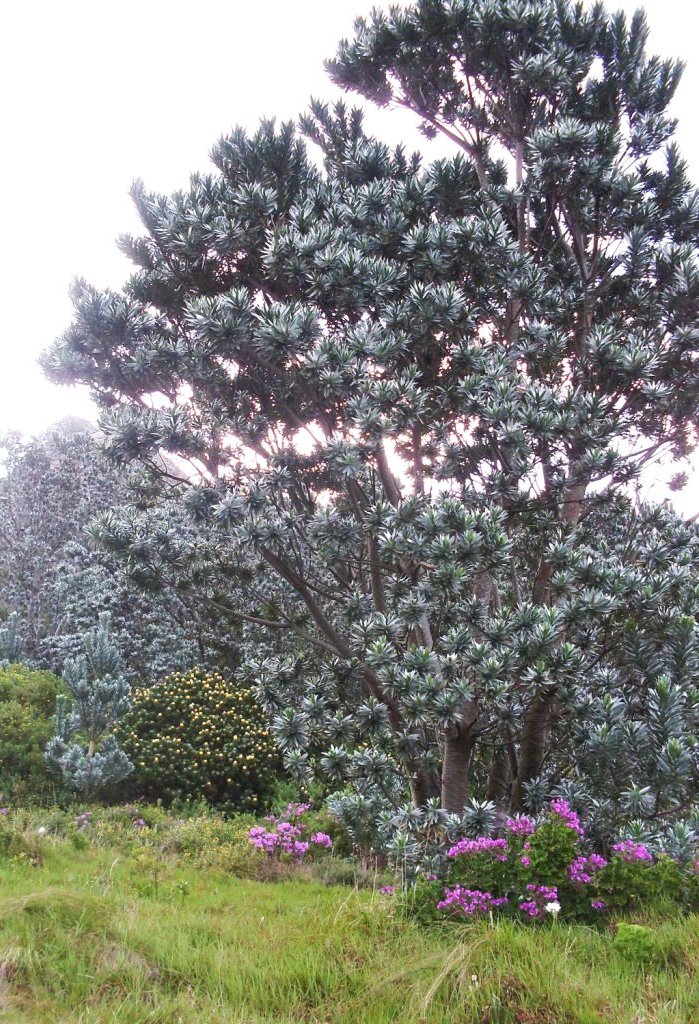


Side by side
| Sickle-leaf Conebush | Silver Tree | |
|---|---|---|
| Scientific name | Leucadendron xanthoconus (Kuntze) K.Schum. | Leucadendron argenteum (L.) R.Br. |
| English name | Sickle-leaf Conebush | Silver Tree |
| Group | Flowering plants | Flowering plants |
| Class | Magnoliopsida | Magnoliopsida |
| Order | Proteales | Proteales |
| Family | Proteaceae Protea Family | Proteaceae Protea Family |
| Genus | Leucadendron | Leucadendron |
| Red List category | Least Concern | Vulnerable |
| Countries on record | 1 country | 3 countries |
| GBIF occurrence records | 6,195 records | 2,146 records |
Rows where the two agree are shown in grey.
Where each is found
Both recorded in 1 country
Only Silver Tree (2)
From Catalogue of Life checklists and GBIF occurrence records. A country missing from a list means no record is held, which is not proof of absence.
Checked facts
| Sickle-leaf Conebush | Silver Tree | |
|---|---|---|
| Appearance |
|
|
| Size | No checked fact yet |
|
| Habitat |
|
|
| Behaviour | No checked fact yet |
|
| Reproduction |
|
|
| Lifespan |
|
|
| Distribution |
|
|
| Conservation | No checked fact yet |
|
| Other |
|
|
In brief
Sickle-leaf Conebush
Leucadendron xanthoconus occurs in mountain fynbos in the south-western Cape of South Africa. It produces woody cones that retain seeds for two to three years before releasing them together following a fire. Full profile
Silver Tree
The Silver Tree (Leucadendron argenteum (L.) R.Br.) is an evergreen flowering plant in the Proteaceae family. It grows naturally on the slopes of Table Mountain in the Cape Peninsula and is endemic to a small area of the Cape Peninsula in South Africa. It is distinguished by its shiny silver, silky leaves and pink, spherical flowers. Full profile
Compare something else
Page built on 28 November 2026 from the data on the two species pages, where every source is listed.
Cite this page
ScientificNames.org. (2026). Sickle-leaf Conebush vs Silver Tree. Retrieved November 28, 2026, from https://scientificnames.org/compare/sickle-leaf-conebush-vs-silver-tree
“Sickle-leaf Conebush vs Silver Tree.” ScientificNames.org, 2026, scientificnames.org/compare/sickle-leaf-conebush-vs-silver-tree. Accessed 28 Nov. 2026.
ScientificNames.org. “Sickle-leaf Conebush vs Silver Tree.” Accessed November 28, 2026. https://scientificnames.org/compare/sickle-leaf-conebush-vs-silver-tree.
@misc{scientificnames_sickle_leaf_conebush_vs_silver_tree,
  author = {{ScientificNames.org}},
  title = {Sickle-leaf Conebush vs Silver Tree},
  year = {2026},
  url = {https://scientificnames.org/compare/sickle-leaf-conebush-vs-silver-tree},
  note = {Accessed 2026-11-28}
}