Species · Flowering plants
Silver Tree Leucadendron argenteum
The scientific name of the Silver Tree is Leucadendron argenteum. It is a species of flowering plant in the family Proteaceae (protea family), order Proteales.
- Scientific name
- Leucadendron argenteum (L.) R.Br.
- Common name
- Silver Tree
- Genus
- Leucadendron
- Family
- Proteaceae (Protea Family)
- Order
- Proteales
- Class
- Magnoliopsida
- Red List category
- VU Vulnerable
- Recorded in
- 3 countries
- Name status
- accepted in the Catalogue of Life
Overview
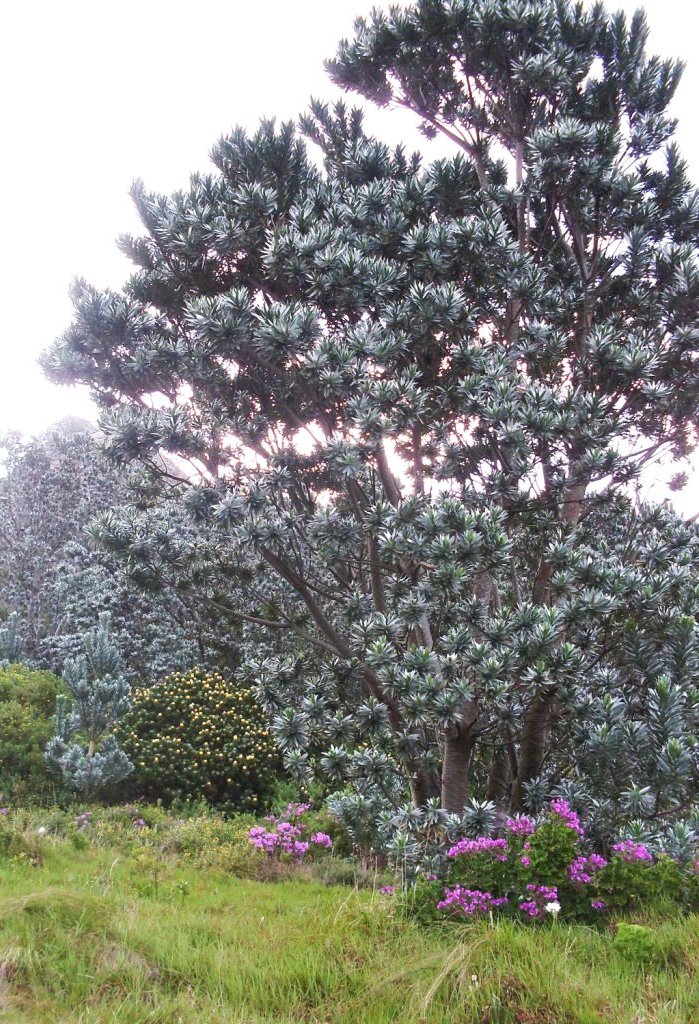
The Silver Tree (Leucadendron argenteum (L.) R.Br.) is an evergreen flowering plant in the Proteaceae family. It grows naturally on the slopes of Table Mountain in the Cape Peninsula and is endemic to a small area of the Cape Peninsula in South Africa. It is distinguished by its shiny silver, silky leaves and pink, spherical flowers.
Written 26 November 2026 from the sources listed below. Each statement was checked against the passage it cites; statements that could not be supported were removed.
Appearance
Its leaves are shiny silver, soft, silky and lance-shaped, measuring 8–15 centimetres long and approximately 2 centimetres wide. Dense velvety hairs produce their distinctive silvery sheen.[1][2][3]
The flowers are pink and spherical, arranged in dense inflorescences, and produce a pleasant scent. Its fruit is a heavy, woody cone containing numerous seeds.[4][5][6]
Each seed is a small nut equipped with a silky-haired, helicopter-like parachute. After germination, seedlings produce two green, bare, leathery cotyledons.[7][8]
Habitat
The Silver Tree grows naturally on the slopes of Table Mountain in the Cape Peninsula. Its main population occurs around Lion's Head, above Rhodes Memorial, and on mountain slopes above Kirstenbosch National Botanical Garden.[9][10]
Most individuals grow in and around Cape Town, South Africa. Outlying populations have been recorded near Somerset West, Paarl, and Stellenbosch.[11][12]
The Somerset West population occurs within the Silvertree Gorge natural heritage site in the Spanish Farm suburb.[13]
Behaviour
The seeds are dispersed by wind using their parachute-like structures. Mortality following a fire is initially negligible but subsequently increases by approximately 5% annually.[14][15]
Phytophthora root rot inhibits the roots' ability to absorb water. Long periods without burning can be followed by sudden mortality events.[16][17]
Reproduction and life cycle
The Silver Tree is dioecious, with separate male and female plants, and is wind-pollinated.[18][19]
The cones contain a canopy seed bank that is released following fire. Fire also triggers the germination of the soil seed bank, and natural seedling recruitment occurs only after fire.[20][21][22]
Fires rejuvenate populations on average every 15–20 years by killing surviving adults and triggering seed release and germination. The seeds can remain viable for at least 80 years.[23][24]
Juvenile plants take approximately 5–7 years to flower and produce seeds.[25]
Conservation
The Silver Tree is classified as endangered and is a protected tree in South Africa. It has become rare and endangered following the historical loss of its forests.[26][27][28]
Historical demand for timber resulted in the felling of many Silver Tree forests on Table Mountain.[29]
Warm berg winds and root disease associated with Phytophthora root rot are believed to contribute to sudden die-offs.[30][17]
An estimated 40–50% of the existing native population burned during the January 2006 fire. The native population recovered completely following that fire.[31][32]
Classification of the Silver Tree
| Kingdom | Plantae |
|---|---|
| Subkingdom | Pteridobiotina |
| Phylum | Tracheophyta |
| Class | Magnoliopsida |
| Order | Proteales |
| Family | Proteaceae (Protea Family) |
| Subfamily | Proteoideae |
| Tribe | Leucadendreae |
| Subtribe | Leucadendrinae |
| Genus | Leucadendron |
| Species | Leucadendron argenteum (L.) R.Br. |
Where the Silver Tree is found
Checklists and occurrence records place Leucadendron argenteum in 3 countries across Africa and Oceania. GBIF holds 2,146 georeferenced records of it.
Countries where it is native or its origin is not stated
Countries where it has been introduced
Regions and cities with the most records
- Western Cape, South Africa 1,964
- Cape Town, South Africa 1,776
- Rondebosch, South Africa 1,775
- Retreat, South Africa 1,773
- Muizenberg, South Africa 1,756
- Kuils River, South Africa 112
- Stellenbosch, South Africa 108
- Paarl, South Africa 75
- Somerset West, South Africa 65
- Kraaifontein, South Africa 64
- Grabouw, South Africa 53
- Wellington, South Africa 34
- Le Roux, South Africa 21
- Durbanville, South Africa 19
- George, South Africa 10
- Northland, New Zealand 9
- Franschhoek, South Africa 5
- Malmesbury, South Africa 4
3 more countries have a few records outside this range
These countries hold a few records of Leucadendron argenteum but lie outside the range the checklists give for it. Such records are often zoo or garden specimens, museum material or vagrants, so the species is not counted as occurring there.
Range as the checklists state it
South Africa (W-Cape Prov.); New Zealand [I]
A number beside a place is its count of GBIF occurrence records. A place without a number comes from a checklist alone. Records show where a species has been observed or collected, which can include escapes and vagrants.
Common names
English
- Silver Tree
- Cape Silver Tree
- Silver Conetree
- Silver Pine Tree
- Silvercone
- Silvery Protea
Names in 10 other languages
- Afrikaans
- Silwerboom, Witteboom, silverboom
- Chinese
- 木百合, 银树
- Finnish
- isohopeapuu
- German
- Silberbaum
- Japanese
- ギンヨウジュ
- Lithuanian
- Paprastasis balkšvis
- Norwegian Bokmål
- Sølvtre
- Russian
- Левкадендрон серебристый, Серебряное дерево
- Slovak
- leukadendron strieborný
- Swedish
- silverträd
Synonyms
2 other scientific names have been used for this species and are now treated as synonyms of Leucadendron argenteum.
- Euryspermum argenteum (L.) Knight
- Protea argentea L.
Related species
-
 Common Sunshine ConebushLeucadendron salignum
-
 Piketberg ConebushLeucadendron discolor
-
 Spinning-top ConebushLeucadendron rubrum
-
 Golden SunshinebushLeucadendron laureolum
-
 Woolly ConebushLeucadendron sorocephalodes
-
 Peninsula ConebushLeucadendron strobilinum
-
 Grey ConebushLeucadendron pubescens
- Hairless ConebushLeucadendron galpinii
Compare
Questions and answers
What is the scientific name of the Silver Tree?
The scientific name of the Silver Tree is Leucadendron argenteum. Written with its author, the full name is Leucadendron argenteum (L.) R.Br..
Which family does the Silver Tree belong to?
Leucadendron argenteum belongs to the family Proteaceae, in the order Proteales and the class Magnoliopsida.
Where is the Silver Tree found?
Checklists and occurrence records place Leucadendron argenteum in 3 countries, including South Africa and Reunion.
What is the conservation status of the Silver Tree?
The IUCN Red List category recorded for Leucadendron argenteum is Vulnerable (VU).
What other names does the Silver Tree have?
Leucadendron argenteum is also known in English as Cape Silver Tree, Silver Conetree, Silver Pine Tree, Silvercone and Silvery Protea.
Where does leucadendron grow?
The Silver Tree grows naturally on the slopes of Table Mountain in the Cape Peninsula. Most individuals grow in and around Cape Town, South Africa, with outlying populations near Somerset West, Paarl, and Stellenbosch.[9][11][12]
How long does leucadendron last?
Most Silver Trees live no longer than 20 years. Their populations are rejuvenated by fire on average every 15–20 years.[33][23]
Is the silver tree indigenous?
Yes. The Silver Tree is endemic to a small area of the Cape Peninsula in South Africa.[34]
Sources
Passages the profile rests on
- Its leaves are shiny silver, soft, silky, and lance-shaped. Source passage: “The soft, silky leaves are shiny silver, lanceolate” — English Wikipedia
- The leaves measure 8–15 centimetres long and approximately 2 centimetres wide. Source passage: “8–15 cm long and 2 cm broad” — English Wikipedia
- Dense velvety hairs on the leaves produce their distinctive silvery sheen. Source passage: “their distinct silvery sheen produced by dense velvety hairs.” — English Wikipedia
- The flowers are pink, spherical, and arranged in dense inflorescences. Source passage: “flowers are produced in dense pink, globose inflorescences” — English Wikipedia
- The flowers produce a pleasant scent. Source passage: “and give off a pleasant scent.” — English Wikipedia
- Its fruit is a heavy, woody cone containing numerous seeds. Source passage: “The fruit is a heavy woody cone, containing numerous seeds;” — English Wikipedia
- Each seed is a small nut equipped with a silky-haired, helicopter-like parachute. Source passage: “each seed is a small nut with a silky-haired helicopter-like parachute” — English Wikipedia
- After germination, seedlings produce two green, bare, leathery cotyledons. Source passage: “After germination it pushes up two green, bare and leathery cotyledons.” — English Wikipedia
- The species grows naturally on the slopes of Table Mountain in the Cape Peninsula. Source passage: “Its main population grows on the slopes of Table Mountain” — English Wikipedia
- Its main population occurs around Lion's Head, above Rhodes Memorial, and on mountain slopes above Kirstenbosch National Botanical Garden. Source passage: “notably the Lion's Head area, above Rhodes Memorial and the mountain slopes above Kirstenbosch National Botanical Garden.” — English Wikipedia
- Most individuals grow in and around Cape Town, South Africa. Source passage: “Most grow in and around the city of Cape Town” — English Wikipedia
- Outlying populations have been recorded near Somerset West, Paarl, and Stellenbosch. Source passage: “outlying (perhaps introduced) populations exist near Somerset West (Silwerboomkloof), Paarl and Stellenbosch.” — English Wikipedia
- The Somerset West population occurs within the Silvertree Gorge natural heritage site in the Spanish Farm suburb. Source passage: “The Somerset West population is located within a natural heritage site called Silvertree Gorge, in the Spanish Farm suburb.” — English Wikipedia
- The seeds are dispersed by wind using their parachute-like structures. Source passage: “enabling it to disperse by wind.” — English Wikipedia
- Mortality following a fire is initially negligible but subsequently increases by approximately 5% annually. Source passage: “Mortality of these short-lived trees is negligible after a burn, but then increases to about 5% per annum.” — English Wikipedia
- Long periods without burning can be followed by sudden mortality events. Source passage: “During a longer term absence of burns however, sudden die-offs may occur, even in a matter of hours.” — English Wikipedia
- Phytophthora root rot inhibits the roots' ability to absorb water. Source passage: “which inhibits their water absorption.” — English Wikipedia
- The species is wind-pollinated. Source passage: “The wind-pollinated flowers” — English Wikipedia
- The silver tree is dioecious, with separate male and female plants. Source passage: “Like all Leucadendron species, this tree is dioecious, with separate male and female plants.” — English Wikipedia
- Natural seedling recruitment occurs only after fire. Source passage: “As recruitment of seedlings only occurs naturally after fire” — English Wikipedia
- The cones contain a canopy seed bank that is released following fire. Source passage: “the release of the canopy seed bank (in the cones)” — English Wikipedia
- Fire also triggers the germination of the soil seed bank. Source passage: “and germination of the soil seed bank.” — English Wikipedia
- Fires rejuvenate populations on average every 15–20 years by killing surviving adults and triggering seed release and germination. Source passage: “fires rejuvenate populations on average every 15–20 years by killing the surviving adults and triggering the release of the canopy seed bank” — English Wikipedia
- The seeds can remain viable for at least 80 years. Source passage: “Seeds remain viable for at least 80 years.” — English Wikipedia
- Juvenile plants take approximately 5–7 years to flower and produce seeds. Source passage: “Juveniles take 5–7 years to flower and set seed” — English Wikipedia
- The species is classified as endangered. Source passage: “is an endangered plant species” — English Wikipedia
- The silver tree is a protected tree in South Africa. Source passage: “It is a protected tree in South Africa.” — English Wikipedia
- The species has become rare and endangered following the historical loss of its forests. Source passage: “and now the silvertree is a rare and endangered species.” — English Wikipedia
- Historical demand for timber resulted in the felling of many silver tree forests on Table Mountain. Source passage: “early demand for timber led to much of these forests being felled” — English Wikipedia
- Warm berg winds and root disease associated with Phytophthora root rot are believed to contribute to sudden die-offs. Source passage: “This is believed to be the combined result of (warm) berg winds and diseased roots which are weakened by Phytophthora root rot” — English Wikipedia
- An estimated 40–50% of the existing native population burned during the January 2006 fire. Source passage: “An estimated 40 to 50 percent of the extant native population burned in the fire of 26 to 27 January 2006.” — English Wikipedia
- The native population recovered completely following the January 2006 fire. Source passage: “and the population has recovered totally.” — English Wikipedia
- Most silver trees live no longer than 20 years. Source passage: “as most don't live more than 20 years.” — English Wikipedia
- The silver tree is endemic to a small area of the Cape Peninsula in South Africa. Source passage: “which is endemic to a small area of the Cape Peninsula, South Africa.” — English Wikipedia
Data
- Catalogue of Life, 2026-10-16 XR cc by
- Global Biodiversity Information Facility CC BY 4.0
- Wikidata CC0
- GeoNames CC BY 4.0
- Wikimedia Commons per image; credit shown with each image
- Within the Catalogue of Life, this name comes from Synonymic Checklists of the Vascular Plants of the World cc by
References
- R.Br. (1810). Trans. Linn. Soc. London 10: 52 (1810). where the name was published
This species in other databases
- Catalogue of Life 6PSJH
- Wikidata Q3644294
- iNaturalist 186154
- World Flora Online wfo-0001106925
- GRIN 21938
Page built on 29 November 2026. See how the catalog is made and all sources and licences.
Cite this page
ScientificNames.org. (2026). Leucadendron argenteum (Silver Tree). Retrieved November 29, 2026, from https://scientificnames.org/species/leucadendron-argenteum
“Leucadendron argenteum (Silver Tree).” ScientificNames.org, 2026, scientificnames.org/species/leucadendron-argenteum. Accessed 29 Nov. 2026.
ScientificNames.org. “Leucadendron argenteum (Silver Tree).” Accessed November 29, 2026. https://scientificnames.org/species/leucadendron-argenteum.
@misc{scientificnames_leucadendron_argenteum_silver_tree,
  author = {{ScientificNames.org}},
  title = {Leucadendron argenteum (Silver Tree)},
  year = {2026},
  url = {https://scientificnames.org/species/leucadendron-argenteum},
  note = {Accessed 2026-11-29}
}